Tuesday, March 15, 2011

Japan feeds more money to banks as stocks slump

By TOMOKO A. HOSAKA

Japan's central bank pumped billions more into the financial system Tuesday to quell fears that the country's banks could be overwhelmed by the impact of the massive earthquake and tsunami. Stocks slumped as a nuclear crisis escalated.

Two cash injections totaling 8 trillion yen ($98 billion) came a day after the Bank of Japan fed a record 15 trillion yen ($184 billion) into money markets and eased monetary policy to support the economy in the aftermath of Friday's 8.9 magnitude quake that has killed thousands.

The injections have helped stabilize currency markets. But stock markets dived for a second day as investors unloaded assets amid escalating worries of a nuclear crisis.

The benchmark Nikkei 225 stock average slid as much as 14 percent after Prime Minister Naoto Kan warned residents near a damaged nuclear power plant in tsunami-ravaged northeastern Japan to stay inside or risk getting radiation sickness. It closed Tuesday down 10.6 percent at 8,605.15.

Radiation is leaking from damaged reactors at the crippled plant in a dramatic escalation of the 4-day-old catastrophe. Kan said there is dangers of more leaks and told people living within 19 miles (30 kilometers) of the Fukushima Dai-ichi complex to stay indoors.

The Bank of Japan has moved quickly to try to keep financial markets calm. By flooding the banking system with cash, it hopes banks will continue lending money and meet the likely surge in demand for post-earthquake funds.

Analysts say Japan can tap its vast bond market to help pay for reconstruction in the coastal regions shattered by the tsunami that the quake spawned. But it will add to strains on the national finances. The country is saddled with massive debt that, at 200 percent of gross domestic product, is the biggest among developed nations.

"Japan will be poorer, for this disaster," said Peter Morici, a business professor at the University of Maryland. "Rebuilding will run down Japan's financial wealth."

Credit Suisse economist Hiromichi Shirakawa and analysts at Barclays Capital estimated the damage at up to 15 trillion yen ($183 billion) — about 3 percent of gross domestic product. Other experts warned the economy will shrink for two straight quarters.

That represents a painful blow for Japan which lost its place as the world's No. 2 economy to China last year. The Japanese economy has been ailing for two decades, barely managing to eke out weak growth between slowdowns. It is saddled with a massive public debt that, at 200 percent of GDP, is the biggest among industrialized nations.

Morici said the nuclear crisis combined with the twin hit from the quake and tsunami could make Japan more vulnerable than it was in the past.

"The double whammy has the potential to keep the Japanese economy shut down longer and globalization offers Japan's export customers alternatives they might not have enjoyed a decade or two ago," he said. 

"Hyundai and Ford now are good substitutes for Toyota's cars, and even more so, Caterpillar tractors made in China can replace Komatsu's land movers."

The aftermath of the disaster is being felt across the country.

Four nuclear plants were damaged in the temblors, causing widespread power shortages. Trains in Tokyo, the nation's capital, usually run like clockwork. But are running on a reduced schedule or stopped entirely, preventing millions of commuters from reaching workplaces.

Far outside the disaster zone, stores are running out of necessities, raising government fears that hoarding may hurt the delivery of emergency food aid to those who really need it. Canned goods, batteries, bread and bottled water have vanished from store shelves and long lines of cars circle gas stations.

The four most severely affected prefectures (states) in the northeast — Iwate, Miyagi, Fukushima and Ibaraki — account for about 6 percent of Japan's economy.

Power supply has failed in the worst affected areas. Ports are closed, steel plants have stopped producing, and several major oil refineries have shut down. Getting manufacturing up and working again may be a bigger challenge than in the catastrophic 1995 Kobe earthquake because a larger area is affected.

The northeast is also a major center for car production, with a myriad of parts suppliers and a network of roads and ports for efficient shipments. 

Toyota Motor Corp said it would suspend manufacturing at its domestic plants through Wednesday — a production loss of 40,000 cars. Other manufacturers including Sony Corp. and Honda Motor Co. were also forced to halt production. 

"There is no way to get our products out, even if we make them, with the roads and distribution system damaged," said Honda Motor Co. spokeswoman Natsuno Asanuma. 

Auto analysts at Tong Yang Securities Inc in South Korea said car production in Japan is unlikely to get back to normal anytime soon. "Since a finished car requires about 20,000 parts, it is hard to predict when production may resume until we can ascertain which auto parts makers have been hit and to what extent." 

Billions of dollars are expected to be needed to rebuild homes, roads and other infrastructure requiring public spending that will benefit construction companies but add to the national debt. 

The economy will eventually get a boost from reconstruction but "this does not mean that Japan is better off," said Julian Jessop, chief international economist at Capital Economics in London. It's a quirk of accounting that destruction of assets is not counted as a reduction in the economy but replacement of those assets boosts economic activity, he said. 

Credit Suisse's Shirakawa said in a report the direct economic losses such as property destruction could total 6 trillion yen ($73 billion) to 7 trillion yen. Indirect losses such as lost production will probably be higher.
Other estimates are more pessimistic. 

"At the end of the day, this will probably cost a few hundred billion dollars," said Song Seng Wun, economist with CIMB-GK Research in Singapore. "It's going to be a big strain on public finances."

Japan disaster costs seen at least $180 billion

By Natsuko Waki Natsuko Waki

(Reuters) – Quake-hit Japan faces a recovery and reconstruction bill of at least $180 billion, or 3 percent of its annual economic output, or more than 50 percent higher than the total cost of 1995's earthquake in Kobe.

Even though some extreme projections of the longer-term costs project figures closer to $1 trillion over several years, standard tallies akin to those used after the Kobe quake hover around this level.

The world's third-largest economy, already saddled with public debt double the size of its $5 trillion output, must rebuild its infrastructure -- from roads and rail to power and ports -- on a scale not seen since World War Two.

Moody's Investors Service warned on Monday the huge financing needs Japan faces may erode investor confidence in the country's ability to repay its debts, forcing up borrowing costs.

"The earthquake may have shifted such a potential tipping point a bit forward, unless Japan's political parties are galvanized by the crisis to also address the country's long-term fiscal challenges," Moody's lead analyst Tom Byrne said in a statement.

The quake and tsunami have killed at least 10,000 people, officials estimate, striking a northeastern region that accounts for an estimated 6-8 percent of gross domestic product, compared with around 12.4 percent from the areas affected by the Kobe quake in 1995.

However, the loss of fixed assets and human capital from Friday's quake, which also triggered several explosions at a nuclear power plant north of Tokyo, looks to be far greater. It comes at a time when oil is hovering near a 2-1/2-year peak and other commodity prices remain elevated.

The economic damage is likely only to shave a sliver off global growth and the tens of billions of dollars spent on the reconstruction bill should eventually boost Japan's economy and the Asian construction sector.

But analysts also say costs could overshoot initial estimates.

"From the experiences, there is a tendency to underestimate," said Brendan Brown, head of economic research at Mitsubishi UFJ Securities.

"There are many uncertainties -- we don't know how long power outages will last and that's an ongoing cost in addition to reconstruction. There is a loss of output from dislocation. If that goes on for two months, that may dwarf the cost of reconstruction," he added.

ROLLING BLACKOUTS

The Kobe earthquake is estimated to have cost $115 billion to $118 billion, or 2 percent of GDP in 1995 terms. This time -- in a still unfolding disaster -- initial estimates from Credit Suisse and Barclays have put the cost at $180 billion.

Mitsubishi UFJ Securities and Sarasin expect the cost could run as high as 5 percent of GDP.

Mitsubishi's estimates take into account a wider economic cost including a loss of tax revenues, subsidies to various industries of the affected area, a loss of productivity following rolling blackouts on top of straight reconstruction costs.

Rough estimates show that replacing a nuclear power plant alone may cost $5 billion. Desperate to avert a nuclear meltdown, Japan was forced to sacrifice three of its reactors by pumping seawater to cool reactor cores.

Insured losses from Japan's earthquake could be as high as $35 billion, even without tsunami- and nuclear-related losses.

Mitsubishi UFJ's Brown says historical estimates of the Tokyo earthquake of 1923 put destruction as equivalent to 50 percent of annual economic output at the time, but the economic context was so different as to not make a direct comparison very fruitful.

Fitch Ratings said in a statement it believes that while the earthquake will be among the largest insured losses in history, the losses can be absorbed by the insurance and reinsurance industries without widespread solvency problems or undue financial strain.

CAPITAL STOCK CALCULATIONS

But some estimates of the reconstruction costs shoot far higher than these consensus forecasts as economists take into account the potential need to replace the country's devastated capital stock over a longer timeframe.

Vanessa Rossi, senior research fellow at London-based think-tank Chatham House, estimates that 10 percent of Japan's capital stock was lost in the earthquake, which equates to around 20 percent of the country's GDP, or $1 trillion.

"The bigger cost is rebuilding of capital stock. This type of problem really causes damage to capital stock. There's enormous damage to infrastructure -- installations, power plants, housing, factories, ports, coastline," Rossi said. "You couldn't possibly rebuild so extensively in the period of 1-2 years. I expect it would be 4-5 years of work."

She also said Japan's rich private sector was likely to supplement the debt-ridden government by selling its overseas assets and possibly using foreign exchange reserves, which could weigh on international markets.

Paul Newton, auto industry analyst for IHS Global, speaking of the damage to the auto sector, said the rebuilding had to encompass much more than just the country's production facilities to get the economy back on its feet.

"The tragic loss of life and homes across the region means that even if infrastructure and facilities can be repaired, whole communities that have supported many of these plants have been uprooted or are still unaccounted for," he said.

Don’t Look for Fed to Flag Japan Worries Directly.


Economists believe the Federal Reserve will acknowledge the economic impact of the Japan disaster indirectly, if it does so at all, at Tuesday’s monetary-policy meeting.

Fed watchers reckon that if the central bank wishes to note the fast-moving events in Japan in the wake of a devastating earthquake and tsunami, it will do so under the flag of “geopolitical” uncertainties. Using that phrase will allow central bankers to pay heed to Japan’s situation, as well as the unrest unsettling the Middle East, without committing the Fed to any policy action.

The Fed is unlikely to go any further in the document announcing the outcome of the Federal Open Market Committee meeting because it doesn’t know how these twin currents will play out. Both could be big negatives for the U.S., but it is hard to say right now. Hence the Fed’s likely limited commentary, which should arrive in a policy statement likely to reaffirm the Fed’s commitment to providing support to the economy.

“At this stage, I would be surprised if there was an explicit line in the statement” about Japan, but “there is quite a lot that’s happened in the world,” and the Fed may note that, however vaguely, said Paul Ashworth, economist with Capital Economics.

Economists reckon the policy statement will largely look like the one from late January, albeit with central bankers offering a modest upgrade of their outlook for hiring. That said, an improving outlook at a time where overseas forces could be problematic argues for the Fed being extra careful in how much optimism it shows. “Given all the uncertainties right now, they don’t want to shock the market with anything,” said Julia Coronado, economist with BNP Paribas.

That said, the Fed could play it a different way, if the past offers any precedent.

At the Sept. 20, 2005, FOMC meeting, central bankers were unusually explicit in taking stock of the then-unsettled developments arising from Hurricane Katrina. The Fed said then “the widespread devastation in the Gulf region, the associated dislocation of economic activity, and the boost to energy prices imply that spending, production, and employment will be set back in the near term,” even as it said any economic setbacks were unlikely to generate a more “persistent” threat. The FOMC continued noting hurricane-related factors through the rest of 2005, but ceased doing so by the start of 2006.

The FOMC trotted out its generic “geopolitical” warnings in meetings ahead of the launch of the Iraq invasion in 2003. The meeting in January of that year said “geopolitical risks have reportedly fostered continued restraint on spending and hiring by businesses.” By the May 2003 meeting, it flagged “the ebbing of geopolitical tensions.”

The hurricane-related woes of 2005 and the onset of war in 2003 have, of course, only loose connections to what is happening now. But they do provide some guidance on how Fed policy makers could address the current landscape while at the same time trying to make clear their longer-run view on the economy.
For most economists, the bigger issue is how the Fed phrases its view on hiring and inflation.

“We will watch to see if the characterization of inflation expectations as ‘stable’ is moderately downgraded,” said Deutsche Bank economists.

Of course, if the Fed were to signal inflation expectations were on the rise, the root cause of that shift would be the big jump in food, energy and raw-material costs, some of which is caused by the Middle Eastern troubles falling under the geopolitical-risks category the Fed may choose to note.

Japan Quake Setting Off Market Aftershocks

by Attain Capital

Unless you’ve been hiding under a rock all weekend, you all know the news out of Japan. While initial reports indicated that the nuclear facilities in range had been secured in time to prevent any major damage, subsequent explosions on site have caused near panic as news of radioactive leaks have spread. No one knows yet just how substantial the damage will be to the world’s 3rd largest economy, which is among the world’s leading importers of Oil, Corn, and Cattle, but the Nikkei stock index down -7% since the quake can give you and idea.

The last time Japan (and the rest of the world) was affected by an earthquake anywhere close to this magnitude was the Kobe quake of 1995, and that was only a 7.2. Thus far, the markets are following a relatively similar path to that time period, with the Nikkei Index dropping 6.2% already today (WSJ).
Nikkei Performance- Kobe and 2011 Comparison
In 1995, Nikkei dropped 7.99% within four days of the quake. We’re only on the third day of trading since the 2011 quake, and it’s dropped 7.81% – taking most global stock markets with them (not to mention commodities like Platinum which are used in Japanese car production).  If you weren’t listening last week when we said it was time to diversify, you might want to now.

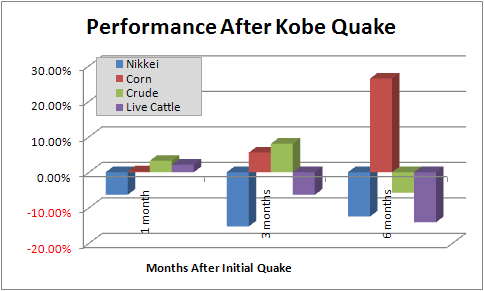
How this will play out over the next several months is anyone’s guess.  In looking at the moves in Japan’s largest import markets of Oil, Corn, and Cattle in the months of demand disruption after the Kobe quake, we can see there wasn’t a clear cut ‘trade’ to be put on. This is due to several factors, the largest of which is that even the world’s third largest economy (2nd largest at the time of the Kobe quake) having a hiccup isn’t enough to overcome other factors such as supply, interest rates, and more.
Market Performance After Kobe
But this demand disruption looks to be on a larger scale – and comes at a time when other market currents are going the other way. On one hand, violence in the Middle East and inflationary pressures due to quantitative easing have been driving commodity futures higher and higher.  On the other, the earthquake affecting the world’s third largest economy can drop demand (causing for lower prices) for things like oil, platinum and corn in the face of lowered production capabilities. For today at least, the quake is winning.

See the original article >>

THE NIKKEI DECLINES 13% AS NUCLEAR MELTDOWN FEARS INCREASE

by Cullen Roche

Japan’s Prime Minister, Naota Kan, did little to quell fears this evening during a press conference in which he said the leakages from the 4 nuclear reactors were worse than previously believed.  There are also reports of radiation readings in Tokyo.  The Nikkei index is trading down over 13% as investors price in a crushing economic environment.

The S&P futures are trading down 29 points or 2.25%, the Nikkei is down an incredible 13% and the Hang Seng composite is off 4%.  The downturn is being seen as 100% deflationary as JGB’s rally 1% and the USD rallies higher.  The Japanese economy is at risk of becoming dysfunctional and investors are finally taking note of the contagion from the world’s third largest economy.


Japan braces for potential radiation catastrophe


(Reuters) - Japan warned radiation levels had become "significantly" higher around a quake-stricken nuclear power plant on Tuesday after explosions at two reactors, and the French embassy said a low-level radioactive wind could reach Tokyo within hours.
 Fukushima: il reattore numero 2 sta per fondere

Prime Minister Naoto Kan urged people within 30 km (18 miles) of the facility north of Tokyo to remain indoors and conserve power, underscoring the dramatic escalation of Japan's nuclear crisis, the world's most serious since the Chernobyl disaster in Ukraine in 1986.
As concern about the crippling economic impact of the nuclear and earthquake disasters mounted, Japanese stocks fell as much as 14 percent before ending down 9.5 percent, compounding a slide of 7.6 percent the day before. The two-day fall has wiped some $620 billion off the market.
The French Embassy in Tokyo warned in an 0100 GMT advisory that a low level of radioactive wind could reach the capital -- 240 km (150 miles) south of the plant -- in about 10 hours.
Radiation levels in the city of Maebashi, 100 km (60 miles) north of Tokyo were up to 10 times normal levels, Kyodo news agency said. Only low levels were found in the capital itself, which so far were "not a problem", city officials said.
"There has been a fire at the No. 4 reactor and radiation levels in the surrounding area have heightened significantly. The possibility of further radioactive leakage is heightening," a grim-faced Kan said in an address to the nation.
"We are making every effort to prevent the leak from spreading. I know that people are very worried but I would like to ask you to act calmly."
Despite the plea for calm, residents rushed to shops in Tokyo to stock up on supplies. Don Quixote, a multi-storey, 24-hour general store in Roppongi district, sold out of radios, flashlights, candles and sleeping bags.
In a sign of mounting regional fears about the risk of radiation, China said it was strengthening monitoring, Air China said it had canceled flights to Tokyo. The Japanese government announced a 30-km no-fly zone around the reactors.
Several embassies advised staff and citizens to leave affected areas. Tourists cut short vacations and multinational companies either urged staff to leave or said they were considering plans to move outside Tokyo.
Winds over the nuclear facility were blowing slowly in a southwesterly direction that includes Tokyo but will shift westerly later on Tuesday, a weather official said.
Japanese media have became more critical of Kan's handling of the disaster and criticized the government and nuclear plant operator TEPCO for their failure to provide enough information on the incident.

Residents want information on the health risks.
"Very acute radiation, like that which happened in Chernobyl and to the Japanese workers at the nuclear power station, is unlikely for the population," said Lam Ching-wan, a chemical pathologist at the University of Hong Kong.
But the blasts could expose the population to longer-term exposure to radiation, which can raise the risk of thyroid and bone cancers and leukemia , he said. Children and fetuses are especially vulnerable.

Main Image
Residents want information on the health risks.
"Very acute radiation, like that which happened in Chernobyl and to the Japanese workers at the nuclear power station, is unlikely for the population," said Lam Ching-wan, a chemical pathologist at the University of Hong Kong. 
But the blasts could expose the population to longer-term exposure to radiation, which can raise the risk of thyroid and bone cancers and leukemia , he said. Children and fetuses are especially vulnerable. Chief Cabinet Secretary Yukio Edano, talking of levels of radiation at the Fukushima Daiichi plant's No. 4 reactor, said: "There is definitely a possibility that this could affect people's bodies."
Many of the worrying milestones mapped out by experts have been passed, with some workers having left the complex and people living within 30 km told to stay indoors.
There have been a total of four explosions at the plant since it was damaged in last Friday's massive quake and tsunami. The most recent were blasts at reactors No. 2 and No. 4.
There was a real possibility of a leak in the No.4 reactor container, which houses the nuclear fuel rods, according to Murray Jennex, a professor at San Diego State University in California.
Concerns center on damage to a part of the reactor core known as the suppression pool, which helps cool and trap the majority of cesium, iodine, strontium in its water. The nature of the damage was unclear, as was its impact on the containment structure, a thick steel vessel that surrounds the core.
Jennex said the crisis in Japan, the only nation to have suffered a nuclear attack, was worse that the Three Mile Island disaster of 1979.
"But you're nowhere near a Chernobyl ... Chernobyl there was no impediment to release, it just blew everything out into the atmosphere," he said. "You've still got a big chunk of the containment there holding most of it in."
Authorities had previously been trying to prevent meltdowns in the complex's nuclear reactors by flooding the chambers with sea water to cool the reactors down.
A sudden drop in cooling water levels when a pump ran out of fuel had fully exposed the fuel rods for a time, an official said. TEPCO had resumed pumping sea water into the reactor early on Tuesday.
U.S. warships and planes helping with relief efforts moved away from the coast temporarily because of low-level radiation. The U.S. Seventh Fleet described the move as precautionary.
South Korea, Hong Kong, Singapore and the Philippines said they would test Japanese food imports for radiation.
"SCENE FROM HELL"
The full extent of the destruction from last Friday's massive quake and tsunami that followed it was still becoming clear, as rescuers combed through the region north of Tokyo where officials say at least 10,000 people were killed.

"It's a scene from hell, absolutely nightmarish," said Patrick Fuller of the International Red Cross Federation from the northeastern coastal town of Otsuchi.
Kan has said Japan is facing its worst crisis since World War Two and, with the financial costs estimated at up to $180 billion, analysts said it could tip the world's third-biggest economy back into recession.

The U.S. Geological Survey upgraded the quake to magnitude 9.0, from 8.9, making it the world's fourth most powerful since 1900.
Car makers, shipbuilders and technology companies worldwide scrambled for supplies after the disaster shut factories in Japan and disrupted the global manufacturing chain.
About 850,000 households in the north were still without electricity in near-freezing weather, Tohuku Electric Power Co. said, and the government said at least 1.5 million households lack running water. Tens of thousands of people were missing.
"The situation here is just beyond belief, almost everything has been flattened," said the Red Cross's Fuller in Otsuchi, a town all-but obliterated."The government is saying that 9,500 people, more than half of the population, could have died and I do fear the worst."
Whole villages and towns have been wiped off the map by Friday's wall of water, triggering an international humanitarian effort of epic proportions.
Estimates of the economic impact are now starting to emerge.
Hiromichi Shirakawa, chief economist for Japan at Credit Suisse, said in a note to clients that the economic loss will likely be around 14-15 trillion yen ($171-183 billion) just to the region hit by the quake and tsunami.
Even that would put it above the commonly accepted cost of the 1995 Kobe quake which killed 6,000 people.
The earthquake has forced many firms to suspend production and global companies -- from semiconductor makers to shipbuilders -- face disruptions to operations after the quake and tsunami destroyed vital infrastructure, damaged ports and knocked out factories.
"The earthquake could have great implications on the global economic front," said Andre Bakhos, director of market analytics at Lec Securities in New York."If you shut down Japan, there could be a global recession."
See the original article >>

Follow Us