Thursday, February 10, 2011

Go Short On Platinum - Super Commodity trading System

Set-up di vendita ieri sera sul Platinum da parte del nostro Super Commodity system, accompagnato da alcune divergenze negative sulla chart giornaliera. Lo Stop loss è già stato spostato a breakeven in virtù del raggiungimento del relativo obiettivo da parte dei prezzi. I risultati real-time sono a disposizione al seguente link: http://www.box.net/shared/5vajnzc4cp

Sell Short set-up on Platinum last night by our Super Commodity system, accompanied by some negative divergences on the daily chart. The Stop Loss has already been moved to breakeven as a result of reaching its target by price. Real-time results are available at the following link: http://www.box.net/shared/5vajnzc4cp

PL
Material in this post does not constitute investment advice or a recommendation and do not constitute solicitation to public savings. Operate with any financial instrument is safe, even higher if working on derivatives. Be sure to operate only with capital that you can lose. Past performance of the methods described on this blog do not constitute any guarantee for future earnings. The reader should be held responsible for the risks of their investments and for making use of the information contained in the pages of this blog. Trading Weeks should not be considered in any way responsible for any financial losses suffered by the user of the information contained on this blog.

IS THE HIGH YIELD BOND MARKET LOOKING FROTHY?

by Cullen Roche

After an incredible 85% rally since the 2009 lows there are some signs that the high yield bond market is beginning to look expensive. In a search for yield investors have driven high-yield bond risk premiums just below their historical average of 5.1%.   Risk premiums can be tricky in an environment such as the current one.  Risk premiums are historically high at 70% of yield so there is an argument to be made that the Fed’s extraordinary actions are distorting valuations.  Average yields, meanwhile are sinking to all-time lows.  High yield bonds, at 7.1% based upon the Merrill Lynch U.S. High Yield Master II Constrained Index, are just shy of the record low yield of 6.81% recorded in December 2004.  In addition issuance is ballooning.  According to Fitch high yield issuance surged 67% in 2010 to $252.4B vs 2009 levels of  $151.5B.

In his recent outlook for the bond market Jeff Gundlach of DoubleLine stated that high yield corporates were never more expensive:
“Junk bonds have never been richer….At best, they’ll hold their own against competing investments.”
Martin Fridson, Global Credit Strategist, BNP Paribas Investment Partners disagrees:
“Whatever the future may hold, pundits who are bearish on high yield cannot justify their stance on grounds of valuation….Given where the fundamentals are, the spread is actually a touch more than it should be.”
David Rosenberg of Gluskin Sheff, in yesterday’s market commentary, offers a more balanced perspective:
“The overall not-too-hot/not-too-cold macro backdrop is obviously very constructive for the high yield market. These companies have radically restructured their balance sheets over the past two years to the point that the volume of debt to refinance by 2014 has plunged 44% to $482 billion. Default risks have accordingly declined.

At the same time, the sector trades at a premium and the yield at 7% is flirting with all-time lows. Total returns in the past two years have come to total 87% versus 53% for the S&P 500. Last year’s darlings were the BRICS and now we see these markets faltering and escalating outflows from emerging market equity funds. Every dog has its day.

What is a bit scary is that inflows into high-yield funds are surging — almost $5 billion so far this year, which is over one-third of the 2010 intake. This is a bit worrisome from a contrarian standpoint, but I am at least heartened by the fact that portfolio managers in this sector (looking at the ICI data) have cash ratios now that are in excess of 6%. This is a much better cushion than they had going into the credit meltdown (when they were just at 4%, and at the worst of the crisis in late 2008, they were over 10% cash).
Spreads have tightened dramatically and are at levels we saw at the 2007 peak of the risk cycle. That said, they did get well below 300bps in each of the two prior bull runs so there may in fact be more juice left based on recent history but not a whole lot.”
As of the end of 2010 the junk bond default rate was 3.1%.  That’s down from 13% in 2009.  Moody’s expects that to fall to 1.9% this year, however, pressures will mount as the corporate debt burden increases in the coming years:
“A flood of US speculative-grade, nonfinancial corporate debt—almost $690 billion—is scheduled to mature during 2011-2015. Despite heavy new issuance in 2010, the maturities have fallen by only $100 billion from the roughly $800 billion noted in last year’s study. This indicates the recent robust new issuance in 2010 merely “kicked-the-can” of the pending refunding needs to a later date.
Near-term refunding needs are relatively modest, with just $26 billion maturing in 2011 and $67 billion in 2012—a welcome relief as the economy continues its slow recovery. But the big refunding need in 2013-2015 of approximately $600 billion poses a greater concern given the still somewhat weak economic recovery, a high unemployment rate that is expected to be about 9% at year-end 2011,11 and the prospect of higher interest rates in the future.”
All in all the risk trade in high yield appears to be on in 2011 barring an unforeseen economic downturn.  It’s likely that moderate to high valuations combined with low default risk and reasonable funding needs will continue to feed the debt binge in high yield corporate bonds.  This should make Ben Bernanke quite pleased as his goal of re-leveraging an overleveraged private sector comes to fruition.  Whether or not this trend is sustainable is a totally different question and likely doesn’t have a happy ending.

Continue reading this article >>

Ethanol producers may be making trouble for themselves

by Mike Verdin

America's ethanol producers should enjoy the good times while they last.
They are in clover at the moment, processing corn into record quantities of the stuff.
And potentially at healthy margins too. Ethanol plants appear, cannily, to have bought their corn supplies in advance last year, before prices really took off, the US Department of Agriculture said on Wednesday, explaining the gap between growers' receipts from the grain and the "substantially higher" cash market bids.
However, there are good reasons to think that times for the industry might be about to get tougher. 
Role reversal
Some are financial. One reason America's corn ethanol producers are enjoying a boom is that, unusually, they are more competitive than Brazilian rivals which make the biofuel from sugar.
If corn prices look steep, at their highest in more than two years, remember raw sugar is near a 30-year high.
However, that dynamic, which has allowed America's corn ethanol producers to usurp Brazilian peers on export markets, may reverse.
Indeed, futures markets indicate pricing power returning to sugar ethanol mills, which can buy their raw material for March next year 22% cheaper than they can get it for delivery next month.
That's more than twice the discount that corn ethanol plants can count on, to judge by Chicago prices.
Tax factor 
But other hurdles will require more than canny hedging.
The industry's favourable finances are supported by tax perks - a blender's tax credit, besides the market protection offered by levies slapped on ethanol imports.
However, the clock is ticking for these benefits. They are due to run out at the end of this year, when reinstating them may not be so easy as it was last time they lapsed, in December.
Even in the few weeks since, food prices have risen up the world agenda, questioning the morality of tying up so much productive farmland for an industrial purpose.
Latest official estimates forecast 40% of the US corn crop going to make ethanol, up from 35% last year, and equivalent to the fruits of 35m acres of land.
That's a large target for the food lobby to aim at should concerns about supplies become an even bigger deal. 
Achilles heel 
Ethanol producers can at least count on a silver lining from the turn towards civil upset in Middle East and North Africa.
The threat the unrest poses to some major oil exporters exposes America's vulnerability on energy - its reliance on imports for roughly half the 19m barrels or so of oil it uses a day.
The food concerns of importing states may appear a luxury if domestic fuel security is at stake.
Ironically, the discontent sparked by food price gains could provide a shield for an industry which helped cause them.
 

Cisco: An Also Ran

by Beskope Investment Group

It has been a bad nine months for Cisco (CSCO).  After trading near $28 per share in May of 2010, the company has managed to disappoint Wall Street's expectations for three straight quarters.  After today's report, it looks like investors have had enough.  In after hours trading, the stock is now trading under $20 per share to as low as $19.77.

Back in June 2009 when General Motors (GM) filed for bankruptcy, the keepers of the Dow Jones Industrial Average replaced GM with CSCO.  At the time, many said the move was done to show the Technology sector's increased importance in the US economy.  CSCO itself echoed this sentiment when it issued a statement saying that, "We believe our inclusion in the Dow demonstrates not only Cisco's role as a broad technology indicator, but how remarkably the Internet and networking have transformed the way businesses and consumers connect, communicate and collaborate."  The only problem with this view is that CSCO is no longer representative of the Technology sector.

The chart below compares the performance of CSCO to the overall S&P 500 Technology sector since CSCO was added to the DJIA in June 2009.  As shown, while the Technology sector has rallied more than 50% over that time, CSCO, after including tonight's after hours decline, is down 0.5%.

To add insult to injury, since CSCO was added to the DJIA, it is one of only six of the 76 stocks in the Technology sector that are down.  CSCO is often referred to by the press as a bellwether for the Technology sector, but based on the last several months, the stock has become increasingly irrelevant.  Perhaps one bright side to CSCO's after hours decline is that even though the stock is down 10%, because of its low share price, its downside impact on the Dow 30 translates to only 15 points.


Continue reading this article >>

Risk Management: Watch the Hang Seng

By macroman

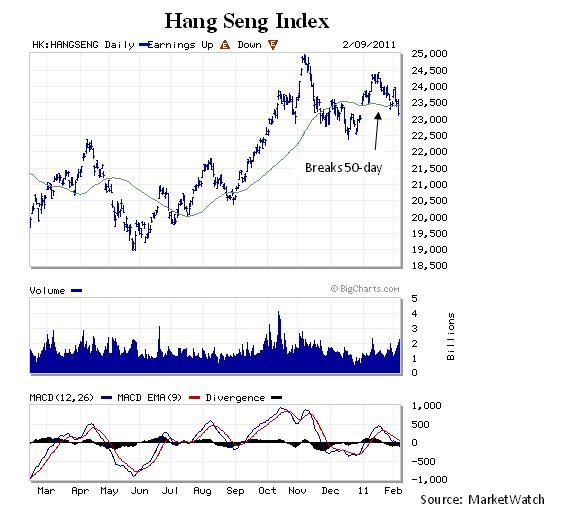
You know our schtick by now that we view the Hang Seng Index as the indicator species for global risk appetite and a signal as to whether the Mainland’s economy will land hard or soft.  Since returning from the Lunar holiday the Hang Seng is down 3.1 percent and has broken its 50-day moving average.   We  sense a growing concern about China’s economic situation as they continue to tighten monetary policy.

We’ve lightened up a little and monitoring the Hang Seng closely and a break of 22,600 would lead us to reduce risk across the board and get short certain commodities.  A break in China would almost instantly turn all the market chatter about inflation into deflation, in our opinion.   We are not certain where the Hang Seng and China are headed but we do know our action plan if certain support is broken.

By the way, have you been watching the bloodbath in Brazil and India, and today’s flop in the Korean ETF?  Also watch carefully the response of the British Pound if the BoE raises rates tomorrow.    (click here if chart is not observable)

Continue reading this article >>

CORPORATE PROFITS ARE SOARING THANKS TO RECORD UNEMPLOYMENT

By Mark Provost

In a January 2009 ABC interview with George Stephanopoulos, then-President-elect Barack Obama said fixing the economy required shared sacrifice: “Everybody’s going to have to give. Everybody’s going to have to have some skin in the game.”

For the past two years, American workers submitted to the President’s appeal—taking steep pay cuts despite hectic productivity growth. By contrast, corporate executives have extracted record profits by sabotaging the recovery on every front—eliminating employees, repressing wages, withholding investment, and shirking federal taxes. The global recession increased unemployment in every country, but the American experience is unparalleled. According to a July OECD report, the U.S. accounted for half of all job losses among the 31 richest countries from 2007 to mid-2010. The rise of U.S.

unemployment greatly exceeded the fall in economic output. Aside from Canada, from mid 2008 to mid 2010 U.S. GDP actually declined less than any other rich country. Washington’s embrace of labor-market flexibility ensured companies encountered little resistance when they launched their brutal recovery plans. Leading into the recession, the United States had the weakest worker protections against individual and collective dismissals in the world, according to a 2008 OECD study. Blackrock’s Robert Doll explains, “When the markets faltered in 2008 and revenue growth stalled, U.S. companies moved decisively to cut costs—unlike their European and Japanese counterparts.” The United States now has the highest unemployment rate among the ten major developed countries.

The private sector has not only been the chief source of massive dislocation in the labor market, but it is also a beneficiary. Over the past two years, productivity has soared while unit labor costs have plummeted. By imposing layoffs and wage concessions, U.S. companies are supplying their own demand for a tractable labor market. Private sector union membership is the lowest on record. Deutsche Bank Chief Economist Joseph LaVorgna notes that profits-per-employee are the highest on record, adding, “I think what investors are missing—and even the Federal Reserve—is the phenomenal health of the corporate sector.” Due to falling tax revenues, state and local government layoffs are accelerating. By contrast, U.S. companies increased their headcount in November at the fastest pace in three years, marking the tenth consecutive month of private sector job creation. The headline numbers conceal a dismal reality; after a lost decade of employment growth, the private sector cannot keep pace with new entrants into the workforce. The few new jobs are unlikely to satisfy Americans who lost careers. In November, temporary labor represented an astonishing 80% of private sector job growth. Companies are transforming temporary labor into a permanent feature of the American workforce. UPI reports, “This year, 26.2 percent of new private sector jobs are temporary, compared to 10.9 percent in the recovery after the 1990s recession and 7.1 percent in previous recoveries.” The remainder of 2010 private sector job growth has consisted mainly of low-wage, scant-benefit service sector jobs, especially bars and restaurants, which added 143,000 jobs, growing at four times the rate of the rest of the economy.

Aside from job fairs, large corporations have been conspicuously absent from the tepid jobs recovery. But they are leading the profit recovery. Part of the reason is the expansion of overseas sales, but the profit recovery is primarily coming off the backs of American workers. After decades of globalization, U.S. multinationals still employ two-thirds of their global workforce from the United States (21.1 million out of 31.2 million). Corporate executives are hammering American workers precisely because they are so dependent on them.

An annual study by USA Today found that private sector paychecks as a share of Americans’ total income fell to 41.9% earlier this year, a record low. Conservative analysts seized on the report as proof of President Obama’s agenda to redistribute wealth from, in their words, those “pulling the cart” to those “simply riding in it”. Their accusation withstands the evidence—only it’s corporate executives and wealthy investors enjoying the free ride. Corporate executives have found a simple formula: the less they contribute to the economy, the more they keep for themselves and shareholders. The Fed’s Flow of Funds report reveals corporate profits represented a near-record 11.2% of national income in the second quarter.

Non-financial companies have amassed nearly $2 trillion in cash, representing 11% of total assets, a sixty-year high. Companies have not deployed the cash on hiring, as weak demand and excess capacity plague most industries. Companies have found better use for the cash, as Robert Doll explains: “high cash levels are already generating dividend increases, share buybacks, capital investments and M&A activity—all extremely shareholder friendly.”

Companies invested $262 billion in equipment and software investment in the third quarter. That compares with nearly $80 billion in share buybacks. The paradox of substantial liquid assets accompanying a shortfall in investment validates Keynes’ idea that slumps are caused by excess savings. Three decades of lopsided expansions have hampered demand by clotting the circulation of national income in corporate balance sheets. An article in the July issue of The Economist observes “business investment is as low as it has ever been as a share of GDP.”

The decades-long shift in the tax burden from corporations to working Americans has accelerated under President Obama. For the past two years, executives have reported record profits to their shareholders partially because they are paying a pittance in federal taxes. Corporate taxes as a percentage of GDP in 2009 and 2010 are the lowest on record, just over 1%.

Corporate executives complain that the United States has the highest corporate tax rate in the world, but there’s a considerable difference between the statutory 35% rate and what companies actually pay (the “effective” rate). Here again, large corporations lead the charge in tax arbitrage. U.S. tax law allows multinationals to indefinitely defer their tax obligations on foreign-earned profits until they ‘repatriate’ (send back) the profits to the United States. U.S. corporations have increased their overseas stash by 70% in four years, to now over $1 trillion—largely by dodging U.S taxes through a practice known as “transfer pricing”. Transfer pricing allows companies to allocate costs in countries with high tax rates and book profits in low-tax jurisdictions and tax havens—regardless of the origin of sale. U.S. companies are using transfer pricing to avoid U.S. tax obligations to the tune of $60 billion dollars annually, according to a study by Kimberly A. Clausing, an economics professor at Reed College in Portland, Ore.

The corporate cash glut has become a point of recurrent contention between the Obama administration and corporate executives. In mid December, a group of 20 corporate executives met with the Obama administration and pleaded for a tax holiday on the $1 trillion stashed overseas, claiming the money would spur jobs and investment. In 2004, corporate executives convinced President Bush and Congress to include a similar amnesty provision in the American Jobs Creation Act; 842 companies participated in the program, repatriating $312 billion back to the United States. at 5.25% rather than 35%. In 2009, the Congressional Research Service concluded that most of the money went to stock buybacks and dividends—in direct violation of the Act.
The Obama administration and corporate executives saved American capitalism. The U.S. economy may never recover.
Continue reading this article >>

Follow Us