Saturday, March 7, 2015

SPY Trends and Influencers March 7, 2015

by Greg Harmon

Last week’s review of the macro market indicators suggested, heading into March the strength that was anticipated to close February did not appear, but weakness did not show up either.

Elsewhere looked for Gold ($GLD) to continue the short term bounce higher while Crude Oil ($USO) churned in the consolidation of the downward move. The US Dollar Index ($UUP) seemed ready to move higher again while US Treasuries ($TLT) were biased higher short term in the pullback. The Shanghai Composite ($ASHR) was on the cusp of another leg higher and Emerging Markets ($EEM) were stalled at resistance but not showing any bias.

Volatility ($VXX) looked to remain subdued and possibly drifting lower keeping the bias higher for the equity index ETF’s $SPY, $IWM and $QQQ. Their charts were not as strong with consolidation or a pullback looking more likely in them, especially the SPY with the IWM next and QQQ strongest, holding level.

The week played out with the Gold bounce lasting a nanosecond before reversing lower while Crude Oil continued in the consolidation range. The US Dollar broke out of consolidation higher while Treasuries broke lower and just kept going. The Shanghai Composite found resistance and pulled back while Emerging Markets followed everything else lower.

Volatility tested last week’s low before rebounding higher. The Equity Index ETF’s started the week drifting with a downward edge, but accelerated after the Non-farm payroll report Friday, closing near the lows. What does this mean for the coming week? Lets look at some charts.

SPY Daily, $SPY
spy d

The SPY started the week to the upside, testing the 212 area and in consolidation. But it did not take long for the price to break to the downside. The 20 day SMA acted as support for a couple of days but then Friday saw a big push lower. The range of the long red candle had not been seen for two weeks. It ended the week below the December high but over the January high of the prior consolidation range. The daily chart shows the RSI pulling back along with the price pullback from the rising trend resistance and the MACD crossed down and falling. These all bode for more downside.

On the weekly chart the price moved back into the consolidation zone that started in October. The RSI on this timeframe is falling but bullish and the MACD about to cross down. Also a downside bias. Notice on both timeframes that the Bollinger Bands® are tightening, often a precursor to a bigger move. There is support lower at 206.40 and 204.30 followed by 203 and 202.30 before 200 and 198.60. Resistance higher stands at 209 and 210.25 followed by 212.25. Continued Pullback in the Uptrend.

SPY Weekly, $SPY
spy w

Heading into next week the equity markets look vulnerable. Elsewhere look for Gold to continue lower while Crude Oil churns in a consolidation zone. The US Dollar Index looks to continue higher while US Treasuries continue lower. The Shanghai Composite looks to continue its broad consolidation with a short term downside bias and Emerging Markets are biased to the downside.

Volatility looks to remain low keeping the bias higher for the equity index ETF’s SPY, IWM and QQQ. Their charts look better to the downside though with the SPY the weakest and the IWM and QQQ a bit stronger on the longer timeframe. Use this information as you prepare for the coming week and trad’em well.

See the original article >>

Monday, March 2, 2015

Weekend update

by Tony Caldaro

REVIEW

The week started off at SPX 2110. Then after dipping to SPX 2103 Monday morning the market rallied to new highs at 2120 by Wednesday. After that it spent the next two days within that range. For the week the SPX/DOW were -0.1%, the NDX/NAZ were mixed, and the DJ World index was +0.3%. On the economic front negative reports continued to outpace positive ones. On the uptick: Case-Shiller, durable goods, the FHFA, consumer sentiment, and pending homes sales. On the downtick: existing home sales, consumer confidence, the CPI, the Chicago PMI, Q2 GDP, the WLEI and weekly jobless claims rose. Next week’s reports are highlighted by monthly Payrolls, the FED’s beige book and the PCE.

LONG TERM: bull market

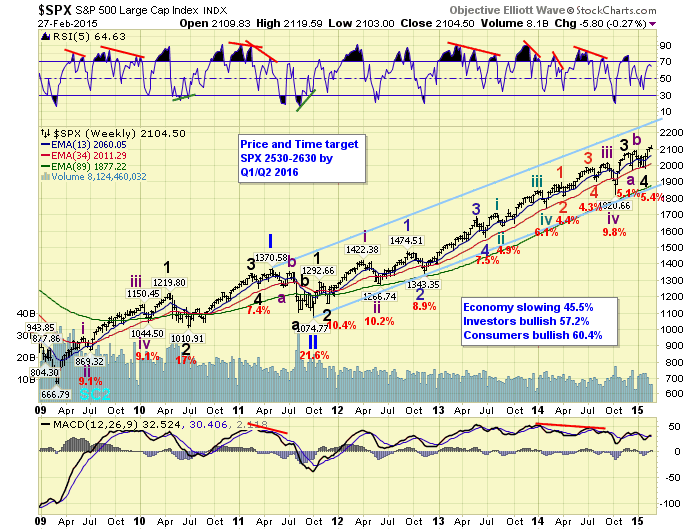
The five primary wave Cycle [1] bull market from March 2009 continues. Primary waves I and II completed in 2011, and Primary wave III has been underway since then. During the entire 130 year recorded history of the US stock market there has only been five bull markets that have lasted five calendar years or more: 1921-1929, 1932-1937, 1987-2000, 2002-2007 and 2009-2015 so far. Of these five, three have been the last three bull markets and the current one is the third longest in history. During each of these five bull markets each of the three rising waves unfolded in 1, 2, 3, 5 or 8 years. These are all Fibonacci numbers. The longest one for example had rising waves of 3, 8 and 2 years. As a result of this analysis, and the new highs posted this year, we are expecting Primary III to top around Q1/Q2 of 2016. When applying several mathematical relations we arrived, as posted last week, with a target of SPX 2530-2630 for Primary III. Then after a steep Primary IV correction we are expecting the bull market to top in 2017, completing an eight year long term uptrend. Fundamentally, the ECBs EQE, scheduled to start in March, supports this scenario.

SPXweekly

We have labeled Primary III with Major waves 1 and 2 in late 2011, then Major waves 3 and 4 in late-2014 and early-2015. The current uptrend, which started in early -February, should be the beginning of Major wave 5. Since we are not expecting Major wave 5 to complete until next year, we are labeling this uptrend as Intermediate wave i. After it concludes we still should have at least four more trends, Intermediate waves ii thru v, before Major wave 5 completes. Since this uptrend is only one month old, and has not reached an overbought condition on the weekly RSI, we are expecting it continue higher.

MEDIUM TERM: uptrend

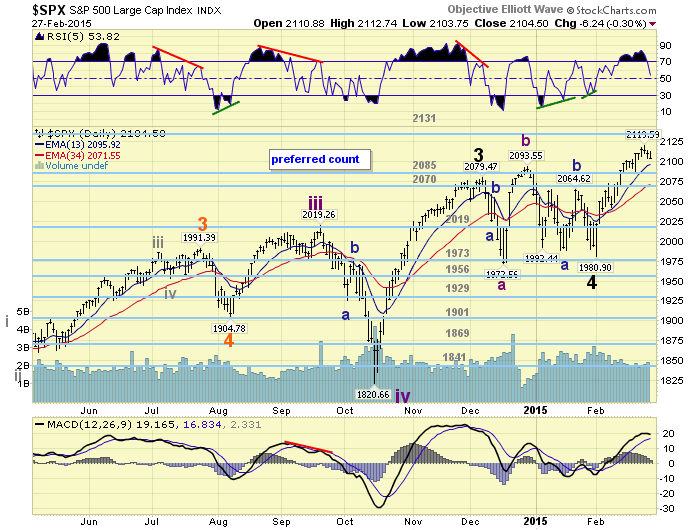
After a somewhat complex Major wave 4, Major wave 5 began on the first trading day of February. From the downtrend low of SPX 1981 the market has risen about 7% during this month. Currently we see five waves up from that low, with each rising wave shorter than the previous wave: 2072-2042-2102-2085-2120. This is a bit unusual for a potential completed wave pattern, since the third wave is usually the longest. However, it is acceptable since the fifth wave is the shortest wave.

SPXdaily

The easiest way to count this pattern is either: 1. a completed uptrend, or 2. a completed wave 1 of the uptrend. In both of these cases the SPX would have to drop below 2085 to consider either of these two counts valid. Since we are expecting the uptrend to continue higher, #2 would then be the best option. Another way to count this pattern would be a series of subdividing waves. More on this below. Medium term support is at the 2085 and 2070 pivots, with resistance at the 2131 and 2198 pivots.

SHORT TERM

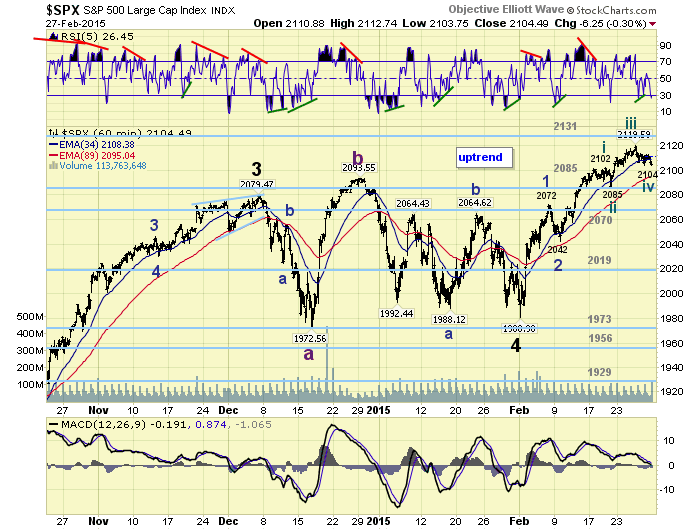
If we were to consider this uptrend currently in a series of subdividing waves, then the easiest count would be a 1-2, i-ii, 1-2. But this seems a bit stretched since this uptrend has already risen about 140 points from its low. The count we do prefer is the one posted on the chart below. This suggests Minor waves 1 and 2 completed at SPX 2072 and 2042. Then Minor wave 3 has subdivided into four Minute waves thus far: 2102-2085-2120-2104. With this count, and the somewhat lethargic market action lately, we would expect Minor 3 to top around the OEW 2131 pivot. This count also offers several interesting wave/price relationships.

SPXhourly

With Minute i 60 points, (2042-2102), and Minute iii only 35 points, (2085-2120), the maximum Minute v could reach is also 35 points, (2104-2139). Wave five can not be longer than wave three, when wave three is shorter than wave one. Should it exceed SPX 2139 then the triple subdivision noted above would be in play. Should it end around the 2131 pivot then another wave/price relationship comes into play. Minor wave 1 rose 91 points (1981-2072). In order for Minor 3 to equal, or better, Minor 1 it has to reach at least SPX 2133, (2042-2033 or 91 points). Should it reach SPX 2133 or better, then Minor 5 can be any length. If not, Minor 5 will be limited to the length of Minor 3 or less. Should it be less this uptrend will not make it to the OEW 2198 pivot. If more, then the 2198 pivot an even higher is obtainable before any sizeable correction.

While this all may seem quite complicated we will try to summarize with some defined levels. If the SPX drops below 2085 we will have five waves up from the 1981 low, suggesting either the uptrend completed, or more likely, only the first wave up of the uptrend completed. If/when the SPX rises above 2120 then Minor wave 3 continues. The rest we will deal with on a day to day basis as this market unfolds. Short term support is at SPX 2104 and the 2085 pivot, with resistance at SPX 2120 and the 2131 pivot. Short term momentum ended the week oversold.

See the original article >>

Sunday, March 1, 2015

Weighing the Week Ahead: Will the Economic News Alter Fed Policy?

by oldprof

The economic calendar includes an avalanche of important data. The daily economic news, culminating in the jobs report on Friday, will dominate the market discussion this week. The popularity of parsing everything through the lens of Fed policy creates a special situation. Pundits will ask:

Will the economic data alter Fed policy?

Prior Theme Recap

In last week’s WTWA I predicted that the punditry would focus on housing data and economic impacts with a brief diversion for the Yellen testimony. That was as good call, since the housing debate bracketed the testimony and still followed our themes at week’s end, especially on CNBC programming. Josh Brown’s excellent article, 10 reasons the housing market could go ballistic this spring, captures the spirit of the discussion. Regular readers know that I have long recommended viewing pent-up demand (reason #2) along with shadow inventory. All ten reasons are interesting.

Feel free to join in my exercise in thinking about the upcoming theme. We would all like to know the direction of the market in advance. Good luck with that! Second best is planning what to look for and how to react. That is the purpose of considering possible themes for the week ahead.

This Week’s Theme

The upcoming week is loaded with interesting data, more than we often see in two weeks and including the most important reports. With Fed Chair Yellen’s testimony fresh in our minds, it will be natural to combine questions about the Fed with interpretation of the data.

Will the Economic Data Alter the Fed’s plan?

The Viewpoints

Here are the key viewpoints on the economy and Fed policy:

  • The Fed is on course to raise interest rates this year. Vice-Chair Fischer suggests that the current balance sheet effect, without any more buying, is 110 bps on the ten-year yield. This leaves room to normalize rates.
  • The Fed will remain data dependent, with a possible delay until next year (Bloomberg).
  • The Fed will be forced to initiate more QE. (Critics fearing deflation).
  • The Fed has undermined all data. It is hopelessly “behind the curve” from a failure to raise rates earlier. (Critics fearing hyperinflation).

Critics of all flavors were represented during Chair Yellen’s Congressional testimony. The same economic data will be viewed quite differently depending upon the viewing lens. Bob Dieli emphasizes the inflation test as especially important and provides an interesting chart to consider the timing of the first rate hike:

Dieli on Fed

As always, I have some additional ideas in today’s conclusion. But first, let us do our regular update of the last week’s news and data. Readers, especially those new to this series, will benefit from reading the background information.

Last Week’s Data

Each week I break down events into good and bad. Often there is “ugly” and on rare occasion something really good. My working definition of “good” has two components:

  1. The news is market-friendly. Our personal policy preferences are not relevant for this test. And especially – no politics.
  2. It is better than expectations.

The Good

There was some good news last week.

  • Progress in Greece. The four-month delay was agreed upon.
  • Inflation is still subdued. And no, it is not a deflationary threat, explains Brian Wesbury.
  • Weekly jobless claims dipped. Back below 300K. Calculated Risk analyzes and charts the significance.
  • Q4 GDP was revised lower, but beat expectations at 2.2%. While the market sold off later in the day, this did not seem to be a major factor. Some were encouraged at the reasons for the revisions, including a lower inventory effect. Doug Short has the best summary of the effect of each component:

dshort gdp

  • Durable goods orders beat expectations. Steven Hansen at GEI has a complete analysis, including a longer trend and some caveats.
  • Earnings reports strengthened. The blended growth rate is 3.7%. Companies beating estimates are seeing solid stock price increases. (FactSet). Brian Gilmartin is pretty optimistic about the picture for 2015 focusing on increases in the bottom-up estimates.
  • The chemical activity index. We always appreciate updates from “Davidson” via Todd Sullivan. The correlation suggests “a rise in equity prices for the next 12 months or so.”

Screen-Shot-2015-02-24-at-10.11.45-PM-622x420

  • Michigan sentiment rebounded to 95.4. This is slightly off the recent high, but still very strong.
  • Pending home sales hit 18 month highs. (Calculated Risk) This is a forward looking indicator, but Bill remains concerned about NAR sales estimates. He has an update noting major revisions in seasonal adjustments for the West region.

The Bad

There was also some discouraging economic news.

  • Fund managers are bullish. This is negative on a contrarian basis (The Short Side of Long). Contra from The Fat Pitch, tracking financial bloggers. Both sources have interesting charts, so make up your own mind. I am scoring this with the standard contrarian interpretation.
  • Jobless claims rose dramatically to 313K, the most since December, 2013. This is an important series, but difficult to track with moving holidays like President’s Day. (Bloomberg)
  • Ukraine cease fire is in jeopardy, hanging by a “hair trigger.” (CNN) This is a continuing human tragedy and a major drag on the world economy.
  • Existing home sales disappointed, the lowest level since May, 2014. Mesirow Financial observes that the best investment properties have traded and the baton must now be passed to first-time buyers – a crucial shift. Other observers blame low inventory (WSJ).

The Ugly

Congress is back in action! Or inaction. With minutes to spare before funding would end for the Department of Homeland Security, Congress managed a one-week funding extension. This means that we get to watch the entire story again next week. Groundhog Day was a month ago. Even Greece and the Germans managed a four-month extension.

And following up from a prior “Ugly” the Chicago financial situation gets worse.

The Silver Bullet

I occasionally give the Silver Bullet award to someone who takes up an unpopular or thankless cause, doing the real work to demonstrate the facts.  Think of The Lone Ranger.

This week’s award goes to Nicholas Cola and Jessica Rabe of Convergex. Cola takes on the oft-cited Jeff Gundlach slide deck on the 2015 outlook. Gundlach states that equities have never risen for seven years in a row since 1871. The Convergex analysis, while quite deferential, demonstrates that Gundlach is inaccurate in several respects. The points are all nicely documented and charted in a supplement. The conclusion is that several more years of rally would not be a surprise.

(Note more discussion of bull markets and old age in today’s final thought).

Quant Corner

Whether a trader or an investor, you need to understand risk. I monitor many quantitative reports and highlight the best methods in this weekly update. For more information on each source, check here.

Recent Expert Commentary on Recession Odds and Market Trends

RecessionAlert: A variety of strong quantitative indicators for both economic and market analysis. While we feature the recession analysis, Dwaine also has a number of interesting market indicators. This week he notes an increase in his combined measure of economic stress, although the levels are still not yet worrisome.

Doug Short: An update of the regular ECRI analysis with a good history, commentary, detailed analysis and charts. If you are still listening to the ECRI (three years after their recession call), you should be reading this carefully. Doug has the latest interviews as well as discussion. Also see Doug’s Big Four summary of key indicators.

Georg Vrba: has developed an array of interesting systems. Check out his site for the full story. We especially like his unemployment rate recession indicator, confirming that there is no recession signal. Georg continues to develop new tools for market analysis and timing, including a combination of models to do gradual shifting to and from the S&P 500. I am following his results and methods with great interest. You should, too.

Bob Dieli does a monthly update (subscription required) after the employment report and also a monthly overview analysis. He follows many concurrent indicators to supplement our featured “C Score.”

This week’s report is chock full of insights and ideas. Here is Bob’s take on last week’s theme, housing:

James Picerno, a leading business cycle expert, warns against relying on too few “cherry-picked” indicators. He cites a statement that the housing recovery is faltering. His thoughtful article has several great examples, leading him to conclude as follows:

On that note, recession risk is still quite low, based on a broad review of the published numbers. Yes, the housing market may be an early sign of trouble; ditto the weak trend in commodity prices. But there are many positives one could point to as well. But it’s ridiculous to get into a tit-for-tat debate–my indicators are better than yours! The emphasis should be on developing superior multi-factor business cycle benchmarks. Fortunately, there’s no shortage of efforts on this crucial work. The bad news is that you’re not likely to read about it unless you’re looking beyond the usual suspects.

Sad, but true. The story that “all is well” does not get much attention.

The Week Ahead

It will be a big week for economic data.

The “A List” includes the following:

  • Employment report (F). The most watched economic indicator, despite the wide error band and revisions.
  • ISM Index (M). Important concurrent economic read with some leading qualities.
  • Personal income and spending (M). Will the bonus from lower gas prices show up?
  • PCE prices (M). Favorite Fed inflation indicator.
  • Auto sales (T). Good non-government verification of spending. Weather effects last month?
  • Initial jobless claims (Th). The best concurrent news on employment trends, with emphasis on job losses.
  • ADP private employment (W). Deserved recognition as a solid independent measurement of job growth.

The “B List” includes the following:

  • ISM services index (W). Less history than the manufacturing index, but now covering more of the economy.
  • Beige book (W). Anecdotal economic evidence that the FOMC will use at the next meeting. If you are a veteran of the Art Cashin era you may call this the “tan book.”
  • Trade balance (F). Impact of oil prices should be evident.
  • Construction spending (M). January data, but an important growth measure.
  • Factory orders (Th). January data for this volatile series.
  • Crude oil inventories (W). Maintains recent interest and importance.

There is not much FedSpeak, but plenty on the international affairs front.

How to Use the Weekly Data Updates

In the WTWA series I try to share what I am thinking as I prepare for the coming week. I write each post as if I were speaking directly to one of my clients. Each client is different, so I have five different programs ranging from very conservative bond ladders to very aggressive trading programs. It is not a “one size fits all” approach.

To get the maximum benefit from my updates you need to have a self-assessment of your objectives. Are you most interested in preserving wealth? Or like most of us, do you still need to create wealth? How much risk is right for your temperament and circumstances?

My weekly insights often suggest a different course of action depending upon your objectives and time frames. They also accurately describe what I am doing in the programs I manage.

Insight for Traders

Felix has continued a “bullish” posture for the three-week market forecast. The data have improved a bit, but are only slight better than the recent neutral readings. There is reduced uncertainty, reflected by the falling percentage of sectors in the penalty box. Our current position is still fully invested in three leading sectors, and we remain aggressive. For more information, I have posted a further description — Meet Felix and Oscar. You can sign up for Felix’s weekly ratings updates via email to etf at newarc dot com.

This week’s special advice for traders comes from two of my favorite sources: Brett Steenbarger citing Charles Kirk. The basic idea is the importance of not overfitting your trading models. The important technique is to resist temptation to add many variables for slight theoretical improvements in performance. My partner Vince calls this “pruning.” It is the key to what he calls a “robust” model. When you are looking at a new trading system it is one of the key things to consider. Less is more.

As I have noted for seven weeks, Felix continues to feature selected energy holdings. The focus has shifted from refiners, to producers, to natural gas during this time. Solar stocks have also earned a high rating.

Insight for Investors

I review the themes here each week and refresh when needed. For investors, as we would expect, the key ideas may stay on the list longer than the updates for traders. Major market declines occur after business cycle peaks, sparked by severely declining earnings. Our methods are focused on limiting this risk. Start with our Tips for Individual Investors and follow the links.

We also have a new page summarizing many of the current investor fears. If you read something scary, this is a good place to do some fact checking.

My bold and contrarian prediction for 2015 – that the leading sectors would lose and the laggards would win – still looks promising. I also see plenty of time left in this economic and stock cycle.

Other Advice

Here is our collection of great investor advice for this week:

Personal Finance

The annual Berkshire Hathaway letter is a must-read for investors. If you cannot spare the time to read all 42 pages, see pp. 18-19 for an explanation about why to prefer stocks to bonds in the long run. The risk often comes from our own behavior:

Investors, of course, can,by their own behavior, make stock ownership highly risky. And many do. Active trading, attempts to “time” market movements, inadequate diversification, the payment of high and unnecessary fees to managers and advisors, and the use of borrowed money can destroy the decent returns that a life-long owner of equities would otherwise enjoy. Indeed, borrowed money has

No place in the investor’s tool kit: Anything can happen anytime in markets. And no advisor, economist, or TV commentator – and definitely not Charlie nor I – can tell you when chaos will occur. Market forecasters will fill your ear but will never fill your wallet.

And also see page 34-35. Mr. Buffett advises at least a five-year time horizon for those buying his stock. He also explains the reason for keeping adequate cash reserves (counting Treasuries):

The reason for our conservatism, which may impress some people as extreme, is that it is entirely predictable that people will occasionally panic, but not at all predictable when this will happen. Though practically all days are relatively uneventful, tomorrow is always uncertain. (I felt no special apprehension on December 6, 1941 or September 10, 2001.) And if you can’t predict what tomorrow will bring, you must be prepared for whatever it does.

A CEO who is 64 and plans to retire at 65 may have his own special calculus in evaluating risks that have only a tiny chance of happening in a given year. He may, in fact, be “right” 99% of the time. Those odds, however, hold no appeal for us. We will never play financial Russian roulette with the funds you’ve entrusted to us, even if the metaphorical gun has 100 chambers and only one bullet. In our view, it is madness to risk losing what you need in pursuing what you simply desire.

Barry Ritholtz is on the same theme:

The noise box in your den (and on the wall of your trading room) has been tallying a catalog of potential crises and hazards. That parade of terribles seems to be getting longer each day. Although none of them are new, it is as if all of them have suddenly risen in unison, a chorus of noise, funk and angst. Markets are expensive, the Federal Reserve’s stimulus of quantitative easing and zero interest rates is ending, the euro is collapsing, deflation is a threat, rates are rising, residential real estate is a mess, biotech is a bubble, oil prices are plunging, Grexit will arrive any day.

Stock and Sector Ideas

Surprise! As Pimco reaches beyond its identity as a bond company, it now features income-oriented funds that feature stocks as well. Simon Constable (Barrons) has an excellent story that also includes information about the fund holdings – plenty of ideas.

Barron’s also features Vulcan Materials (VMC). We have been looking at stocks in this sector as solid value plays.

“We’re in the second inning of the cycle,” says Rick Lane, lead manager of Broadview Opportunity fund, which owns Vulcan stock (ticker: VMC). Lane sees Vulcan generating more than $1 billion in free cash in the next three years, which could help drive the stock price to $127, up more than 50% from last week’s $82.

Beware the high-yield market.

The thirty most-shorted stocks. (Akin Oyedele at BI)

Market Outlook

Morgan Housel has another great column, this time on the forecasting failures of Wall Street analysts. He cites the chart below from Birinyi Associates concludes as follows:

Finance is much closer to something like sociology. It’s barely a science, and driven by irrational, uninformed, emotional, vengeful, gullible, and hormonal human brains.

If you think of finance as being akin to physics when it’s actually closer to sociology, forecasting becomes a nightmare.The most important thing to know to accurately forecast future stock prices is what mood investors will be in in the future. Will people be optimistic, and willing to pay a high price for stocks? Or will they be bummed out, panicked about some crisis, pissed off at politicians, and not willing to pay much for stocks? You have to know that. It’s the most important variable when predicating future stock returns. And it’s unknowable. There is no way to predict what mood I’ll be in 12 months from now, because no matter what you measure today, I can ignore it a year from now. That’s why strategists have such a bad record.

Worse than a Blind Forecaster.

Birinyi on forecasts

No wonder Mr. Buffett recommends a five-year horizon.

Ben Carlson weighs in on the same theme using a great success story.

Perception and Psychology

You probably get involved in the debate over “the dress” and what color it is. For the full story — Market Watch’s Shawn Langlois starts my day with his “Need to Know” column. Perhaps more than anyone I appreciate how difficult this is – something like a daily WTWA. He also contribute other pieces like this one on the Internet debate over the dress. Mrs. OldProf and I disagreed on this one, as did our team at the office. If you managed to miss it, take a look and decide for yourself. There are some important investment lessons:

  1. No matter how simple the question, people see things differently.
  2. We do not understand the foundation for our perceptions – not even recognizing why they differ from those of others.
  3. No wonder people see the same chart, or the same balance sheet, and draw different conclusions.
  4. Buyers and sellers at the same price….

Business Cycle

Consistent with our Silver Bullet award is this excellent article from Cullen Roche, warning about extreme viewpoints and stubborn adherence thereto. He suggests that the bull market has another $816 million to go.

Final Thought

One of my regular themes is the difference in time frames between traders and investors.

Traders parse everything through the lens of Fed policy. HFT algorithms look for key words and front-run the humans. Human traders do the same thing – but more slowly. The blog posts hit, “explaining” why the Fed will change course.

If you are a trader, you have a tough job competing in this game.

Investors are free to ignore the immediate psychological reaction and to consider the fundamentals. Here are the most important two points:

  1. The exact timing of the first Fed rate increase does not matter. There is a difference between tight monetary policy and slightly less accommodative policy. Markets do quite well in the early stages of rising rates, especially when starting from a low initial point. This will be ignored by many who will invoke “Don’t fight the Fed.” This will be the fundamental battleground between traders and investors, bears and bulls, and various political types – perhaps lasting for years.
  2. The end of the business or stock market cycle is not imminent. Bull markets do not die of old age. Investors should understand that this one might run for many years. There are many famous and successful investors who have explained this, but I especially like this year-old analysis from Leon Cooperman. It happened just as a famous technical analyst noted that markets were at “an inflection point” not unlike the 1929 crash. (See also David Rosenberg).
See the original article >>

SPY Trends and Influencers February 28, 2015

by Greg Harmon

Last week’s review of the macro market indicators suggested, heading into the end of February saw the Equity markets as strong moving out of consolidation higher.

Elsewhere looked for Gold ($GLD) to continue lower in the short term while Crude Oil ($USO) continued to consolidate after its bounce. The US Dollar Index ($UUP) also looked to continue to consolidate sideways while US Treasuries ($TLT) were biased lower. The Shanghai Composite ($ASHR) and Emerging Markets ($EEM) were both consolidating with a bias to break that to the upside.

Volatility ($VXX) looked to remain subdued keeping the bias higher for the equity index ETF’s $SPY, $IWM and $QQQ, despite the moves higher the past week. Their charts also suggested more upward price action on both the daily and weekly view. This was the first week in a while that all 3 Index ETF’s looked strong.

The week played out with Gold probing lower before finding support at 1200 again while Crude Oil drifted lower in its consolidation. The US Dollar moved moved sideways but to the top of the range by the end of the week while Treasuries had a small bounce before pulling back. The Shanghai Composite came out of the holidays to the upside while Emerging Markets tried to move higher but stalled.

Volatility drifted to a new low for 2015. The Equity Index ETF’s rose on this combination but gave back most or all of the gain by Friday. All were in a tight range all week. What does this mean for the coming week? Lets look at some charts.

SPY Daily, $SPY
spy d

The SPY started the week with a whimper, moving slightly higher after the big move the Friday prior. A slight drift higher through to a new all-time high close Tuesday and failed attempt at another Wednesday led to a small pullback and slightly lower close on the week. The daily chart shows the RSI rolling over, but still firmly in the bullish zone, while the MACD is also turning lower.

Out on the weekly chart the breakout held but with a small candle and an upper shadow. Could be consolidation or a signal for a pullback. Perhaps a retest of the range break out. The RSI is turning down on this timeframe, but remains bullish, while the MACD is rising after crossing up last week. There is resistance higher at 212 and Measured Moves to 215 and 225 above that. Support lower comes at 210.25 and 209 followed by 206.40. Possible Pause or Pullback in the Uptrend.

SPY Weekly, $SPY
spy w

Heading into March the strength that was anticipated to close February did not appear, but weakness did not show up either. Elsewhere look for Gold to continue the short term bounce higher while Crude Oil churns in the consolidation of the downward move. The US Dollar Index seems ready to move higher again while US Treasuries are biased higher short term in the pullback. The Shanghai Composite is on the cusp of another leg higher and Emerging Markets are stalled at resistance but not showing any bias.

Volatility looks to remain subdued and may drift lower keeping the bias higher for the equity index ETF’s SPY, IWM and QQQ. Their charts are not as strong with consolidation or a pullback looking more likely in them, especially the SPY with the IWM next and QQQ strongest, holding level. Use this information as you prepare for the coming week and trad’em well.

See the original article >>

Wednesday, February 18, 2015

The Next Real Estate Crash

by Ramsey Su

On Shaky Ground

Real estate does not crash, it is real estate financing that crashes.

Easy sub-prime mortgages caused real estate prices to artificially appreciate, lack of even-more-sub-than-sub-prime financing caused prices to come back down.  Real estate did not crash, the sub-prime mortgage market did.  During the RTC era, deregulation allowed the S&Ls to lend and participate in all kinds of unsound projects.  Re-regulation shut down the madness.  The daisy chain broke and wiped out the entire S&L industry (Daisy chain was the the most popular Ponzi scheme of those days). It was financing that took the prices up, only to return to earth when financing crashed.

Superficially, the real estate market today is stable and steadily recovering, so I am told.  When you examine the invisible forces propping up prices, today’s market is on shakier ground than the sub-prime or the RTC era.  Government intervention has always been part of the real estate market but never to the extent of today.  Now that the private sector has been squeezed out, the government can only turn to itself.

The Federal Reserve

The Federal Reserve created $1.488 TRILLION via purchases of mortgage back securities under QE3, from September 2012 to present.  Below are two excellent charts from MDN.  They show the 30 fixed mortgage rate vs the refinance and purchase indexes.

1-refinance index vs 30 year fixed

Refi index vs. 30 year fixed mortgage rate – click to enlarge.

2-Purchase-Index vs 30 year fixed

Purchase index vs. 30 year fixed mortgage rate – click to enlarge.

What conclusions can we draw?

QE3 succeeded originally in lowering the mortgage rate, which was already declining.  The mortgage rate subsequently moved in anticipation of but not due to actual Fed actions, such as talk of tapering.  Now rates are at the mercy of global currency wars and who knows what they will do tomorrow, with or without more Fed intervention.

The refinance index behaved as expected, moving inversely to mortgage rates.  The purchase index, however, flat-lined as if purchasers weren’t paying attention to rates at all.  I believe this is because rates are so low already that purchase decisions have become impervious to interest rate fluctuations.

The Agencies

The other force elevating the real estate market is the choke hold on the secondary market by the agencies, namely Freddie, Fannie, the FHA and VA.  Increasingly, it is politics that determines underwriting guidelines.  It has been almost 7 years since the government took over Freddie and Fannie.  It took over 5 years to appoint a permanent director, Mel Watt, for a conservatorship that is supposed to be temporary.  Quietly, Mel Watt has been pushing higher debt-to-income ratios, lower down-payments and lower credit scores.  In other words, sub-prime lending is back.

Increasingly, these agencies are behaving like self insured companies with a random but unlimited amount of loan loss reserves.  They know full well that if the excrement were to ever hit the fan again, they will always be bailed out. The FHA recently reduced its mortgage insurance (MMI) by .5%, from 1.35% to 0.85%.  The market cheered.  The Mortgage Bankers Association reported a 76.5% increase in FHA refinance applications the week this reduction was announced.  Is this a good thing?

This decision to reduce MMI came at a time when the FHA’s capital reserve ratio is at .41% vs. 2% as mandated by Federal Law.  The FHA’s justification is that insurance rates can be reduced because it is on a path to reach that 2% reserve goal in 2 years.  Can you imagine State Farm reducing flood insurance premiums, even though they have inadequate reserves to cover losses, because they think their reserves should be adequate in 2 years time?  What happens if there is a flood in the meantime, especially when the weather report forecasts heavy rain?

The Borrowers, a.k.a. The Sheep

Sam Khater, economist at CoreLogic, wrote an excellent article recently, entitled Ability-to-Leverage Drives Foreclosure Risk.  Mr. Khater presented two charts that perfectly illustrate the deterioration in the quality of borrowers.

Figure 1 of his article shows the high level of foreclosure rates:

3-foreclosure rates since 1980s

Foreclosures have been in a steady uptrend since the 1980s – i.e., since the start of the credit bubble era – click to enlarge.

Figure 2 shows that the current loan-to-value ratios are still substantially higher than before the sub-prime era. Lower ratios would suggest that the market can absorb extraneous shocks with ease, and vice versa.

4-Leverage drives foreclosures

Leverage drives foreclosures.

Sheep will always be sheep.  They survive for the purpose of getting fleeced and then slaughtered. During the original sub-prime era, sheep were turned into mortgage slaves and their household balance sheets destroyed.  The flock has not yet recovered from the 2007 disaster and the masters are already planning their next visit to the slaughter house.  I think they are now labeled “credit worthy borrowers” who are unfairly denied financing because of overly stringent underwriting guidelines.

The Regulators

There were plenty of regulators. The Fed, FDIC, SEC, OCC, OTS all fell asleep at the wheel during the sub-prime bubble.  All of them are still in existence and as regulators, still napping.  Today, as a result of Dodd-Frank, there is a new regulator, the CFPB.  So far, the CFPB has proven to be more of a bureaucratic nuisance, adding to the red tape but serving no preventive purposes. The CFPB started out with a roar.  They wanted QM (qualified mortgages) that mandate a down payment of 20% and a maximum benchmark of 43% DTI (debt to income).

In the battle of one government agency against another, the CFPB was beaten back before it could make a move.  Here is a video of its attempt:

My point is that regulators did nothing to prevent the sub-prime fiasco and are doing nothing apart from inflating a new bubble today.

So What Could Crash the Real Estate Market?

Anything to do with financing could crash the market.  Higher rates, moving to the 5% range for a 30 year fixed rate mortgage, would shut down the market.  Privatizing the agencies would do it, unless the government remains as the unconditional guarantor of all agency mortgages.  In other words, if the Federal Reserve and the Treasury discontinue the massive blood transfusion, the market will crash.

Any negative change to the financial well-being of households could crash the market as well.  The bulls said millions of jobs are being created.  The bears retort that only low paying jobs are being created, while the work force continues to decline.  The facts, as they pertain to mortgages, will manifest themselves in delinquencies.

Defaults are sky high in comparison to historical standards.  Here is the latest delinquency report from the St Louis Fed:

5-delinquencies

Delinquency rates on single family mortgages – click to enlarge.

The Fed’s data is outdated by a quarter.  Black Knight (formerly LPS) has data up to December 2014.  Here is their delinquency table:

6-black knight delinquency table

Up-to-date delinquency and other data, via Black Knight – click to enlarge.

The best leading indicator is the first row in the table above – properties that are in the early stages of default.  This rate is stabilizing at an unacceptable level.  The market has seemingly forgotten that there are still millions of negative equity loans. There are also millions of artificially modified loans in the agencies’ portfolios.  Compounded by the shaky loans that have been originated by the agencies during the last couple of years, especially minimal down FHA loans, too many households remain just a couple of paychecks away from default.

The bigger issue is not what may crash the market but the magnitude of the event.  During the Volcker years, even when rates were raised to astronomical levels (can you imagine a Federal Funds rate of 20%, vs. one approaching negative levels today), the market did not move much because there were only a small minority of loans at risk.  During the sub-prime bubble, if not for derivatives that leveraged its size, Bernanke could have been correct by stating that sub-prime was contained in 2007.  Today, the underlying market weakness is so broad that any new snow flake may be the one that sets off an avalanche.  Policy makers have already gone all in with no tools left to minimize the damage.

As you might expect, I remain bearish on housing.

See the original article >>

The Catastrophic Costs of Extend-and-Pretend Are About to Crush Europe

by Charles Hugh Smith

Like a star which has expanded and now cannot maintain its grand state, Europe's extend-and-pretend economy is now poised to experience a supernova implosion.


The costs of ill-conceived policies are always paid by someone--usually those with the least political power. In ill-conceived wars, the costs are paid by the soldiers on the ground and their families, and the civilians who suffer collateral damage.

The costs of ill-conceived financial policies end up being paid by taxpayers, savers, borrowers and those who lose their jobs in the inevitable bust. Those who conjured up the disastrous policies slink away to plush villas or defend their stubborn addiction to failed ideologies in the media (see Keynesian Cargo Cult and Paul Krugman).

The most ill-conceived financial policy of all is extend-and-pretend: extend-and-pretend means if a debtor is bankrupt, then extend him more loans to maintain the illusion of solvency.

Here's how extend-and-pretend works in the real world:

-- If a homebuyer has defaulted, give him new loans, or shift his loan off the books into zombie mortgage status.

-- If a student defaults on student loans, shift the loans into forbearance, i.e. mask the default by putting the defaulted debt into zombie mode.

-- If a bank is insolvent, give it unlimited access to unlimited lines of central bank credit and lower interest rates to zero so the bank doesn't have to pay interest on deposits.

-- If a nation is bankrupt, extend it new loans.

The official reason for extend-and-pretend is the belief that time will heal all-- that given enough time, all problems solve themselves via some sort of pixie dust. In essence, this faith that time will heal all is a delusional state of magical thinking, for extending and pretending only enables the kleptocrats and the elites benefiting from the failed Status Quo to continue holding power.

As painful as it would have been, Greece should have been refused loans in 2010 and 2011, and been ejected from the euro. The situation was visibly hopeless to everyone then, and extend-and-pretend was never going to solve the structural imbalances in the Greek economy that had been furthered or enabled by the euro and easy credit.

What did Europe buy with its $245 billion bailouts of Greece? Nothing. The $245 billion-- equal to the entire GDP of Greece--squeezed the citizens of Greece while leaving the kleptocracy in charge--the worst possible outcome.

If policymakers had rejected extend-and-pretend and grasped the nettle in 2010/2011, Greece would be through the painful period of adjustment to its own currency. Deprived of the euro gravy train, its ruling kleptocracy would have collapsed or been ejected by the people as a failed regime.

Thanks to extend-and-pretend bailouts, the pain of adjusting to reality is now being dumped not just on the people of Greece but on the people of every nation in the EU. Frequent contributor Mark G. explains why: most of the debt owed by Greece doesn't just vanish when Greece defaults--it must be paid by the other EU nations that guaranteed the debt.


Here's Mark's explanation:

The issue is not whether Greece's European Financial Stability Facility (EFSF) backed debts will be repaid. The question is who will repay them.  European Financial Stability Facility (Wikipedia)
The structure of the EFSF and related packages means that if Greece will not/can not pay then every single guarantor country has to come up with fiscal appropriations to backstop any deficiency left by Greece in a default. This means going back to their national parliaments in most if not all cases for fiscal appropriations to do this. At this point what the Germans demonize as The Transfer Union will emerge stripped of all camouflage in all its hideousness.
This is going to be politically explosive in itself for every one of these Eurozone governments. Nor is this confined to so-called "creditor" states, except in the sense that every non-defaulting state will be a creditor.
So-called debtors and crisis states like Italy, Spain, Portugal and Ireland are all liable in large varying amounts as well as Finland, Holland, France and Germany. The first four, generally classed as being 'debt crisis' states themselves, are liable for a total of 240 billion euros as their end of the EFSF. Since Greece accounts for about 1/3 of the EFSF this works out to 80 billion euros for four weakened sates already experiencing their own Austerity.
I cannot imagine that at this moment any of these cabinet politicians could tolerate a second budgetary line item that decodes as Additional New Money & Guarantees For Greece Under Tsipras/Varoufakis/Syriza.
Greece can indeed initiate that process. And having done so, no one will have any further tolerance for Greece at the table. Their leverage begins and ends with default.
The seeds of disaster were planted when Greece was first admitted to the ECB and euro under false pretenses.

Extending imprudently massive loans to marginal borrowers always plants the seeds of disaster, and extending and pretending turns a potentially containable disaster into an uncontainable financial calamity. Yet this is the game plan of policymakers everywhere, from Europe to the U.S. to China--extend enormous loans to marginal borrowers and then mask the inevitable defaults with extend-and-pretend policies that vastly increase the size of the debt.

By the time extend-and-pretend finally reaches its maximum limits, the resulting implosion is so large that the shock waves topple regimes, banks, currencies and entire nations.

Like a star which has expanded and now cannot maintain its grand state, Europe's extend-and-pretend economy is now poised to experience a supernova implosion.

See the original article >>

Follow Us