Wednesday, September 17, 2014

Is the Run in the Chinese Market Over?

by Greg Harmon

The Chinese market has been on a tear lately. So it is no surprise when you look at the weekly chart of the Shanghai Composite below, price is pulling back. It has been an 11% run up from the bottom at 2000. Technically it printed a topping doji candle last week and is confirming it this week with the move down. And this happened at the 200 week SMA. You can see that the price has not closed over that 200 week SMA since April 2010. No one should be surprised if it consolidated or pulls back here. The question though is whether this a short term or long term top. To answer that you need to look at the monthly chart.

ssec w

The monthly chart presents some clues that any pullback or rest might be short lived. First, the price has consolidated along the rising 200 month SMA since mid 2012 and is rising now. Next it broke above the 5 year down trending channel two months ago and has followed through higher. It also shows a touch at the 50 month SMA and a slight pullback so far. The RSI is breaking above the mid line, very close to the July 2009 high level and is rising. As long as the Composite can stay above the 2200 level it looks ripe for more upside. and potentially a change of character to a long bullish run.

ssec m

See the original article >>

La stella della sera non è Venere

by Edoardo Varini

La stella della sera non è Venere

Rispetto all'agosto dello scorso anno, in Italia i prezzi sono calati dello 0,1%. I giornali riportano che non accadeva dal '59. Vero: in quell'anno il dato più negativo fu quello luglio su luglio: -2%. Ma già nell'ottobre l'inflazione riagguantò la crescita: +0,6. Al contrario, se di qualcosa possiamo esser certi negli sviluppi dell'economia italiana dei prossimi mesi, è che l'inflazione seguiterà a calare. Per la verità un calo dei prezzi non si chiama più "inflazione" ma "deflazione", ma la parola spaventa troppo e non viene solitamente usata. Lo faremo qui, per amor di verità.

La deflazione deriva da un calo della domanda, che si traduce in un calo dei ricavi, nella riduzione dei costi da parte delle aziende, dunque in un'aumentata disoccupazione, in una riduzione degli investimenti e nel conseguente aumento della speculazione. Insomma, quel piccolo segno meno davanti al tasso d'inflazione è quello che nel trading – perdonatemi la deformazione professionale – chi impiega i grafici a candele giapponesi chiama "evening star" o "stella della sera": candelona bianca, seconda candela con apertura in gap up dal corpo ridotto e terza candela long nera che antecede il trend ribassista, il precipizio.

alt

Fosse l'economia governata dagli astri, forse la stella del mattino e della sera sarebbero la stessa, sarebbero Venere, ma nel mondo della cosiddetta "economia di mercato", governato dal volere e dalle necessità dei suoi operatori, il tramonto e l'aurora sono facilmente distinguibili perché nel primo trovi paura e fame.

La paura dice il Ripa che in allegoria deve avere la faccia piccola e smorta, i capelli ritti e le mani alzate. La fame invece dev'esser, come si conviene, pell'e ossa, e con gli occhi che ti guardano dal buio. Quel buio in economia non è l'ignoto. Si sa benissimo ciò che sta per arrivare. Ma nulla si sta facendo, in Italia, per evitarlo.

Gli investimenti in edilizia sono quelli del '67, le immatricolazioni auto quelle del '79, il reddito disponibile quello dell''86, esattamente come la produzione industriale. Il tasso di disoccupazione è quello del '98 e la spesa mensile delle famiglie quella dell'anno prima, come la loro ricchezza.

Ma non stiamo tornando agli anni '60, perché allora esisteva una politica industriale e il Pil viaggiava intorno al 5% ed il reddito disponibile non era da meno. Ed esisteva la fiducia nel futuro e questo aumentava la propensione al consumo.

No, stiamo tornando molto più indietro. Solo il gas esilarante ci sostiene.

See the original article >>

Revamping Europe’s Tattered Social Contract

by Kemal Derviş

WASHINGTON, DC – For most of the beginning of 2014, the eurozone seemed to be in a state of recovery – weak and unsteady, but nonetheless real. In April, the International Monetary Fund estimated that overall GDP growth would reach 1.2% this year, with slowly declining unemployment, up from its previous forecast of 1% growth. With the threat of unsustainably high interest rates in the countries of the eurozone periphery having disappeared, the path to moderate recovery was supposedly open, to be followed by some acceleration in growth in 2015.

While it is important not to overreact to quarterly figures, recent data, as well as some of the revised data for the first quarter, are deeply disappointing. The pessimism of two years ago has returned – with good reason.

Italy is in an outright recession, and, far from showing hoped-for signs of vitality. French growth is close to zero. Even Germany’s GDP declined in quarterly terms in the first half of the year. Finland, a staunch supporter of firm austerity policies, is in negative territory for the first half of the year.

Nominal interest rates for periphery countries’ sovereign debt have remained extremely low, and, even when taking into account expectations of very low inflation (or even deflation), real interest rates are low. The eurozone now is facing not only a financial crisis, but a stagnation crisis. Tensions with Russia may make recovery even more difficult, and it is unlikely that the eurozone can attain 1% growth in 2014 without major policy changes.

The European Central Bank has announced that it will offer new monetary-policy support and has decided to use all instruments short of direct quantitative easing (it is still not buying sovereign bonds). But it is far from clear whether the proverbial horse led to water will actually drink.

If growth and employment expectations remain dismal, it will be difficult to rekindle demand, particularly private business investment, no matter how low interest rates are, or how many resources banks have for potential lending. ECB President Mario Draghi’s message in his speech last month in Jackson Hole, Wyoming, as well as at his September press conference was a clear call for more fiscal support to boost effective demand.

The essential economic problem is clear: there is an almost desperate need for more fiscal space in the eurozone to boost aggregate demand, including more investment in Germany. But there is also a persistent need for deep structural reforms on the supply side, so that fiscal stimulus translates into sustainable long-term growth, not just temporary spurts and further increases in countries’ debt ratios.

What the “best” structural reforms actually are remains a matter for debate. But in most countries, they include some combination of tax, labor-market, service-sector, and education reforms, as well as reforms in territorial administration, particularly in France.

These reforms should seek to achieve a thoroughly revamped social contract that reflects the realities of twenty-first-century demographics and global markets, but that also remains sensitive to Europeans’ commitment to distributive fairness and political equality, and insures citizens against shocks. It is easy to call for “reforms” without specifying their content or taking into account the social, historical, and political context.

At the same time, it will not be possible to design this new social contract country by country. Europe has become too interwoven in myriad ways – not just in purely financial and economic terms, but also psychologically. It must have come as a surprise to many that it was a German court, not a French one, that banned Uber, the mobile app that is revolutionizing the taxi business.

If the new social contract cannot be forged Europe-wide, it must at least apply to the eurozone to enable the necessary structural reforms. Otherwise, given that the politics and economics of eurozone reform are inseparably linked, fiscal expansion could prove to be as ineffective as efforts by monetary policymakers to foster growth.

Italy’s finance minister, Pier Carlo Padoan, is rightly pushing for a eurozone “reform scorecard,” which would enable direct comparison among national reforms. But, beyond such a scorecard, the will to overcome the stagnation trap must be more than a sum of national wills. Germany must be reassured by what is happening in France and Italy; conversely, Southern Europeans must be able to trust that their efforts will gain additional traction from greater investment throughout the region, particularly in Germany.

A new social contract will not appear out of thin air. Now is the time for the new European Commission to propose – and the new European Council and European Parliament to endorse – a political pact to legitimize and sustain the reforms needed to solve Europe’s economic problems.

See the original article >>

A Cosmopolitan Take on the Referendum

By Anthony Lang

Gordon Brown, the former Prime Minister of the United Kingdom, recently wrote the following concerning the referendum on Scottish independence that will take place on Thursday:

So a new idea of citizenship is emerging. It is not cosmopolitanism if that means that national loyalties do not matter. It is a citizenship that upholds national identities while recognising the benefits of shared sovereignty – the kind of citizenship Scottish people can understand: being Scottish, British, European and a citizen with connections with a world wider even than that. It is not abstract: it represents how people now live their lives – connected constantly through mobiles and the internet, able to communicate with anyone, in any part of the world, at any time – involving an identity that is, for individuals, more a matter of choice than at any time in history.

Brown’s intervention is in the context of his support for keeping Scotland as part of the United Kingdom. What is interesting is he puts it in terms of global citizenship, something that one wouldn’t expect in a debate between two sides that seemed very fixed on their understandings of nation and nationalism. Brown’s point, here and in other places, is that the United Kingdom can and will change, but devolving into smaller sovereign nation states is not the way to go. Rather, a new kind of citizenship and a new constitution is necessary to bind the UK together and simultaneously give it the chance to become part of the world in a different way.

His arguments have a strong appeal for me. Brown’s understanding of cosmopolitanism is close to my own – a mix of local, national, regional, and global orientations that allows us to understand and act in the global political sphere in new and interesting ways.

I know that for many in this country, Brown is a polarizing figure. His role as Chancellor under Tony Blair was part of the New Labour process of shifting the United Kingdom toward more neoliberal economic policies. And his tenure as Prime Minister was filled with stories of bullying and poor governance. But since leaving 10 Downing Street, Brown has embodied the kind of cosmopolitanism he describes above – he advocates for his own small constituency in Fife yet continues to speak on issues of national and global importance. Unlike his predecessor, whose cosmopolitanism is the jet setting world of the corporate executive, Brown’s cosmopolitanism is Scottish, British, European and global.

Many friends and colleagues have strong views on the independence debate, and even in my own family we do not all agree on what is the best route for Scotland. Much of the argument for independence has focused on economics and culture, both of which are important. What I like about Brown’s point, though, is that it’s about politics, the kind of politics that I think is most important – citizenship, constitutionalism, cosmopolitanism. Moreover, these are concepts that are not distant and unimportant in the debate, but actually underlie the more prominent issues of currency, pensions, and the future of the NHS.

There are, of course, very good political arguments on the side of independence. They include the centrality of self-determination, disparities in power, and a vision of social justice in Scotland that is more progressive than the current UK government. But too many of these arguments for the Yes campaign remain insular and localised. I believe, like Gordon Brown – and like other important figures such as Pope Francis – that division and borders are not necessarily good things. Rather, I want a Scotland and United Kingdom that is part of the world in a new way.

In fact, the reason I can’t vote in this referendum is partly the result of the sovereign state system that creates artificial barriers. I’m an American citizen who has worked in the United Kingdom for 10 years. Two of my children were born here. Citizens of EU countries and some former Commonwealth countries residing here can vote, but for reasons that perhaps have more to do with the United States than with the United Kingdom, I don’t have that opportunity. Brown’s vision of a different kind of world, one in which a kind of global citizenship creates new opportunities for political engagement might allow me to vote on my own future (truth be told, I have indefinite leave to remain and am only not a citizen because I don’t want to pay the exorbitant fees – but why should I have to pay money to become a citizen?).

An independent Scotland might be able to engage in the world in this new way, and if the vote goes for independence, I hope it will. But I think the danger of nationalism, a negative nationalism that wants to find conspiracies and dangers in those ‘down South’ will only lead to further divisions. I agree with Yes campaigners that having a say in how you are governed is really important. And, there is certainly no guarantee that a united United Kingdom will create the kind of cosmopolitan representativeness that Brown advocates. But it gets closer to the global politics that I support, one that sees through and beyond the insularity of a single sovereign state to a wider global constitutional order.

See the original article >>

The Time For Caution Has Arrived

by Bret Jensen

I should feel good about the market today given my huge gains in Avanir Pharmaceuticals (NASDAQ:AVNR) yesterday. The shares rocketed up some 85% on positive Phase II trial results for its compound to treat agitation in Alzheimer's patients. The shares are now up some 150% since I provided a positive profile on the company in early May right here on Seeking Alpha in addition to my inaugural Small Cap Gems newsletter in July.

So why am I not happier with the market right now? Well, to begin with we have Jim Cramer yelling on CNBC this morning that equities currently have a horrid set up at the moment that feels like that before the huge "risk off" sell-off that occurred in early March. Ordinarily this would not bother me, but he is echoing some of my same concerns that I have recently noted on Real Money Pro.

The market has hit a major resistance point since the S&P 500 hit the magical 2,000 level earlier this month. This is something I predicted would happen at the time on Seeking Alpha. I believe the time for caution has arrived for investors especially those that have a good portion of their portfolio in "risk on" sectors such as biotech and small caps.

My biggest concerns for the overall market are the following:

Price action is deteriorating:

Monday was the perfect microcosm for the deteriorating price action in the market. The Dow Jones Industrial Average actually managed a gain yesterday and the S&P posted a small loss. However, both the more volatile and richly valued Russell 2000 and NASDAQ fell more than one percent yesterday.

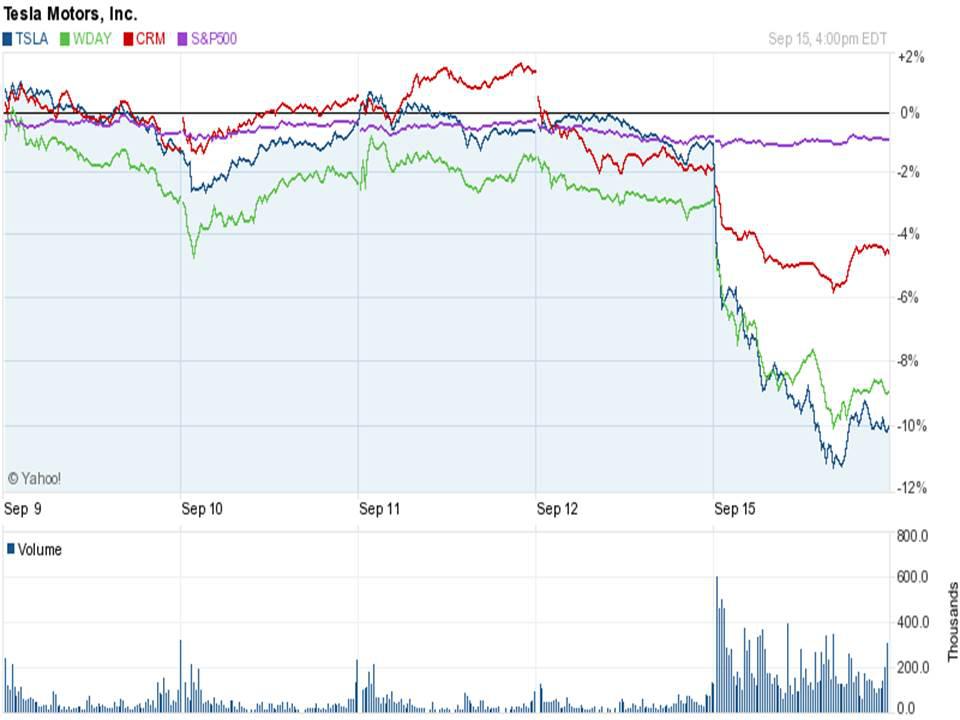
Higher beta sectors such as biotech saw even larger gains. Individual high momentum names like Workday (NYSE:WDAY), Tesla Motors (NASDAQ:TSLA) and Salesforce (NYSE:CRM) were pasted yesterday and have been very poor performers over the last week. Until this action reverses, I would be reluctant to put more money to work in this part of the market.

(click to enlarge)

The End of Quantitative Easing:

The ending of "QE1" and "QE2" both triggered double-digit declines in the overall market. Investors are rightly cautious in front of the end of "QE3" in October. This latest version of QE added more than $1 trillion in additional assets to the Fed's balance sheet, which now stands at over $4 trillion from under $1 trillion before the financial crisis.

Unfortunately, this huge infusion of liquidity by the Federal Reserve has not had all the benefits the board anticipating. The economy has grown at a two percent annual GDP level since the recession ended in June 2009. This is less than half the 4.4% annual GDP growth the nine previous post war recoveries averaged coming out of a recession. It also pales against the 5.3% annual GDP growth we got after the last deep recession (1980-82) ended.

This easy money era also has had some perverse impacts. Corporations have utilized low interest rates to raise money to buy back stock and avoid paying additional taxes from repatriating cash from overseas. Companies bought back some $340 billion of stock in the first half of 2014. This is the highest level since 2007 right before the market started to turn down.

Smart Money is getting out:

In addition to robust stock buyback activity, both M&A and IPO activity are near 2007 peak levels punctuated by Friday's massive public offering of Chinese E-commerce giant Alibaba (Pending:BABA). If the so-called "smart money" consisting of venture capitalists and company insiders are cashing out, should retail investors be getting more comfortable allocating more funds into the market at these levels?

Slowing Global Growth:

The European Central Bank recently had to announce significant liquidity measures which some have dubbed "QE Lite" in order to keep the Eurozone from tipping into recession again especially in light of increasing sanctions on Russia. Italy already has recently suffered two straight quarters of contraction - the common definition for a recession. Not surprisingly, the Euro has continued its recent decline against the dollar, which will hit the earnings of American multi-nationals that get a good portion of their earnings from Europe when they next report quarterly results.

The Shanghai posted its worst one-day decline in four months overnight as Foreign Direct Investment just hit a four-year low. Iron ore prices remain dismal as this commodity is near four-year lows as well pointing to tepid global demand. A real slowdown in China is a "black swan" that I feel is likely at some point in the foreseeable future but few pundits talk about on a consistent basis. I just don't trust a government that states economic growth is consistently within 1/10 of one percent of GDP projections quarter after quarter.

Summary:

I believe my cautious stance is warranted at the current time. I have a higher than normal allocation to cash within my portfolio at the moment. In addition, I have either exited or sold covered calls against most of my small cap positions. I will add reasonably valued blue chip stocks like Apple (NASDAQ:AAPL) or JPMorgan Chase (NYSE:JPM) on any significant dips in the overall market. Hopefully, by the end of the year it will be safe again to start moving back into some of the "risk on" sectors that seem primed for additional declines currently.

See the original article >>

Final Remarks Ahead of Scotland’s Referendum

by Pater Tenebrarum

Don’t Listen to the Scaremongers

Political elites around the world are scared of independence movements. Whether it is the allegedly sacrosanct territorial integrity of Ukraine or Iraq, the possible secession of Catalonia from Spain, of Sardinia from Italy, or the vote on Scottish independence: in all cases, visions of calamity are painted in vivid colors if the overarching nation states were to split into two or more parts.

These fears are understandable from the point of view of the ruling elites: the agents representing the force monopolist State always want to have as big a territory under their control as possible. It means more power for them and a larger tax base to exploit. However, the bigger the territory under the control of a single force monopolist, the less the individual counts, the more the State’s policies will tend toward a mixture of warfare and welfare, both of which as a rule prove disastrous for the average citizen.

Ask yourself why the most prosperous places on earth are all tiny political entities. There is a reason for that. No-one expects Liechtenstein to bomb ISIS in Iraq, or whoever the US enemy du jour is. Liechtenstein doesn’t even have a military. It doesn’t need one, because it is not busy making enemies left and right. Contrary to the larger European nations, it is also not up to its proverbial eyebrows in red tape and taxes. Incidentally, no Islamist extremists have yet thought of attacking Liechtenstein; most probably they don’t even know where it is, and if they did, they wouldn’t regard it as attack-worthy. After all, it has never meddled in the affairs of their homelands.

The UK on the other hand can be expected to waste both blood and treasure on every single war cooked up in Washington, no matter how cockamamie a scheme it is. Just remember the effort to free Iraq of Saddam’s mythical “WMD” and the associated fairy tale chemical rockets, which Mr. Blair asserted “could reach London in 45 minutes”. As long as Scotland is part of the UK, everyone in Scotland is involved in these schemes as well (at a minimum as a payer), whether they want to or not.

What about the alleged inability of Scotland to go it alone on economic grounds, or on grounds of being “too small”, or any of the other reasons that have been dragged up in recent weeks? These objections were already answered in this pages in great detail (see the list below this article), but let us just say that given that there exist much smaller independent countries possessing far fewer natural resources than Scotland and all of them are rich, simple common sense should tell one that such arguments cannot possibly hold water.

The one thing every eligible voter in Scotland needs to be aware of before making the decision is this: those who tell you that you aren’t up to it, that Scotland and its people won’t cut it, all have motives, interests and priorities of their own. Rest assured that the world will keep turning after Scotland gains independence.

We should also mention that what holds for Scotland is also true, if to a lesser extent, for the remainder of the UK – that fact that it will be somewhat smaller, is likely to be to the long term advantage of the average citizen.

camr-on

UK prime minister Cameron: He just doesn’t want to be the guy who “lost Scotland”

(Photo credit: dailystar.co.uk)

A Bastion of Socialism?

Some people have argued that the fact that Scottish voters have essentially switched their allegiance from one left-wing party, the SLP (the Scottish Labor Party, which is a local chapter of the UK-wide Labor Party) to another, namely the SNP (the Scottish National Party, which has a very social democratic-sounding platform), an independent Scotland will become a bastion of socialism.

It seems actually likely that the remainder of the UK will become a tad more conservative overall. However, we believe these fears about the Scottish desire for socialism are overblown. A major reason why many Scots have voted for the SNP seems to be their disdain of the Tories in Westminster and not necessarily their great love of socialism (obviously, we cannot possibly speak for all Scots here. It appears to us that this is a major motive for many though).

Moreover, here is another example of a fairly recent amicable parting of ways in a European country, namely the split of Czechoslovakia into the Czech Republic and Slovakia. As John Fund writes, this particular split had many parallels to the potential secession of Scotland from the UK. As it turns out, the results of this particular experience have been quite happy and represent a heartening and favorable indication for a future independent Scotland. An excerpt from Fund’s article:

“The two halves of the country had struggled for three years after the fall of Communism to stay together, but the Slovaks thought the state was too centered on the Czech capital of Prague, and the Czechs resented subsidies and over-representation of Slovaks in key bodies. The same complaints are echoed in Britain, where members of Scotland’s parliament may vote in the Westminster parliament on matters involving all of the U.K., but non-Scottish members of the U.K. parliament are unable to vote on the domestic legislation of the Scottish parliament. In addition, Scotland has more seats in the U.K. parliament than its population would normally be allocated.

There were strains and disputes in the Czech-Slovak divorce, especially over jointly owned gold reserves, but after a few years all was sorted out. Back then, Czechs viewed the Slovaks as more statist and slower to seize economic opportunities than they were. But today, both countries have shown remarkable improvement in the Heritage Foundation’s Index of Economic Freedom; and last year, Slovakia’s economy grew by 2.1 percent — three and a half times faster than it’s grown in the Czech Republic.

“We are doing very well,” Miroslav Lajcak, Slovakia’s deputy prime minister, told the BBC last year. “The Czech republic is doing well, and our friendship is better than ever,” he said.

Slovakia’s population of 5.4 million is almost precisely that of Scotland, and its success shows how small countries can do well on their own.

There was also one other tangible benefit of separation to Slovakia, though it’s one many don’t want to discuss. “After we became independent, people couldn’t blame every problem on Prague anymore or look to it for subsidies,” a former top minister in Slovakia’s government told me. “We had to drop some outmoded socialist thinking and scapegoating and stand on our own two feet.”

Even with its oil revenue, the same phenomenon could occur in Scotland, where the ruling Scottish National party has often pursued foolish economic policies. With independence, a new government might be more realistic. A recent white paper produced by the Scottish government proposes cuts in corporate tax rates to attract business as well as a more skill-based immigration system as new policies to set in place after independence.”

(emphasis added)

We can confirm that there was indeed a remarkable transformation in Slovakia after it gained independence. It is doing quite well with a population almost the same size of Scotland’s, even without any off-shore oil.

It is in any case unrealistic to expect that an SNP government or any other future Scottish government will be able to fund a kind of welfare nirvana from its oil-related tax revenues. It seems rather more likely to us that the points addressed in the white paper which Fund mentions above will come to the fore. Any government of an independent Scotland will have to think about ways to make the country attractive to entrepreneurs and investors. In fact, even its oil-related revenues will largely depend on whether it manages to institute policies that make it attractive to foreign investment. This should automatically lead to more economic freedom for everyone.

Counties

Urquhart Castle, Loch Ness.

(Photo via aldi-reisen.de / Author unknown)

Addendum – Famous Quotes About and by Scots

“We look to Scotland for all our ideas of civilization.”

  • Voltaire

“There are few more impressive sights in the world than a Scotsman on the make.”

  • James M. Barrie

For so long as one hundred men remain alive,

we shall never under any conditions submit to the

domination of the English. It is not for glory or riches

or honours that we fight, but only for liberty, which

no good man will consent to lose but with his life.

  • The Declaration of Arbroath, 1320

“The Baird Undersock is medicated, absorbent and soft, keeping feet warm in winter, cold in summer. Nine pence a pair, post free.”

  • John Logie Baird, electrical engineer and early television pioneer, advertising an early invention

“Tell your king that William Wallace will not be ruled. Lower your flags and march straight back to England, stopping at every home to beg forgiveness for a hundred years of theft, rape, and murder.”

  • William Wallace’s reply to a final plea of King Edward I to surrender shortly before the battle at Stirling Bridge in 1297, which Wallace’s numerically much inferior force won (using the old Spartan trick demonstrated at the Battle at Thermopylae: get a numerically superior enemy to fight you on terrain where numbers don’t count).

wallacesco-368349

William Wallace, who was involved in the early stages of the first war of independence.

For we have three great avantages;

The first is, we have the richt,

And for the richt ilk man should ficht,

The tother is, they are comin here…

To seek us in our awn land…

The third is that we for our livis

And for our childer and our wifis

And for the fredome of our land

Are strenyeit in battle for to stand

  • William Barbour, in his epic poem “The Bruce”

“The dawn of legibility in his handwriting has revealed his utter inability to spell.”

  • Attributed to Ian Hay, Scottish novelist and dramatist 1876-1952

“Blythe to meet,

Wae to part,

Blythe to meet aince mair”

  • This is known as the Bon-Accord toast – “Happy to meet, sorrowful to part, happy to meet once again.” “Bon-Accord” was the password used by the citizens of Aberdeen in 1308 when they rose up, killed the English garrison and captured the town for Robert the Bruce. Bon-Accord is now the motto of the City of Aberdeen.

map_of_scotland

In case anyone is wondering where exactly Aberdeen is, here’s a map. Note also the location of Hadrian’s Wall, which the Romans erected to keep the Picts and Celts out of their hair.

“I understand that perfectly. We feel very much the same in Scotland.”

  • Queen Elizabeth, the Queen Mother, speaking to a Boer in South Africa who told her that he could not forgive the British for having conquered his country. The Queen Mother, daughter of Lord Strathmore and Kinghorne, was born in 1900 and spent much of her childhood in Glamis Castle, Scotland.

“I would hate to die with a heart attack and have a good liver, kidneys and brains. When I die, I want everything to be knackered.”

  • Folksinger Hamish Imlach (1940-1996)

“I have always agreed with the old saying that the only difference between the sacrilegious and the sanctimonious is that the sacrilegious have a sense of humor”

  • Michael McMahon MSP, during the debate on the format of prayers at the start of each day’s session of the Scottish Parliament.

“I went to the butchers to buy a leg of lamb. ‘Is it Scotch?’ I asked. ‘Why?’ the butcher asked. ‘Are you going to talk to it or eat it?’ ‘In that case, have you got any wild duck?’ ‘No,’ he said, ‘but I’ve got one I could aggravate for you.’”

“My wife went to a beauty parlor and got a mud pack. For two days she looked nice, then the mud fell off. She’s a classy girl though, at least all her tattoos are spelled right.”

“This friend of mine had a terrible upbringing. When his mother lifted him up to feed him, his father rented the pram out. Then when they came into money later, his mother hired a woman to push the pram – and he’s been pushed for money since! I asked him once what his ambition was and he replied it was to have an ambition. In the end tragedy struck – as he lay on his death bed he confessed to three murders. Then he got better”

  • all three by Scottish comedian Chic Murray (1919-1985)

“It’s wee surprises like that which keep our marriage alive”

  • Rab C. Nesbitt, after his wife has clubbed him over the head for coming home drunk. This is a Scottish TV comedy – Rab C. Nesbitt is an unapologetic alcoholic, described by his wife as “not anunemployed person, but the original  unemployed person”

“I dinna ken muckle about the law,” answered Mrs Howden; “but I ken, when we had a king, and a chancellor, and parliament-men o’ our ain, we could aye peeble them wi’ stanes when they werena gude bairns – Bit naebody’s nails can reach the length o’ Lunnon.”

  • From “The Heart of Midlothian” by Sir Walter Scott, in 1818.

“Hard by, in the fields called the Leith Links, the citizens of Edinburgh divert themselves at a game called golf, in which they use a curious kind of bat, tipt with horn, and small elastic balls of leather, stuffed with feathers, rather less than tennis balls, but of a much harder consistence. This they strike with such force and dexterity from one hole to another, that they will fly to an incredible distance. Of this diversion the Scots are so fond, that when the weather will permit, you may see a multitude of all ranks, from the senator of justice to the lowest tradesman, mingled together in their shirts, and following the balls with the utmost eagerness.”

  • Tobias Smollet, writing in 1771.

“His worst is better than any other person’s best”.

  • William Hazlitt (1778-1830) the essayist praising the work of Sir Walter Scott

“We are often unable to tell people what they need to know because they want to know something else.”

  • Poet and novelist George MacDonald from Huntly (1824-1905)

“Whaur’s yer Wully Shakespeare noo?”

  • Shouted by an anonymous, over-enthusiastic Scot in the audience at the first performance of the play “Douglas” by John Home, in Edinburgh, December 1756.

“For me, independence is a simple choice between accepting the current state of play or aiming for something better.”

  • by Exclamation Mark of the PoP Campaign, a duo of music-makers in Glasgow

Note: the source of most of these quotes is the Rampant Scotland page, where you will find more quotes, as well as a lot of other information about Scotland.

103446-dunnottar-castle-near-stonehaven-in-aberdeenshire-in-warmer-times

Dunnottar Castle … yes, we have a thing for Scottish castles. So sue us.

(Photo via aberdeen.stv.tv / Author unknown)

Addendum 2: Even in Bavaria They Are Getting Their Hopes Up

NBC reports that yet another European – as of yet fringe – independence movement is looking with hope toward the Scottish referendum and the knock-on effect it might have. This one is based in Bavaria:

“It’s been more than 100 years since the Kingdom of Bavaria was a sovereign state – but the so-called “Bavaria Party” has long campaigned for independence to come once more to the region’s rolling hills. The fringe Bavaria Party has just over 5,000 members – in the southern state of 12.4 million people – and regularly campaigns with slogans such as “Bavaria can also succeed on its own,” but so far has failed to gain widespread support for its ideas. The party hopes all of that will change if Scotland gains independence – envisioning a domino effect – and is putting their voice out in front to support the referendum to their west.

“We hope that the vote will send a clear signal for Europe and that in the long run, Bavaria will become an independent member of the European Union,” party chairman Florian Weber told NBC News. The Scottish vote also has fueled hopes for independence in Italy’s Sardinia and Spain’s Catalonia.”

(emphasis added)

It is certainly no wonder that the centralizers/globalists and statists of all stripes are campaigning so heavily against Scottish independence. The inspiration a Yes vote could be to others is undeniable (there was incidentally also a giant pro-independence rally in Barcelona over the weekend).

And lastly, here is the official US government position (against Scottish independence, natch), plus one final reason to vote “Yes” on Thursday for those who are still undecided and need a bit more prodding:

palinsscotlandtweet

Taking a brief break from watching for invaders from Vladivostok, Sarah Palin opines on Scottish independence.

(Twitter screenshot)

List of Previous Articles on Scottish Independence and Secession Movements:

All you need to know about the philosophical and economic background re. Scotland’s possible secession, by Dr. Jim Walker of Asianomics:

Scottish Independence, Part 1 (It’s Not all About Pounds and Oil)

Scottish Independence, Part 2 (The Currency: Sterling or Not?

Scottish Independence, Part 3 (Fiscal Policy, The Real Difference and The Case Against)

PT on Scotland and Secession in General:

Scotland’s Independence Movement Gains Lead in Polls

Are Nation States Beginning to Splinter?

Secession – An Alternative View

Could the Spanish State Fall Apart ?

Scottish-freedom

Guess what his vote will be …

(Photo via ricksteves.com / Author unknown)

See the original article >>

Follow Us