Wednesday, September 10, 2014

Ferrari chairman to resign

By Manuela Mesco

Departure effective next month

Reuters

Ferrari chairman Luca Cordero di Montezemolo

MILAN — Fiat SpA said Ferrari chairman Luca Cordero di Montezemolo will resign, only days after Chief Executive Sergio Marchionne said the luxury car brand’s Formula One race results were unacceptable.

Marchionne will take over from Montezemolo, whose departure is effective from Oct. 13.

Speaking at a business meeting in Italy last weekend, Marchionne praised Montezemolo for having achieved excellent business results but said he was “sad” that Ferrari hasn’t won any titles since 2008. He that nobody occupying positions of power at the company was indispensable.

“Luca and I have discussed the future of Ferrari at length,” said Marchionne in a statement on Wednesday, “and our mutual desire to see Ferrari achieve its true potential on the track has led to misunderstandings which became clearly visible over the last weekend.”

Montezemolo said in a separate statement that Ferrari will play an important role in the listing of Fiat F, +2.08%   Chrysler Automobiles Group in Wall Street and this new phase “should be spearheaded by the CEO of the group,” said Montezemolo.

See the original article >>

World Growth vs. Copper

by Mike "Mish" Shedlock

Copper is frequently cited as a leading indicator of economic activity because if its widespread use in many sectors of the economy, from homes and factories, to electronics and power generation and transmission.
For that reason, some call it "Dr. Copper".
Inquiring minds may be wondering what copper has to say about future economic growth. The following charts will explain.
World Growth vs. Copper

Copper Daily Chart

The above charts courtesy of Steen Jakobsen, chief economist at Saxo Bank.
Iron Ore Down 38% this Year
China is slowing and its property bubble is under severe pressure. But it's not just copper that is under pressure.
Iron has taken a big hit, and iron producers are under severe stress.
Reuters reports Iron Ore Price Plunge Claims First Australian Casualty.

Plunging iron ore prices have dealt their first blow in Australia, sending fledgling miner Western Desert Resources Ltd into administration after it failed to reach a deal with bankers over its debt.
Western Desert was caught out by a move by the world's top four iron ore producers to flood the market with low-cost supply, outpacing Chinese demand growth for the steel-making ingredient and slashing iron ore prices by 38 percent this year.
UBS estimated that even at present iron ore prices, smaller producers Atlas Iron Ltd, Gindalbie Metals Ltd and Grange Resources are all under water.
Iron ore, which is priced in U.S. dollars, has sunk to a five-year low of $83.60. Australian miners have felt the impact even more as the Australian dollar has risen 5 percent against the U.S. dollar in that time.
China imported 8.5 percent more iron ore in August than a year earlier, but imports for the year are expected to grow by only 49 million tonnes, well below the volume of extra supply, according to Australia's official forecaster.

Expect China to Surprise on the Downside
Iron is under pressure even with rising demand from China. What happens if future demand disappoints?
I have been stating for quite some time that China is on the verge of a major slowdown and base metals would be affected, and so would the currencies of major commodity exporters like Australia and Canada.
China cannot and will not grow at 7% a year as most expect. The consequences of that have yet to be felt.
US Will Not Decouple
Finally, those who think the US will decouple from this global mess are just as wrong as those who thought China would decouple from the global economy in 2008.

See the original article >>

The Most Significant Apple Development No One Is Talking About

by Lou Basenese

Summary

  • With the most anticipated Apple event in history about to kick off, a specific feature, not a product, promises to be the most significant development.
  • Rumors, backed by credible evidence in the form of a patent application suggest Apple's iWatch will offer wireless charging capabilities.
  • Apple is uniquely positioned to bring about the tipping point for consumer awareness and in turn, mass adoption.
  • Energous is the only pure play stock. It's novel RF approach makes it the potentially biggest winner of a wireless charging boom, sparked by Apple.

Forget about the long awaited launch of the iPhone 6. We could be at the doorstep of a much more significant development when Apple (NASDAQ:AAPL) unveils its latest round of products at today's big event.

You see, analysts also expect the company to unwrap its first wearable device, the iWatch. And wearables represent an up-and-coming industry in desperate need of a breakout product.

Despite attracting $1.4 billion in venture capital funding - and lofty expectations for device shipments stretching into the hundreds of millions by 2018 - a mere 1 million smartwatches sold in the second quarter, according to Strategy Analytics.

That compares to 295 million smartphones during the same period. (Can you say, pathetic?).

Market-leader Samsung (OTC:SSNLF) has already launched five smartwatch models. And yet, every last one of them has been a dud.

No wonder industry insiders are publicly "hoping that Apple can crack the missing [sales] code," as Reuters reports.

Whether Apple can officially jump-start the wearables market remains to be seen. We'll save that discussion for another day.

What I'm most interested in today is one of the rumored features of the iWatch. It promises to be the most disruptive of all developments. For the entire mobile market, not just wearables.

Don't Taser Tether Me, Bro!

One of the most annoying things about mobile devices is the requirement to be tethered to a cord every couple of hours to recharge. This becomes an extreme pain point for wearables.

Charging.Habits

Source:IHS

I mean, who wants to have a watch that requires removal every couple hours?

It's no surprise then, Apple's spent years trying to figure out a way to cleverly charge a wearable device.

A patent filed in September 2009 (# 8193781) reveals the company experimented with a kinetic approach, whereby the motion of a person's arm swinging would power a tiny charging station within the device.

Reliable sources confirmed to The New York Times that Apple's also been experimenting with a solar-charging approach, by adding a photovoltaic layer to the screen.

In the end, it appears the company opted for a wireless charging method. And that, my friends, is the development everyone should be talking about.

A Cable-Free Future is Upon Us

Right before the closing bell on September 4, rumors started circulating that Apple's iWatch will include an inductive wireless charging solution.

Strong evidence exists to support the claims, too. Specifically, patent application # 20140241555, which was filed in early 2013 and just published on August 28.

In it, Apple describes coiled inductor wires with dual purposes. The NFC antenna, for instance, which is going to enable Apple's foray into mobile payments, could also be used for wireless charging, as needed.

Wireless charging has been gaining more and more attention because of the obvious need for it.

While mobile devices keep getting more and more powerful, advancements in battery technology have not been able to keep up.

"The gap is becoming larger and larger, so by 2020 the gap will be exponentially larger than it is today," according to Rahul Mangharam, an electrical engineering professor at the University of Pennsylvania.

That means much more frequent tethering to a power cord is coming. Or is it?

In recent months, Intel (NASDAQ:INTC) and Starbucks (NASDAQ:SBUX) made big announcements involving wireless charging initiatives.

On June 11, Intel teamed up with privately held, Witricity, to incorporate wireless charging capabilities into chip designs. Intel's goal is to have a completely wire-free laptop by 2016.

The very same day, Starbucks announced a national rollout of Duracell's Powermat wireless charging stations.

Both initiatives represent important steps towards a cable-free future. But Apple's the one company that can initiate a quantum leap forward.

We can all agree, Apple's in rarefied air when it comes to captivating and influencing consumers. Therefore, Apple's adoption of a wireless charging solution holds the potential to unlock pent up demand that consumers didn't even know existed. In a way Starbucks and Intel simply can't.

Confused? Let me explain…

A recent study by HIS found that two-thirds of consumers don't even have a clue that wireless charging capabilities exists.

However, once informed, a staggering 83% said they would be interested in wireless charging. They'd be willing to pay for the capabilities, too.

Bottom line: Apple's inclusion of a wireless charging solution in the iWatch promises to be the tipping point for consumer awareness and in turn, mass adoption.

Not just in the wearables market, but also in all manner of battery-powered devices. Think Nest Thermostats, GoPro (NASDAQ:GPRO) cameras, keyboards, tablets, LED lighting, video game controllers, medical devices, home security systems and sensors. The list goes on.

Later today, we'll hopefully find out which of the currently available wireless charging standards Apple's going to use.

Regardless of the choice, I'm convinced the biggest, long-term beneficiary of the development promises to be Energous Corp. (NASDAQ:WATT). I'll share more specifics why shortly. It relates to the company's novel approach (radio frequency instead of inductive). So stay tuned.

See the original article >>

U.S. QE Tapering while China Money Constrained

By Economy Watch

Globally equities have fallen amidst fears that European quantitative easing will not be enough to counteract rising interest rates for U.S. Treasuries and falling money supply growth in China.
In early morning trading, the U.S. S&P 500 fell sharply below 2,000 amidst fears that the Federal Reserve may raise interest rates sooner than expected. The Federal Reserve Bank of San Francisco yesterday released a report that said policy makers could increase benchmark interest rates sooner than expected, as quickening inflation rate and a declining unemployment rate encouraged a more hawkish monetary regime.
“An important concern is that the public might not give enough weight to how dependent the central bank’s guidance is on both current and incoming data. Thus, the public could underestimate the conditionality and uncertainty of interest rate projections,” the Federal Reserve report said.
The writers also noted that policy makers themselves were uncertain of future policy decisions: “The public also may be less uncertain about these forecasts than policymakers.”
China Money Constrained
China money supply growth unexpectedly slowed, falling to a five-month low. The Chinese government’s broadest measure of money supply, known as M2, rose 12.8% in August year over year, lower than the 13.5% growth rate in July and below most analysts’ expectations.
Analysts have expected easing monetary conditions to help China growth rates from falling at an accelerating rate, but China’s Premier Li Keqiang surprised experts by a surprisingly hawkish comment at a speech for the World Economic Forum. “There’s already a lot of money in the pool, and we can’t rely on monetary stimulus to spur economic growth,” said Li, adding that China’s monetary policy will remain “prudent”.
The decline in money supply growth indicates continued weakening demand in the Chinese economy as it attempts to shift from an export-driven to domestic demand focused economy. Analysts expect total financing by the Chinese central bank to have rebounded in August, although still below levels seen in August for the past three years.
The decline in financing and the tightening money supply suggest that China may reaching its limit of stimulating domestic demand for goods and services by loosening credit. While China is still seeing high inflation and overall domestic growth, some analysts believe that a slowdown in China could have a strong impact on European and American markets. The EU is China’s biggest trading partner.
U.S. Volatility
After reaching the psychologically significant 2,000 mark in trading, the S&P 500 has remained at that level in recent weeks, but traders’ expectation of volatility has risen in recent days as global deflationary pressures and a slowdown in China may stunt growth for companies in the coming weeks and cause equities’ bull run to reverse.
The Chicago Board Options Exchange Volatility Index, or VIX, rose 2.7% in early morning trading on Tuesday, rising over 13. The VIX, which measures volatility in the S&P 500, has been at historic lows throughout 2014 after remaining very low in 2013, signaling little fear amongst investors of a large crash in U.S. stock prices.
Some analysts have said that the tapering of the Federal Reserve’s bond purchasing program known as Quantitative Easing could cause equities to fall quickly. In previous years, the S&P 500 fell either shortly before or shortly after previous rounds of QE stimulus ended.

See the original article >>

Banks, credit-card companies see Apple Pay as boon for customers

By SitalS. Patel

NEW YORK (MarketWatch) -- All it takes is one touch to pay.

Apple Inc. AAPL, -0.38%  has introduced a new, easier way for customers to make purchases by simply swiping their phones, called Apple Pay.

“Consumers love the tap and pay experience,” said Ed McLaughlin, chief emerging payments officer at MasterCard. “It’s the fastest way to check out and once consumers use this they never go back.” Paying your cab fare, eating McDonald’s and ordering from OpenTable just got easier, he said. “You are always holding your phone, but might not know where your wallet is.”

Apple claims using Apple Pay to shop in stores and online is more secure and private than handing over your credit or debit card, because cashiers won’t see your name, credit card number or security code. Instead, the system assigns and stores unique account numbers on your device for each card, then generates one-time codes to process payments. Shopping on iPhone apps with Apple Pay will also be a lot easier, since payment can be done with a single tap.

Apple says the new payment system will work with top bank issuers that handle 83% of credit card volume, including MasterCard Inc. MA, -0.21% Visa Inc. V, -0.69%   and American Express Co. AXP, -1.16%  cards issued by Bank of America Corp. BAC, -1.28%  , Citigroup Inc. C, -1.52%  , Wells Fargo & Co. WFC, -0.78%   and J.P. Morgan Chase & Co. JPM, -1.39%

JPM, -1.39% Mobile payments are seeing rapid growth outside the U.S., says McLaughlin -- more than 20% of MasterCard transactions in Canada are touch-to-pay -- and Apple Pay may go a long way toward increasing touch-to-pay transactions in the U.S.

J.P. Morgan Chase & Co. is “very excited” about the new payment system, said the bank’s CFO Marianne Lake on Tuesday at a financial conference in New York. Lake endorsed Apple Pay by saying it is “significantly supreme” and safe. J.P. Morgan hopes to unveil its own mobile wallet in the coming months.

Apple Pay is expected to be available to use in October in the U.S. with more than 220,000 stores, including Target Corp. TGT, +0.53% Macy’s Inc. M, -0.35% Bloomingdale’s, Walgreen Co. WAG, -0.56%  and Nike Inc. NKE, -0.68% Apple says it won’t store users’ purchasing history and if the iPhone gets lost or stolen, payments can be suspended from the device.

“We’re providing our customers with tools to make their financial lives better, including our 30 million digital banking customers,” said Brian Moynihan, CEO of Bank of America, in a news release about Apple Pay. “For them, better means simple and convenient.”

See the original article >>

Apple Watch: Disruptive, Profitable, And Yes, The Next Big Thing

by Alex Cho

Summary

  • Apple Watch comes with new technology and is set to be launched in early 2015.
  • Apple Watch will come in three different variations and has a unique user interface.
  • I estimate that Apple Watch will contribute $6.91 billion in net income in FY 2015.

The Apple (NASDAQ:AAPL) Watch took the spotlight at the September 9th event. While other products like the iPhone 6 and 6 Plus offered immense insight into supply chain mechanics, the real show stopper was the disruptive innovation that Apple was able to demonstrate in its new product, the Apple Watch.

Technologically, aesthetically, the Apple Watch is a marvel. But more importantly, I have high conviction that Apple's upcoming device will add meaningful contribution to bottom and top line results.

Here's what we know about the Apple Watch

The watch will come in three different formats - the Apple Watch, Apple Watch Sport Edition, and Apple Watch Edition. The three different watches will be differentiated by materials and wrist straps. The Apple Watch Edition is made of 18k gold, whereas the Apple Watch is made of stainless steel.

The device uses a digital crown, basically a rolling knob, which allows you to zoom in and out of applications, and scroll through stuff. It's the mouse wheel for the Apple Watch, and it works in combination with both touch and voice commands. The Apple watch OS also comes with advanced software to simplify the process of communicating and even includes Siri.

Apple Watch is different from the Galaxy Watch as it's not a shrunken-down version of the smartphone. Instead, it completes the smartphone in ways that the device by itself cannot.

The entry-level iWatch, i.e. the Apple Watch is priced at $350. The device comes with new features, such as a new health and fitness application that will track physical activity. Furthermore the Apple Watch will come in two size form factors, 38mm (height), and 42 mm (height).

(click to enlarge)

Source: Apple

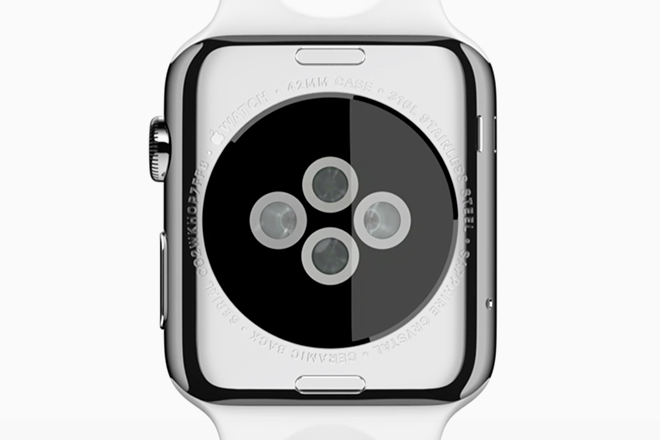
The Apple Watch comes with an accelerometer, gyroscopes, sensors to check heart pules, GPS and Wi-Fi. To use the device, you would need to have an iPhone 5 or above. This gives the iWatch an installed base of 200 million users to work with. Furthermore, the device is set to be launched sometime in early 2015.

The launch will come sometime after the holiday shopping season, which isn't exactly a good thing, but it does give consumers enough time to save money after spending so much during the Christmas holidays. My suspicion is that the sapphire display is what's delaying the shipment of the smartwatch.

The Apple Watch will have NFC capabilities, allowing legacy Apple iPhone 5 and 5S owners to get their hands on Apple's new payment application.

How much will the Apple Watch add to the bottom line?

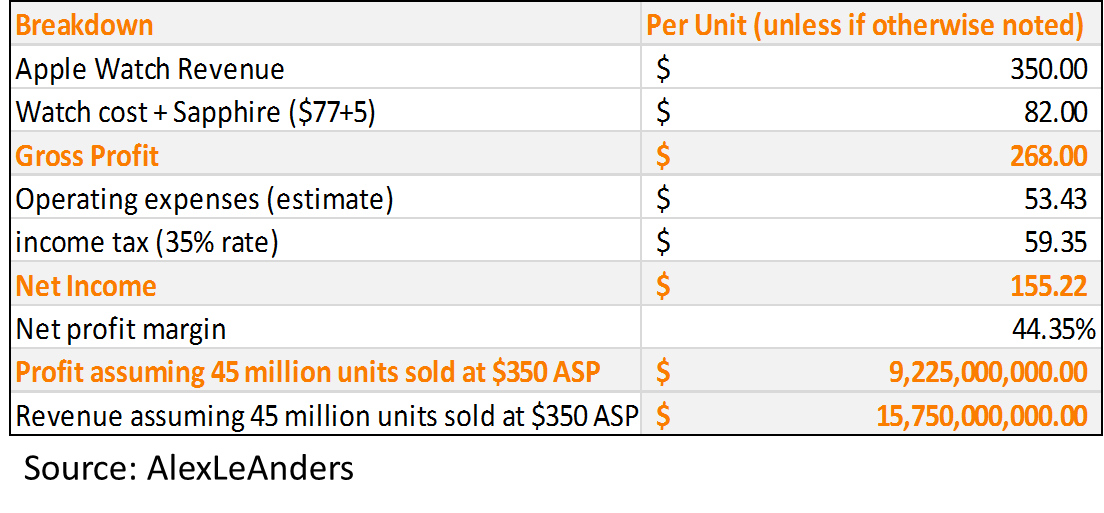
Based on pricing, the device will start at $350, and will increase from there. The Apple Watch Edition (the one made with 18k gold) will be priced significantly higher, for a very limited market. However, I'm going to work with a $350 figure, just to stay a little conservative, and to stay consistent with the mass market product the Apple Watch is meant to be.

Furthermore, I think that shipment figures will come in at the mid-point of the shipment figures that Apple anticipates (50 million) and what I estimate (42 million). However, for the sake of simplicity I'm going to go with 45 million, between 50 million and 40 million units.

(click to enlarge)

The Apple Watch base cost is $77. However, when including the cost of sapphire, it should cost $82. The base cost came from the Taiwan Topology Institute, whereas the cost of sapphire came from Charles Margolis.

After breaking the figures down, I think the device is an extremely high margin device, as it will leverage the pre-existing R&D and OPEX costs from other business segments. Furthermore, I estimate that after a full-year the new category may contribute $9.225 billion to bottom line, and $15.75 billion to top line results. The added impact from Apple Watch will help Apple beat analyst estimates in its next fiscal year.

Assuming the device is sold in the beginning of 2015, the device will only contribute to sales for 3 out of 4 fiscal quarters. Therefore, I think the device contributes $6.91 billion in net income and $11.81 billion in revenue in fiscal year 2015. I'm highly confident that consumers will line-up for the Apple Watch product launch, and demand will be robust in the early innings of the product adoption cycle. Furthermore, because the device connects directly to the iPhone, the device won't need a separate wireless internet subscription, which diminishes the barrier of entry.

Conclusion

Investors should feel more confident than ever with Apple's product line-up. Beyond the favorable impact a new wearable should have, iPhone shipment growth paired with better margins will drive bottom and top line results. Assuming consumers refresh their iPhone and iPad, and purchase a smartwatch, Apple will report a fairly strong fiscal year. Not to mention, the median income of the average iPhone owner is $85,000, according to comScore Mobile Metrix, therefore, there's further room in a typical Apple owner's budget to afford additional devices, and make upgrades from older devices.

See the original article >>

Follow Us