Thursday, September 4, 2014

European Banks – Still Full of Holes?

by Pater Tenebrarum

Comprehensive Assessment Paranoia

The ECB is currently busy stress-testing all “systemically relevant” banks in the euro area, the supervision of which it is going to take over as part of the banking union plan later this year. This stress test has given birth to new acronyms, such as “AQR” (asset quality review) and “CA” (comprehensive assessment). Banks that are found to be short of sufficient tier 1 capital will have to submit a credible  recapitalization plan very quickly after the CA has been concluded, and thereafter will have several months to implement it.

As a result of the massive carry trade in government bonds of the periphery initiated by the LTROs and Draghi's OMT promise (as we have previously mentioned, the timing and sequence of events suggests that there were sub-rosa agreements between governments, the ECB and large commercial banks, with the caveat that this is impossible to prove), a number of bank balance sheets in countries like Spain and Italy probably look significantly improved  simply due to their vast accumulation of zero risk-weighted government debt. Moreover, the ECB's war on savers has clearly served as a redistributive device in favor of banks.

Nevertheless, the recent downfall of the Espirito Santo empire including the bank (Banco Espirito Santo) of the same name in Portugal, was a reminder that there may still be skeletons in a number of closets (an interesting backgrounder on the Espirito Santo affair can be found here by the way). A recent report in the NYT's dealbook suggests that there is a growing consensus that the ECB's stress test will discover many a bank balance sheet falling significantly short.  The Texas ratio has emerged as the analytical tool of choice for guessing which banks will be found wanting:

“As Europe slogs through its latest round of bank stress tests, a growing number of analysts have already reached their own conclusion: Eurozone banks need additional cash.

To buttress their case, some analysts have dusted off an obscure American bank metric that highlights the extent to which Europe’s increasing number of nonperforming loans is threatening to overwhelm existing bank cushions.

The measure, called the Texas ratio, was developed by an analyst who covered troubled United States banks during the late 1980s and early 1990s. During that period, numerous Texas-based financial institutions collapsed under the weight of faulty real estate loans.

Part of what has made the Texas ratio attractive to analysts and regulators is its simplicity. When the ratio of bad loans to equity and cash set aside exceeds 100 percent, it suggests that the bank is either ready to fail or is in desperate need of new capital — as was the case with Texas banks in the 1980s.

“We found it to be a very good guide telling you which banks would fail,” said Gerard S. Cassidy, the bank analyst who introduced the formula and coined the name. “It’s a ratio that everyone can understand.”

Now as the European Central Bank prepares to become the primary bank regulator in the eurozone, the extent to which lenders in troubled economies like Spain, Italy, Portugal and Greece have sufficient cash to protect against ever-rising bad loans has emerged as a crucial question for investors, banks and regulators.

The E.C.B. will publish the results of its half-year investigation into Europe’s 128 largest banks on Oct. 17. But until then, with worries mounting that the central bank will come down hard on banks with particularly weak loan books, investors and analysts have been scrambling to determine which of these lenders are most at peril.

And with European banks sharing similar characteristics with Texas banks in the late 1980s — nonperforming real estate loans and slim cash buffers — the Texas ratio has emerged as a popular analytical tool. This spring, banking analysts for Nomura in London used the Texas ratio to highlight 11 banks in Southern Europe that were most exposed to nonperforming loans relative to cash they had on hand.

Of the 11 banks that exceeded the 100 percent threshold, three banks stood out with ratios of 150 percent and above: Piraeus Bank in Greece, Banco Popolare in Italy and Banco Popular Español in Spain.

(emphasis added)

As the report notes, even the “good” large banks in Europe sport Texas ratios far above those of their US counterparts.

CHART-1-Euro-Stoxx-Banks

Euro-Stoxx bank index, daily. A possible rounded top? - click to enlarge.

One interesting remark was this one, which indicates that the very biggest banks domiciled in Germany and France are far less robust than is generally believed:

“And last year, economists at the Danish Institute for International Studies came out with a report highlighting how low cash buffers were in European banks, especially in France and Germany.”

If a Danish institute says so, it must be true, as it is well known that Danes don't lie (see “Dänen lügen nicht” for details on this).

Meanwhile, in some of the euro area countries that have been struck by severe economic crises, bad loans have kept growing. The situation is nowhere worse than in Greece, where an estimated 34% of the aggregate loan book is said to be in default – which is up from an estimate of 28% made only in March. The total amount is reportedly between €75 to €77 billion, which is quite a big chunk of money for a country the size of Greece.

Expectations are currently that the ECB will demand capital increases of between €5 to €8 billion from Greece's banks. We're not sure how the math on this works, as it seems not very likely that the write-offs and loan loss reserves accumulated to date actually suffice to cover all these bad loans even remotely. Note here that assuming that it is true that NPLs have grown from 28% to 34% of the total loan book, they must have increased by more than $13.6 billion since March alone.

Plunging Government Bond Yields

Given a further slowdown in euro area CPI to 0.3% annualized recently, and a plunge in 5 year forward inflation breakevens to below 2% (see Draghi's Jackson Hole speech, which seemed to hint at “QE soon” because of this), government bond yields have continued to plunge. In Germany, short term yields up to 2 years have turned negative.  This is partly due to technical reasons (need for repo collateral), but there may also be other considerations in play. If one leaves these technical requirements aside, why would anyone pay the German government for the privilege of lending it money? This only makes sense if one fears for the safety of bank deposits. Note that the upcoming implementation of bail-in rules on a Europe-wide basis means that large depositors will no longer be as safe as they once were. The danger of getting the Cyprus treatment will become very real.

CHART-2-Germany, 2yr-yield,-0.0439

Germany's 2 year government note yield falls below zero,  to -0.0438% - click to enlarge.

Of course, euro area economic data continue to be quite weak as well, and are suggesting that the largest economies are either already in recession or are on the brink of one.

Although CPI “inflation” is actually higher in Germany than elsewhere in the euro area, its 10 year bond is beginning to resemble the JGB – it sports only a tiny 0.8837% yield at the moment.

CHART-3-Germany-10-yr-yield-8837

Germany's 10-yr. Bund is yielding a mere 0.8837% these days – click to enlarge.

Note here that contrary to the JGB market, the German bond market is actually still functioning. In the JGB market there is only a single big buyer armed with an electronic printing press, namely the BoJ, and no-one dares to stand in its way (not yet, anyway). On some days there is no trading volume at all anymore, so the JGB market has essentially expired for now.

Meanwhile, the y/y growth rate in euro area money supply has experienced a slight upward bump last month, but the larger downtrend still appears to be  intact. This could change once the TLTROs are offered in September and December – we will have to wait and see about that. In any case, the lack of private sector credit demand means there is still no pickup in inflationary lending by commercial banks, even with short term rates at nominal record lows. To the extent that euro area governments adhere to the new fiscal compact, the rate of new lending to governments should also slow down.

Depending on how much capital impairment the ECB's review brings to light, yet another disincentive for bank credit extension could be in the pipeline.

CHART-4-Euro Area TMS

Euro area true money supply (currency & overnight deposits) and its annual growth rate – click to enlarge.

Conclusion:

Europe seems to be close to another recession, just as the ECB's bank review is drawing to a close. European banks overall should be in somewhat better shape at present than they were two or three years ago, but many are probably still capital-challenged. If another broad-based economic downturn does hit, troubles that were held to have been overcome are likely to quickly resurface.

See the original article >>

Dinner with a Rothschild …

by Bill Bonner

It Wasn't Always Easy …

“What’s the secret?”  We had decided to put the question directly. Why not? How often do you have dinner with a Rothschild, much less dozens of them?

Today, one of Bordeaux’s most notable winemakers goes to her grave. Philippine de Rothschild was already stone cold when we arrived in town on Saturday; she died last week at 80. Today, she will be buried.

But we came not to bury a Rothschild, but to praise one. That is to say we came not for an unhappy occasion, but for a happy one: the marriage of one of Philippine’s cousins.

“She was so loved and respected in the wine industry here in Bordeaux,” a relative reported, “that the other winegrowers, merchants, and even the field hands lined the road and took off their hats when they brought her body back from Paris.”

Philippine told the French leftist newspaper Libération that, despite the family name and the family fortune, she had not always had an easy time of it. During World War II, being a Rothschild in France was hazardous. Philippine’s mother was sent to a concentration camp near Berlin, where she was murdered in 1945.

Philippine used her mother’s maiden name, escaped the deportations and, after the war, she went onstage in Paris as Philippine Pascal. Then in 1988, her father died. And she came back to Bordeaux to run the famous Château Mouton Rothschild wine estate.

James_Mayer_de_Rothschild_by_Southworth__Hawes-231x300

James Meyer de Rothchild

The Rothschild Secret

At the dinner following the wedding we raised a glass in her honor; after all, she had given the wine for the occasion.  Seated to the left of a charming ambassador and to the right of a lively, elegant lawyer (who had married into the Rothschild clan), we happily passed a few hours in light conversation.

Between courses came the inevitable question: How had the Rothschilds been so successful for such a long time?

“They married well,” was one reply. “First, they married each other. I guess the Jewish community was small at the time. And families were very tight. Cousins married each other. That way, they kept the brains and the money in the family. But even later, they were careful about whom they let into the group.”

“They stuck with good industries,” was another hypothesis. “The British branch of the family stayed in finance. That was always a good business in London. And it got better as London became the center of international capital.

“Whenever the Russians, or the Arabs, or the Austrians, or the French, for that matter, ran into trouble in their own countries they went to London. They’re still doing it. That’s why there are so many Russians and so many French people there now. But don’t get me started on the French…”

We will not get started on the French either. But we will pause to briefly note that, as an economist, Paul Krugman might make a good dentist. Then he could expound his ideas to an open mouth without causing further damage.

alien_invasion

Paul Krugman, still waiting for an alien invasion to rescue the economy …

The Fall of France

Instead, he wrote a remarkable column in the New York Times last Thursday. This time he outdid himself. His “The Fall of France” op-ed piece was exceptionally dumb.  After berating French president François Hollande for failing to embrace US-style money printing, he noted that the French economy was doing pretty well.

“Prime-aged adults are a lot more likely to be employed in France than in the United States,” he wrote. France “doesn’t have a trade deficit, and it can borrow at historically low interest rates.”

Krugman believes Hollande and his “austerity” policies are “failing France” and also “failing Europe as a whole.”  Why?

Here Krugman’s delusions stumble over each other. First, France is not practicing austerity. Government spending is already 57.1% of GDP – five percentage points higher than it was 10 years ago. And its deficit is well above the 3% of GDP level allowed by the European Union. And it’s growing infinitely faster than France’s zero-growth economy.

france-government-spending

Incredible! How can France possibly cope with such intense government austerity? – click to enlarge.

Second, you do not get genuine prosperity by spending money you don’t have on things you don’t need. Whether you borrow the money… or digitize it into existence… the result is the same: You get poorer, not richer.

If you could get rich by living beyond your means… and then creating money out of nothing to pay your bills… Zimbabwe would be the richest nation in the world. Instead, it is destitute.

france-government-spending-to-gdp

Krugman just loves French government spending. If only they could do more of it! - click to enlarge.

An Absurd Idea

Krugman fears France will fall into a Japan-like slump because Europe is practicing too much “austerity.”  But neither fiscal nor monetary stimulus will rescue a debt-drenched economy. For all its 30 years of high deficits, Japan has gotten nothing but more debt – it now has a debt-to-GDP ratio of close to 240%.

Finally, Krugman believes prosperity is the key to peace. Europeans aim to “secure peace and democracy through shared prosperity,” he writes.

This idea is absurd when applied to democracy. Democracy was allegedly secured by the ancient Greeks more than 2,000 years ago and again by the American colonists in 1776. Prosperity had nothing to do with it; compared to today’s Europeans, both were appallingly poor.

Likewise, there is no known link between prosperity and peace. The last century was one long, sad story of the world’s richest peoples trying to exterminate each other with thorough planning and sophisticated, expensive weaponry.

At the start of World War II, Philippine’s father left to join de Gaulle’s Free French in London. Many other Jews fled to the US.  Philippine’s mother – a Roman Catholic – believed the Bordeaux officials would protect her and spare her from the Nazi death camps. She was wrong. She was deported to Ravensbrück.

Her cousin was wrong, too. As the Nazis began laying hands on Jews in the occupied zone in France, the young woman fled, accompanied by a young Frenchman who protected her.  He took her to a remote farm, where she would be safe. He left with these words: “After the war is over, I’ll come back and marry you.”

Which he did. We were invited to their grandson’s wedding.

Omnes. Gentes. Alleluia.

423361576_keynesians_fail

Always at the ready with useful policy advice!

See the original article >>

Are US Consumers Evil Hoarders?

by Pater Tenebrarum

Another Keynesian Meme Dragged Up

A recent Fed paper reports that the Fed's wild money printing orgy has failed to produce much CPI inflation because “consumers are hoarding money”. It is said that this explains why so-called “money velocity” is low.

The whole argument revolves around the Fisherian “equation of exchange”, as you can see here. Now, it may be true that the society-wide demand for money (i.e., for holding cash balances) has increased. Rising demand for money can indeed cancel some of the effects of an increasing money supply. However, it should be obvious that there is 1. no way of “measuring” the demand for money and 2. the “equation of exchange” is a useless tautology.

Consider for instance this part of the argument:

“Though American consumers might dispute the notion that inflation has been low, the indicators the Fed follows show it to be running well below the target rate of 2 percent that would have to come before interest rates would get pushed higher.

That has happened despite nearly six years of a zero interest rate policy and as the Fed has pushed its balance sheet to nearly $4.5 trillion.

Much of that liquidity, however, has sat fallow. Banks have put away close to $2.8 trillion in reserves, and households are sitting on $2.15 trillion in savings-about a 50 percent increase over the past five years.”

First of all, banks have not “put away” $2.8 trillion in reserves; in reality, they have no control whatsoever over the level of excess reserves. They are solely a function of quantitative easing: when the Fed buys securities with money from thin air, bank reserves are invariably created as a side effect. Credit can be pyramided atop them, or for they can be used for interbank lending of reserves, or they can be paid out as cash currency when customers withdraw money from their accounts. That's basically it.

Now imagine that a consumer who holds $1,000 in a savings account spends this money. Would it disappear? No, it would most likely simply end up in someone else's account. So the aggregate amount of money held in accounts is per se definitely not indicative of the demand for money either – it wouldn't change even if people were spending like crazy. Someone would always end up holding the money. Money, in short, is not really “circulating” – it is always held by someone.

This also shows why so-called velocity is not really telling us anything: all we see when looking at a chart of money velocity is that the rate of money printing has exceeded the rate of GDP growth (given that money printing harms the economy, this should not be overly surprising).

In Fisher's “equation of exchange”, V is simply a fudge factor. As Rothbard noted with regard to the equation, it suffers from a significant flaw:

Things, whether pieces of money or pieces of sugar or pieces of anything else, can never act; they cannot set prices or supply and demand schedules. All this can be done only by human action: only individual actors can decide whether or not to buy; only their value scales determine prices.

It is this profound mistake that lies at the root of the fallacies of the Fisher equation of exchange: human action is abstracted out of the picture, and things are assumed to be in control of economic life. Thus, either the equation of exchange is a trivial truism— in which case, it is no better than a million other such truistic equations, and has no place in science, which rests on simplicity and economy of methods—or else it is supposed to convey some important truths about economics and the determination of prices.

In that case, it makes the profound error of substituting for correct logical analysis of causes based on human action, misleading assumptions based on action by things. At best, the Fisher equation is superfluous and trivial; at worst, it is wrong and misleading, although Fisher himself believed that it conveyed important causal truths.”

V

“Velocity” of M2 – click to enlarge.

It is of course true that prices in the economy adjust to the supply of and the demand for money. However, low consumer price inflation by itself does also not really mean that one can infer that the demand for money must be exceptionally high.

What if e.g. the supply of goods increases at a strong rate? Then we would ceteris paribus have to expect the prices of goods to decline – if they instead remain “stable”, it is actually indicative of inflationary effects making themselves felt.

Moreover, prices never rise or fall at uniform rates. In today's economy, some prices rise at astonishing rates of change, such as for instance securities prices. These are not part of the consumer price index, but they are nevertheless prices. Their huge rise in recent years is an effect of monetary inflation – and if we were to attempt to infer the demand for money solely from their rates of change, we would have to say that the demand for money cannot have increased a whole lot. So you can see that things are evidently not as simple as “MV=PT” would have it.

In fact, the most pernicious effect of monetary inflation is precisely that relative prices in the economy shift and in the process paint a distorted picture that falsifies economic calculation and leads to capital malinvestment. Money always enters the economy at discrete points, and therefore changes in prices are like the ripples in a pond after a stone has been thrown in. First the goods demanded by the earliest recipients of newly created money rise…then the prices of goods  demanded by the receivers who are second in line, and so forth. The earlier in the chain of exchanges one resides, the more likely one is going to be a winner of the process, the later, the more likely one is going to lose out (as more and more prices rise before the late receivers get their hands on the new money). Needless to say, the number of losers tends to be much greater than the number of winners.

Lastly, a sharper rise consumer price inflation may yet strike with a large time lag. There is no way of knowing for certain, but it wouldn't be the first time it has happened.

TMS-2 with memo-items

Money TMS-2. Obviously, the rate of monetary inflation has been vast. Economic growth meanwhile hasn't been much to write home about (hence “decreasing velocity”) – click to enlarge.

Why Hoarding Isn't “Bad”

Such reports is however do as a rule not merely attempt to explain why  consumer price inflation is apparently low in the face of huge money supply growth (let us leave aside here that the “general price level” is in any event a fiction and cannot be measured. Let us also leave aside that the calculation of CPI such as it is seems highly questionable on other grounds as well). We may for the sake of argument concede that the demand for money (i.e., for holding cash balances) has risen on a society-wide basis after the 2008 crisis. Indeed, it seems quite a reasonable supposition.

The underlying theme of such studies is however invariably that this alleged hoarding somehow harms the economy, because economic growth is assumed to be the result of spending and consumption. This is a bit like arguing that the best way to stay warm is by burning one's furniture. In fact, this is a very good analogy, as burning the furniture will keep one warm for a while, just as people wasting their savings on consumption will for a while make aggregate economic statistics look better. That there might be a problem only becomes evident once all the furniture has been burned. Then it is cold, and there is nothing left to sit on.

Obviously, the argument that consumption drives economic growth is putting the cart before the horse: one can only consume what has been produced after all, so production must come first. If production must come before consumption, then investment must come before production and saving must come before investment. When people save money, nothing is miraculously “lost” to the economy. By saving more, people are merely indicating that their time preferences are lower  – that they prefer consuming more later to consuming less in the present. Their savings can be employed to increase production, so as to enable this later, larger rate of consumption they desire. All that changes is the pattern of spending in the economy – more will tend to be spent on producer's goods and wages instead of on consumer goods.

What about genuine “hoarding” though? What if money is not kept in savings accounts, but instead stuffed under a mattress where nobody has access to it? Isn't that harming the economy?

The answer is actually no.

Let us assume a lone miser takes all the money he earns and stuffs it under his mattress. Given that this money is held in his cash balance and not being spent, prices in the economy must ceteris paribus adjust downward (assuming that no-one else's demand for money changes and that its supply remains fixed). However, all of this continues to fully agree with an expansion in production.

After all, our miser must have earned his money somehow, and he can only have earned it by producing a good or a service. The contribution he has made to the economy's pool of real funding remains “out there”. The fact that he subsequently hoards his money does not alter this fact. He could use his money to exercise a claim on other goods or services, and so consume the portion of the economy's pool of real funding he is entitled to on account of his preceding production. If he doesn't, then whatever he has contributed can be employed to expand production.  The point here is: money is merely a medium of exchange. It is a sine qua non for the modern complex economy as there can be no economic calculation without money and money prices, but money is not what ultimately funds economic activity.

Just think about it: if one is stranded on an island without any real capital – i.e., without concrete capital goods – one can have suitcases full of money and will still be unable to fund even the tiniest bit of production with it.

Conclusion

In short, “hoarding” cannot possibly harm the economy. The same, alas and alack, cannot be said of money printing.

See the original article >>

Stock Market Bears At 27 Year Lows... Complacency At Extremes....

By: Jack_Steiman

What can you say. I warned this morning that buying the gap up probably didn't make muchsense. Buying any strength in a froth-driven market probably isn't the best idea. After a large gap up to start the day, we saw the key-index charts close with either nasty black candles, or worse, red candles, especially the Nasdaq and small caps. The selling wasn't intense, but the closes were well below the gap up open suggest sustained upside will likely be tough for a while here. In normal times, these types of candle sticks would be the prelude to some very intense short-term selling, but you can't count on that here since the rate driven bull is still very much alive.

Again, we should sell from here, but you can't be sure, especially since we also have the ECB talking about an infusion of QE tomorrow morning before the market opens. I think he'll give what the market wants, but I also believe all of that good news is likely in the market. We shall see, of course. The environment is not easy for either side, but the market seems as if it's at, or near, an important near-term top. I didn't say longer term, but I think short term, getting sustainable strong upside from here is going to be more than trouble for the bulls. Adjust to the environment and you'll be fine. Best advice I can give is I wouldn't be very long from here or opening too many new long plays.

Now we turn our attention to the biggest headache facing this market. It isn't the only headache and a big one at that as we are dealing with negative divergences on basically all the key-index charts on the weekly charts and even further out than out. Some of them are getting worse and worse as we grind higher. The longer they go out in time the worse off the bulls should feel about things for they will have to unwind at some point. There is no choice in the matter, but now to our real headache that trumps even those nasty negative divergences. Froth. Not just froth but 27 year level of froth. The bears are now down to 13.3%. This level of bears hasn't been seen since 1987. The market crashed at that level, BUT please remember that interest rates back in 1987 were well in to double digit territory.

There is no way to grasp or understand how we should expect the market to correct off this terrible level of complacency. Will it be 5%? Will it be 20%? No one knows. We can only learn as things move along but the 42.8% bull-bear spread along with 13.3% bears is a disaster for the bulls and will be forced to unwind over time. There's no way around it. The level of bears would scare me enough to avoid longs completely for a while. The risk is off the charts. Do what feels right to you, but know at some point that bull-bear spread will be in the twenties if not much lower.

Yes, this is no fun. It's not fun to wake up to gaps that reverse this hard and it's no fun knowing how tough sustainable upside will now be. It's no fun knowing that we will have to sell hard sooner than later, again, even if we move up first to another new high although that will NOT be easy. The market doesn't always have to be fun to be very interesting. Just relax and understand what we're dealing with. Stock collapses like we saw in Apple Inc. (AAPL) today is what we'll see in the market indexes at some point in the near future. Some down action will be very intense. It won't be straight down.

We're still very much in a bull market, but the topping process for the short-to-medium term, I believe, is under way. We'll see if this is correct or not over time, but I think you'd all be best served with extreme caution being your way of thinking.

See the original article >>

Billionaire George Soros Sold $112 Million of This Gold Miner

By Robert Baillieul

George Soros is probably one of the greatest investors on the planet.

In 1973, he founded the Quantum Fund. Over the next two decades Soros went on to generate a 30% compounded annual return for his investors. Based on that type of performance, he has earned a place amongst business legends like Warren Buffett and John D. Rockefeller.

Because of his exceptional track record, I always pay attention to what stocks Soros is buying and selling. And right now, he’s making some interesting bets on the Canadian mining industry.

Warning: Hedge funds are dumping this gold miner

Soros hasn’t hesitated to express his preference for hard assets like gold and silver in recent years. With central bankers flooding the global economy with phony paper money, fiat currencies are a terrible place to store your wealth over the long haul. That’s probably why Soros has accumulated huge positions in mining companies like Silver Wheaton Corp., Goldcorp Inc., and Yamana Gold Inc.

However, for Soros, one Canadian gold miner no longer fits the bill: Barrick Gold Corp (TSX: ABX)(NYSE: ABX). According to SEC filings published last month, Soros has sold $112 million of his stake in the company, a 90% reduction over the previous quarter. As of June, the billionaire money manager owns only 484,000 shares valued at around US$8.8 million.

As regular Motley Fool Canada readers know, Barrick represents everything that is wrong in the mining industry. The company, under the leadership of former Chairman Peter Munk, squandered billions of dollars on overpriced acquisitions and lavished executives with extravagant pay packages. Because the miner sacrificed profits for growth, the stock has traded at a deep discount to its peers.

However, in recent months there were signs of hope at the troubled miner. Last November, Mr. Munk announced his resignation and was replaced by a slew of new independent board members. The company’s new Chief Executive Jamie Sokalsky, who was popular with shareholders, helped put Barrick on sounder financial footing by raising funds to pay down debt and selling off underperforming mines.

But today, any hopes of a Barrick turnaround are starting to fade. Alarm bells started going off in April when talks of a mega-merger between Barrick and Newmont Mining Corp. broke down.

Investors are worried that Barrick may attempt to expand its empire by buying Newmont outright. An overpriced acquisition would likely flush billions of dollars of shareholder capital down the toilet.

The second blow came in July when Mr. Sokalsky announced his resignation. The management shake-up now cements Chairman and Munk-loyalist John Thornton’s control over the company.

The problem: Mr. Thornton has made it clear that he has bold ambitions for Barrick. Investors are worried the company will once again return to the growth-over-profits philosophy of old.

Soros isn’t the only hedge fund manager bailing on Barrick. SEC filings revealed that billionaire investor John Griffin sold off his entire stake in the company last quarter. Other hedge fund managers including Israel Englander, Louis Bacon, and Steven Cohen also closed their positions in the gold mining giant.

Why are all of these Wall Street titans rushing for the exits? I’d say it could only mean one thing: they don’t trust the managers running the company.

See the original article >>

Stronger Greenback and Its Implications for Crude Oil

by Przemyslaw Radomski

Trading position (short-term; our opinion): In our opinion no positions are justified from the risk/reward perspective.

On Tuesday, crude oil lost 2.70% as the combination of disappointing Chinese data and stronger U.S. dollar weighed on the price. Because of these circumstances, the commodity bounced down the medium-term resistance zone and approached the recent lows. Will they withstand the selling pressure?

Yesterday’s data showed that China’s official manufacturing index dropped to 51.1 in August, while the HSBC manufacturing index ticked down to 50.2. These disappointing numbers fueled worries over demand in the world's second-largest oil consumer and affected negatively the price of light crude.

Additionally, later in the day, the Institute for Supply Management reported that its manufacturing purchasing managers’ index increased to 59.0 in August, beating expectations of a drop to 56.8. Although these bullish figures confirmed that the U.S. economy continues to show signs of improvement, they also supported the greenback, which made crude oil less attractive on dollar-denominated exchanges. This was bearish for the commodity and pushed it to slightly above the recent lows. What’s next? Let’s check the technical picture of light crude and find out (charts courtesy of http://stockcharts.com).

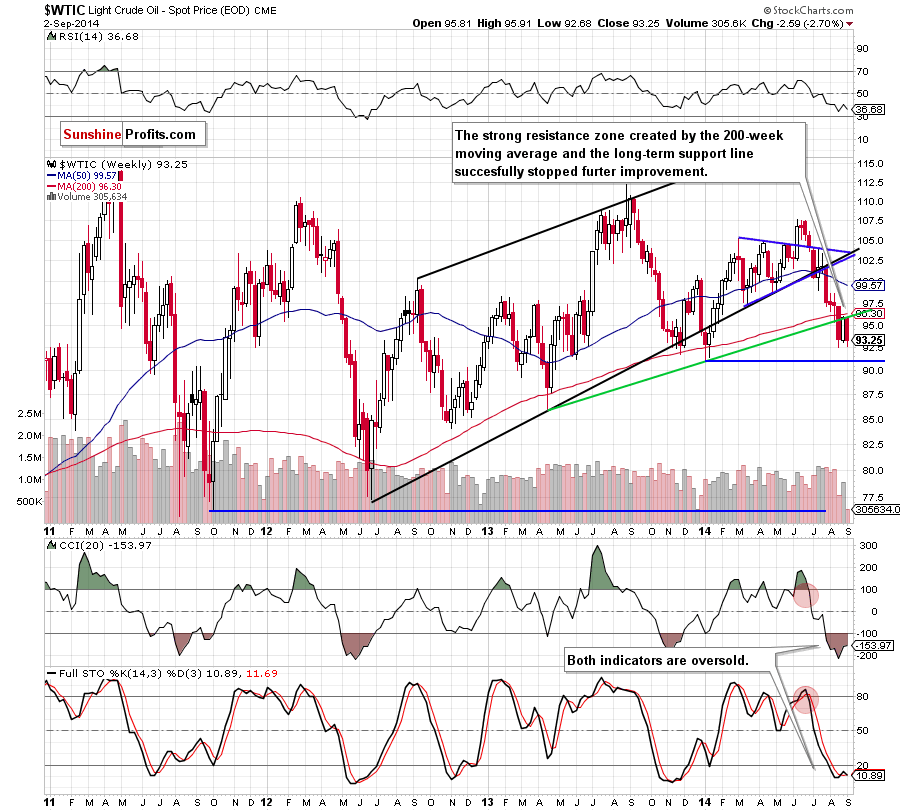
WTI Crude Oil weekly chart

The weekly chart clearly shows that the strong resistance zone created by the previously-broken 200-week moving average and the rising, long-term support line, successfully stopped further improvement and the commodity reversed, declining sharply to around the recent low. This is a bearish signal, which suggests that if crude oil moves lower, the last week’s upswing will be nothing more than a verification of the breakdown and we’ll see a test of the strength of the Jan low of $91.24. At this point, it’s worth noting that although the CCI and Stochastic Oscillator are oversold, they didn’t generate buy signals, which could support oil bulls at the moment.

Will the very short-term chart give us more clues about future moves? Let’s check.

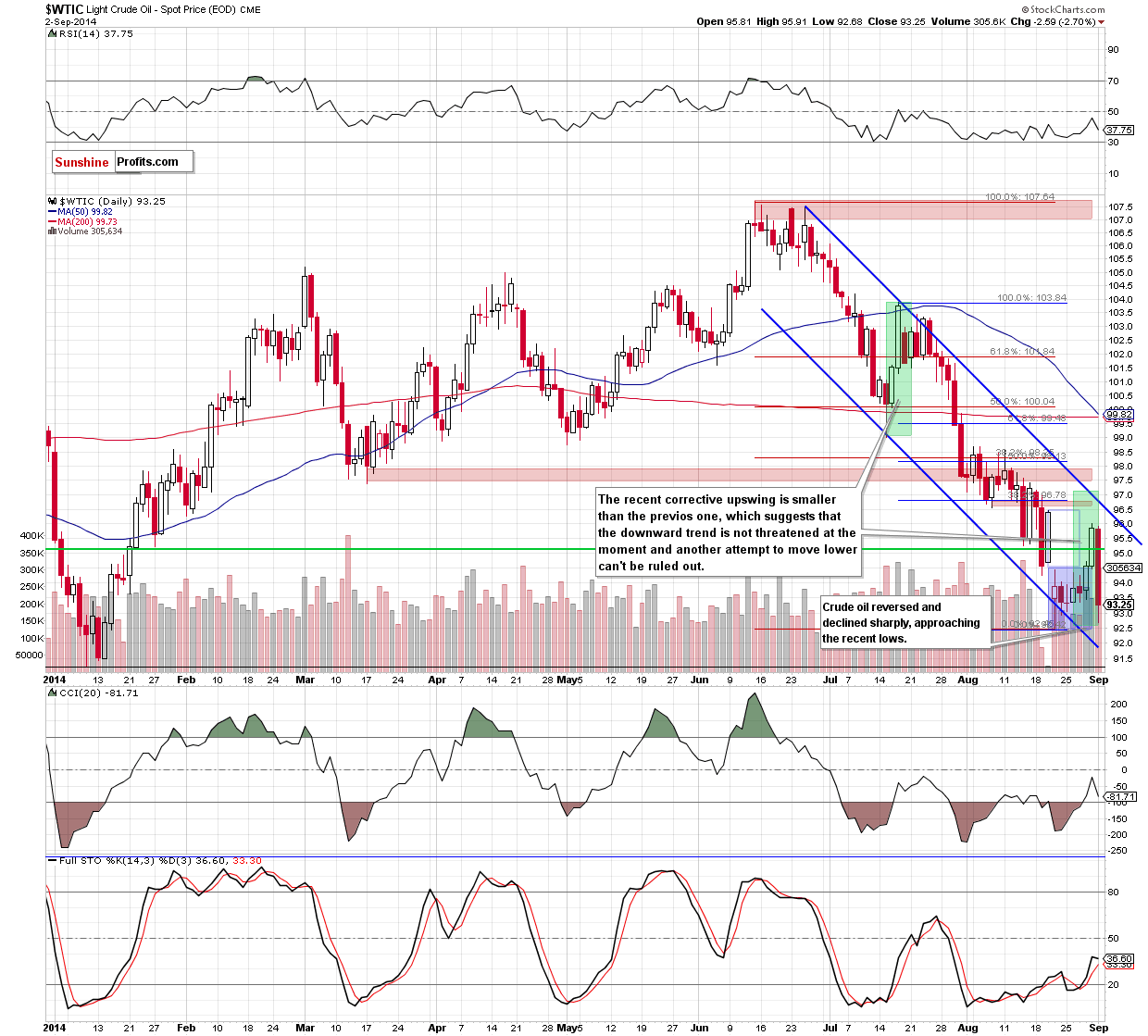
WTI Crude Oil daily chart

Quoting our yesterday’s summarize:

(…) Although the very short-term picture suggests further improvement as light crude remains above the upper line of the consolidation and buy signals are still in play, it seems to us that this medium-term resistance zone could trigger a pullback in the coming day (or days). If this is the case, we may see a comeback to the upper border of the formation.

As you see on the daily chart, oil bears not only realized the above-mentioned scenario, but also managed to push the commodity lower and light crude approached the recent lows. Taking this fact into account, you’re probably wondering whether they withstand the selling pressure or rather we’ll see a test of the 2014 low.

From the technical point of view, this is the point from where crude oil should go north (at least later today) as the proximity to the support level will likely encourage some investors to push the buy button. But is this the right place to open long positions? Not really. The reason? Firstly, light crude is still trading in the declining trend channel, which means that even if we see a rebound from here, oil bulls will have to push the price above the upper line of the formation before we’ll see another sizable upward move. Secondly, as we mentioned earlier, crude oil still remains below the strong medium-term resistance zone, which keeps gains in check. Finally, when we take a closer look at the daily chart, we clearly see that the recent corrective upswing is much smaller than the previous one, which means that oil bulls are even weaker than they were in July. Therefore, in our opinion, the downward trend is not threatened at the moment and another attempt to move lower should not surprise us. If this is the case, we think that the next downside target will be the combination of the 2014 low and the lower border of the declining trend channel around $91.24-$91.50.

Summing up, the medium-term outlook remains bearish and in our opinion opening long positions is currently not justified from the risk/reward perspective. Yesterday, crude oil reversed and declined sharply, approaching the recent lows and as we have pointed out before, although we may see a rebound from here in the very short-term (especially if today’s the EIA weekly report on crude oil inventories will be bullish for the commodity), it will not serve as a buy signal unless the medium-term resistance is taken out. We'll keep you informed.

Very short-term outlook: mixed
Short-term outlook: bearish
MT outlook: bearish
LT outlook: bullish

See the original article >>

Follow Us