Wednesday, April 9, 2014

CS Warns Volume & DeMark Raise "Topping Threat" In Stocks

by Tyler Durden

The 1900 target for the S&P 500 that Credit Suisse since the start of the year but are seeing increasing signs of a market top with a meaningful correction lower likely to emerge. Volume divergences, DeMark clusters, and reversal days all point to weakness and, as CS concludes, a break of 1844/34 (for the S&P) could lead to a decline to 1800 and then to 1768.

Via Credit Suisse,

Indeed, not only has the market all but achieved our 1900/10 target (Friday's high was 1897), but the subsequent rejection from there has seen a bearish "reversal day" complete on increased volume. Below 1863 is needed to keep the immediate risk lower for a test of key price support at 1844/34 – the March lows, rising 63-day average and 38.2% retracement of the February/April rally and "neckline" support. Despite all our fears of a top, only a move below here would see a bearish reversal confirmed. If achieved though, we would look for a decline to 1800/1798 initially, and potentially as far as the mediumterm uptrend and rising 40-week average, currently seen at 1778/68.

While 1844/34 holds, no top will complete, keeping the trend higher.

Volume did not confirm the new high

Whilst market breadth has been trending and continues to trend higher, the volume picture has also shown signs of deterioration over the past few weeks after having previously been steadfast. Not only did Friday see increased volume for the "reversal day", but cumulative OnBalanceVolume (our favourite volume measure) has been trending lower since early March, and more importantly shows a bearish divergence, again warning of a weakening bull trend.

Exhaustion signals have been present for a while

In addition, as we have highlighted on several occasions, the more aggressive DeMark Combo indicator holds daily, weekly and monthly "13" sell signals. The more widely used sequential indicator also holds a weekly "13" sell signal, although it should be noted, not daily or monthly signals.

With Defensives also starting to show signs of further improvement relative to Cyclicals, and Large Caps completing a base relative to Small Caps, we remain of the view that at the very least a potentially important rotation trade is underway and more realistically a top may be close to constructing.

In summary, our 1900/10 core bull target has been all but achieved, but we need to see a break below 1844/34 to see a top established.

See the original article >>

Oil and Gas Reserves Infographic

oil and gas info-1

Another Chinese High Yield Bond Issuer Declares Bankruptcy

by Tyler Durden

Another week, another Chinese default.

A month after Chaori Solar's default turned on its head a long-held assumption that even high-yielding debt carried an implicit state guarantee, another Chinese firm has succumbed to the inevitable outcome resulting from a lack of cash flows. As a reminder, a technical default late last month by a small construction materials firm, Xuzhou Zhongsen Tonghao New Board Co Ltd, was the first in China's high-yield bond market. However, in that case the guarantor of that bond eventually agreed to fund the required interest payment, resulting in the first bailout of the first high yield default. Still if Xuzhou didn't want the distinction of the first Chinese HY default, many are lining up for that particular prize - such as a small manufacturer of polyester yarn based in China's wealthy Zhejiang province has declared bankruptcy, threatening its ability to meet an interest payment on a high-yield bond due in July.

According to Reuters, the firm sold 60 million yuan ($9.7 million) in bonds in a private placement in January 2013 at an interest rate of 11 percent. The next interest payment is due on July 23, while the bond matures in January next year.

Reflecting the government's new attitude towards default, the China Securities Regulatory Commission (CSRC) described the Xuzhou Zhongsen default as a commonplace event.

"(The Xuzhou Zhongsen bond) was issued to investors according to regulations, and the default is an isolated risk event. The commission will abide by market-based principles and handle the case according to law," CSRC spokesman Deng Ge said at the agency's weekly press conference on Friday.

And it is no secret that as the weeks keep rolling in, so will many more defaults:

Analysts widely expect more defaults on loans, bonds, and shadow bank products this year. Semiconductor, software, and commodities firms are among the most at risk for default, a Reuters analysis of more than 2,600 Chinese companies showed.

The Xuzhou Zhongsen default marked the first ever in China's high-yield bond market, which the securities regulator launched in June 2012 in a bid to offer a new financing channel for small, private firms. Such firms often struggle to access credit in China's state-dominated financial system. Zhejiang Huatesi's bond was also issued in that market.

Pengyuan Credit Rating Co Ltd gave Zhejiang Huatesi Polymer's bond an A+ rating when it was issued. That is among the lowest ratings at which bonds are commonly sold in China's market.

Naturally, there is the possibility that this too bankruptcy will be delayed by a post-last minute payment by the guarantor, another polyester firm.

An executive at Dongguan Securities Co Ltd, which served as underwriter on the bond, told Reuters on Tuesday that the guarantor on the bond is likely to meet its obligation to make interest and principal payments if the issuer is unable to do so.

The bond carries an unconditional guarantee by Tianlong Holding Group Co Ltd, another polyester firm in Zhejiang. It is also secured by land rights owned by the company and personal assets owned by the controlling shareholder, the underwriter said.

"There are various different reasons (for Zhejiang Huatesi's problems). Factors affecting that sector, the influence of industrial restructuring, etc," the executive said.

Still, even with a bailout, the scariest thing is that the value of the assets backing the bond at the originator level is a resounding zero: "The phone number on Zhejiang Huatesi's website has been disconnected, according to an automated message."

Expect many more phone disconnections in China as the biggest ever Minsky moment begins to unwind.

See the original article >>

Ukraine Defense Ministry "Warns" Of Imminent Russian Invasion

by Tyler Durden

Ealier we learned that a great number of Americans don't even know where the Ukraine is located. We also learned that those who actually were familiar with the location of the former USSR nation were the least interested in a US military intervention (as opposed to those who inexplicably thought Ukraine is right next to Omaha or in Alaska). And now, we learn that according to the Defense Ministry of the Ukraine, which is citing a "military expert", one Dmitry Tymchuk whose pretty maps have graced these pages in the past, Ukraine is sounding the alarm on what it reports is an imminent invasion by Russia into east Ukraine, which could take place as soon as tonight.

From the ministry's twitter account:

Adn from its Facebook page, where apparently in the social-networked age, military intelligence is distributed:

Invasion of Ukraine planned tonight, says Military Expert Dmitry Tymchuk:

"Breaking news from group "Information Resistance" We, the group "Information Resistance", have received from our reliable sources the satisfactory confirmation of the statement of Ukrainian Foreign Ministry that the observed activity of the separatists in eastern Ukraine which has been lasting for the last three days is nothing but the beginning of the second phase of the scenario for the Russian invasion in our country.

In particular, according to our information, the separatist leaders, who follow the plan of GRU * of General Headquarters of Russian Armed Forces, have been given the instructions to organize a "corridor" through the state border of Ukraine for passage of the convoys of military equipment from the Russian territory at the night of April 8th to 9th.

Separatists also have received the orders to organize provocations with the casualties in the cities of the region which could be interpreted by the Russian side as "terror against the people organized by Ukrainian authorities".

In addition, the coordinators of Russian GRU, who work in the region, have instructed the separatists to use gunfire weapon in case the attempts to liberate the occupied administrative buildings are taken.

According to our information, Ukrainian law enforcement agencies and special services are now taking the necessary measures to block the groups of the separatists.

State Border Service and the Armed Forces of Ukraine are carrying out the activities on blocking and defense of the state border in the respective areas. "

* GRU – Directorate General of Intelligence of General Headquarters of Russian Armed Forces

So just more scaremongering by a nation that is seemingly desperate to be invaded by Russia just so its new "allies" can defend it (if that's Ukraine's gambit, it will be sorely disappointed)? Or will Russia indeed invade tonight? We doubt it - certainly not without much more real or false flag provocations first, and should there be no invasion tonight, one can just say the date has been pushed back by a day, or two, or three.

Then again at this point who knows - as we have pointed out repeatedly, it is not Russia's actions that are unpredictable - in fact quite the opposite - it is the Ukraine that has been the irrational and "defective" actor in the latest Cold War 2.0 realpolitik game theory.

See the original article >>

David Stockman's "Born Again Jobs Scam": The Ugly Truth Behind "Jobs Friday"

by David Stockman

The mainstream recovery narrative has an astounding “recency bias”. According to all the CNBC talking heads, the 192,000 NFP jobs gain reported on Friday constituted another “strong” report card.

Well, let’s see. Approximately 75 months ago (December 2007) at the cyclical peak before the so-called Great Recession, the BLS reported 138.4 million NFP jobs. When the hosanna chorus broke into song last Friday, the reported figure was 137.9 million NFP jobs. By the lights of old-fashioned subtraction, therefore, we are still 500k jobs short—notwithstanding $3.5 trillion of money printing in the interim.

The truth is, all the ballyhooed “new jobs” celebrated on bubblevision month-after-month have actually been “born again” jobs. That is, jobs which were created during the Fed’s 2002-2007 bubble inflation; lost in the aftermath of the September 2008 meltdown; and then “recovered” during the renewed bubble inflation now underway.

Stated differently, back when the NFP jobs count first clocked in at 137.9 million in the fall of 2007, the talking heads assured us that we were in a permanent “goldilocks economy” thanks to the brilliant management skills of the Fed. So here we are nearly 7 years later, still a half million jobs short, and the talking heads are gumming once again about the same old illusory “goldilocks”. Who actually pays these people to bloviate!

Setting aside the utterly superficial recency bias, its not hard to see the dire reality lurking in the actual trends. To be precise, 75 months into the post-2000 cycle the US economy had generated 5 million net new jobs—that is, it was way above its prior high water mark.  Likewise, 75 months on from the 1990 peak, it had produced 10 million net new jobs.

So the fact that we are still in negative jobs territory this far into a recovery cycle is literally off-the-historical-charts. And the fact that we are already in month 57 of this business expansion when the ten expansions since 1950 have averaged only 53 months in duration is even more telling. Notwithstanding Bernanke’s hubristic proclamation of the Great Moderation, the Fed has not abolished recessions—so this time the cyclical clock may run out long before many actual “new jobs” are created.

Indeed, by any reasonable standard, an economy which has gained 10 million new working age citizens during the past 7 years, but has generated not a single net new NFP job is failing badly. The Friday report, like the dozens before it, should have been a cause for alarm, not celebration.

In fact, the true story is even worse for two reasons. First, as shown below the quality-mix of even these “born again” jobs has deteriorated sharply. Secondly, the 7 million jobs that were recovered since the official recession bottom in June 2009 had virtually nothing to do with the massive money printing campaign of the Fed or, for that matter, the rest of the Washington stimulus spree of bailouts and boondoggles.

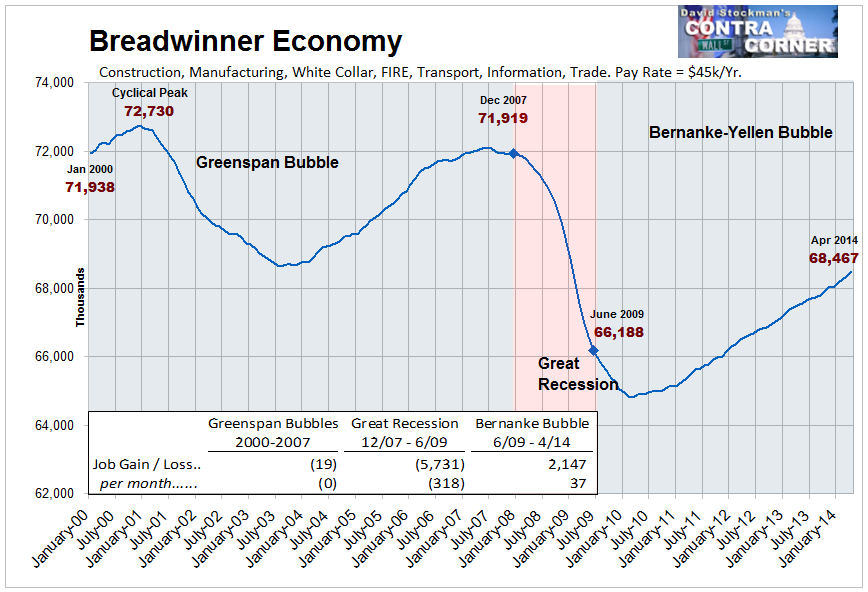
Consider first the quality deterioration, and the fact that when it comes to economics the proper metric is surely not one-job-one-vote. About half of the jobs in the NFP consist of “breadwinner” jobs in the core sectors—–manufacturing, construction, the white collar professions, FIRE, transportation and trade, information services and media and business management and support services.  According to the BLS establishment survey data, these positions generate an annualized pay rate of about $45k—-marginally enough to support a family in many areas of the country.

As shown below, the Breadwinner Economy has been trending south for this entire century! There were 72-73 million of these jobs in 2000; no growth happened during the entire Greenspan Bubble; a thundering collapse occurred during the Great Recession; and there has been only a tepid, fractional recovery since. In fact, among the 5.7 million Breadwinner Economy jobs lost by the time the recession officially ended in June 2009—- only 37 percent have been recovered during the nearly five years since then. And that’s notwithstanding the ritual proclamations about “progress” on each and every “Jobs Friday”.

Breadwinner Economy - Click to enlarge

Breadwinner Economy – Click to enlarge

As shown below, jobs in the Breadwinner Economy pay 2.5X those in the Part Time Economy and 30% more than the HES Complex. So the implications for economic growth and living standards are self-evident. The Breadwinner Economy with half the NFP jobs accounts for more than two-thirds of aggregate wage and salary income. Accordingly, it is not surprising that the real median household income has fallen 7% since 2000. The breadwinner jobs which support it have trended sharply downward and today clock in at only 68.3 million—a level that was first reached during Bill Clinton’s second term.

Yes, there has been some recovery since the recession bottom, but the rate of gain has been tepid and underscores the borrowed time point. At the rate of recovery since June 2009—-about 37,000 per month—it would take until 2024 to get back to the 73 million Breadwinner Economy jobs posted at the time that Florida’s hanging chads were being recounted after the 2000 election.

Digging deeper into the Breadwinner Economy only darkens the picture. The very highest paying jobs in this broad category are in the “goods-producing” sector— construction, mining/energy and manufacturing. The NFP count for goods-producing industries in 2000 was 24.6 million. By contrast, the number reported last Friday was 18.9 million—-23% below its level 14 years ago.

And don’t look for the gap to be filled any time soon. Only 9,000 jobs per month have been created in good-producing since June 2009. So by the lights of pure arithmetic, it would take until the year 2067 to regain the January 2000 high water mark!

Another big chunk of the Breadwinner Economy jobs is accounted for by what we have termed “Core Government” jobs, and it includes employment at all levels of government excluding the Post Office and Education. There were 11 million of these jobs–paying upwards of $60,000 on average— in Friday’s report and that is virtually the same figure reported for December 2007.

So we are at “peak jobs” in the Core Government sector, and if anything the number of these high paying jobs will also shrink during the years ahead. That prospect is owing to the inexorably tightening fiscal vice in which the public sector is now impaled. To wit, the massive growth of transfer payments due to baby boom retirements and the failed economy’s pressure on the safety net is squeezing out all other government spending—-and most especially jobs-intensive public sector service delivery. On the other side of the ledger, publicly-held debt of government at all levels is nearly $16 trillion or 95% of GDP and rising rapidly. This means that spending growth to hire more bureaucrats will be virtually impossible—-even with borrowed money.

That leaves about 38 million jobs in all the other Breadwinner Economy industries mentioned above such as FIRE, trade and transportation, business services etc.—a category we have termed “core private business services”.  Even here, the March print was still 425,000 below the December 2007 peak, and, more importantly, still less than 4% above its turn of the century level of 37 million jobs. Stated differently, this category is the only part of the Breadwinner Economy which has been growing, but the rate of job creation over the last 14 years has been just 8K per month.

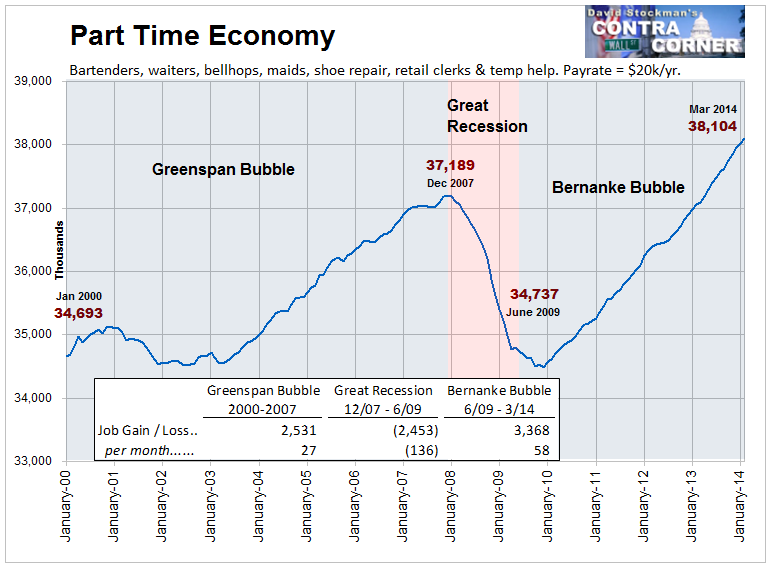
And this points to the real scam embedded in the “Jobs Friday” celebrations. Overwhelmingly, the job count gains being reported are in the Part Time Economy.  This category encompasses about 38 million NFP jobs, and consist of bell-hops, bartenders, waiters, maids, nail salons, shoe repair, street vendors, retail clerks, temp jobs and the like. According to the BLS data, these categories generate an annual full-time pay equivalent of just $20,000. These are ”survival” jobs at best, yet they account for fully one-half of all the born again jobs reported since June 2009 (3.4 million out of 7 million).

Part Time Economy - Click to enlarge

Part Time Economy – Click to enlarge

Unlike the Breadwinner Economy, this sector has recovered its December 2007 high water mark of 37.2 million jobs and then some. Last Friday’s report showed 38.1 million jobs in the Part Time economy for a net gain of about 3% over the past seven years. Yet even here the story is hardly reassuring. To be precise, the Part Time Economy has gained  915,000 jobs since December 2007 and 968,000 of them—more than 100%– have been in bars, restaurants, resorts, race tracks, theme parks and other places of amusement.

In short, what has materialized is a Bread & Circuses economy. The BLS category containing the above industries, called “leisure and hospitality”, posted 11.7 million jobs in January 2000. The figure for March 2014 was 14.5 million. Thus, Bread & Circuses accounted for fully 40% of the entire total of 6.9 million NFP jobs created in the American economy during the 21st century.

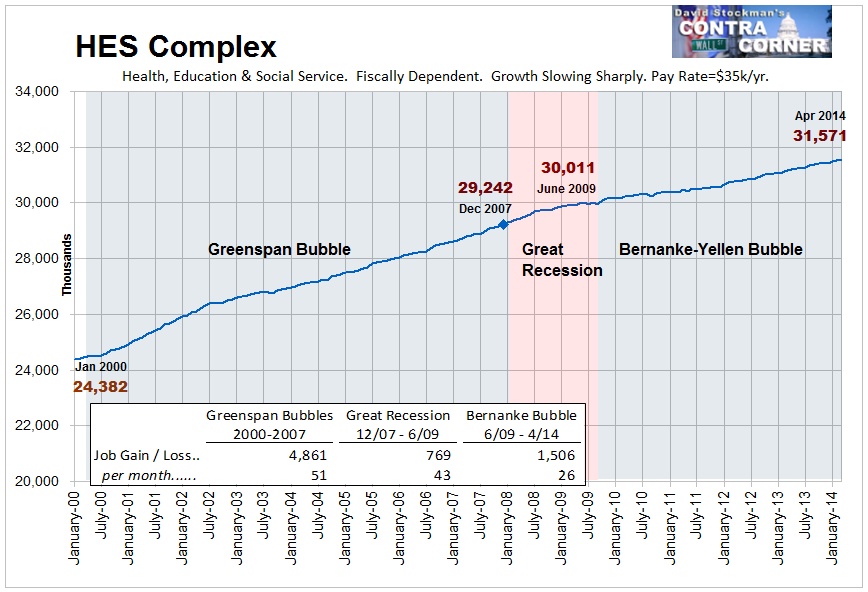
The balance and then some is attributable to the final broad NFP category we have labeled the HES Complex, which consists of health services, education in both private and public sector and social services including day care. As shown below, this has been the growth engine of the NFP. The 31.5 million jobs in the HES Complex reported for March 2014 represented a 2.3 million gain from the December 2007 peak, and a gain of 6.8 million jobs or nearly 30% from January 2000.

Yet there are more than a few skunks in this woodpile, as well.  Nearly 75% of the gain in HES Complex jobs this century occurred before December 2007. That robust gain of 4.9 million jobs, however was heavily concentrated in education, nursing homes, hospitals, home health care and social assistance—which accounted for 80% of the pick-up. The common characteristic of these categories is obviously that they are heavily fiscally dependent. With the exception of hospitals, all of these categories derive 75% or more of their revenues from local, state and Federal coffers, and even in the case of hospitals, Medicare, Medicaid and other public programs account for upwards of one-half of receipts.

Needless to say, the fiscal vice has been tightening steadily ever since the financial crisis. Accordingly, education jobs have been flat since December 2007 and hospital and nursing homes employment has risen at only a 1% annual rate. Overall, the rate of HES Complex job growth has thus slowed sharply—-from 51K jobs per month during the Greenspan Bubble to 43K per month during the Great Recession to just 26K since June 2009.

Health, Education, and Social Service Complex Jobs - Click to enlarge

Health, Education, and Social Service Complex Jobs – Click to enlarge

Not only has the rate of HES job growth slowed markedly in the face of peak fiscal debt, but even the job growth that has occurred has been in the lowest paying parts of the sector. That is, the gains have not been among doctors, skilled nurses or medical technicians. In fact, about 1.2 million or 80% of the HES Complex job gains since June 2009 have been among home health aids, day care workers and nursing home staff. Increasingly, what is left of the HES Complex growth machines amounts to a Bed Pan, Home Companion and Baby Sitters Brigade.

Indeed, annual pay rates for the entire HES Complex average just $35,000 according to the BLS data. Obviously, the growth in recent years has been among categories where compensation is substantially lower.

So this is what the Hosanna Chorus is celebrating—-a job machine that is broken and generating part-time and low-end positions that still do not add up to the 2007 high water mark. Moreover, as will be shown in the next installment, the Fed’s furious money printing has had  virtually no role in generating even the “born again” jobs which have been so joyously welcomed on Jobs Friday.

See the original article >>

Aussie dollar has interesting technical tale to tell

By Matt Weller

The Australian Dollar(CME:ADM14) has been the “Belle of the Currency Market Ball” over the last three weeks, with rates rocketing from below .9000 on March 20 to a high of nearly .9400 today (April 8). The pair remains in broad upward trend ahead of a relatively data-heavy week for the pair, including important data from the United States, Australia, and Australia’s most important trading partner, China.

On a purely technical basis, the pair continues to show bullish signs. Since conclusively breaking above the three-month inverted Head-and-Shoulders pattern neckline at .9080 one month ago, rates have broken above the 200-day moving average for the first time since last April. In addition, this moving average has started to turn higher, indicating that the longer-term trend is turning bullish after a rough year in 2013.

Meanwhile, the AUD/USD has broken out of a near-term bullish flag pattern after a week of consolidation. This classic price action pattern is created by a strong surge higher, followed by a shallow, controlled pullback or consolidation. Once confirmed by a break and close above the top of the flag, the pattern points to a strong bullish continuation. Even looking just at today’s price action, the pair is putting in a Bullish Engulfing Candle on the daily chart, showing strong buying pressure throughout the day and opening the door for further gains (see chart below).

In an uncanny development, the measured move targets of  both the longer-term inverted head and shoulders pattern (.9080 + 420 pips) and the bullish flag pattern (.9205 + 300 pips) come in almost exactly at .9500. While that’s no guarantee that the pair will necessarily reach that level (especially given the near-term overbought readings on some oscillators), it may serve as a logical target for many longer-term traders. The .9500 area is also where the Royal Bank of Australia started to become particularly uncomfortable with its currency’s value and the risk of verbal intervention will grow. For now, the medium-term technical bias remains generally bullish heading into tomorrow’s Aussie employment report. This bullish bias remains intact as long as the pair holds above .9200.

See the original article >>

Follow Us