Friday, March 21, 2014

The Yellen Cacophany Begins: Confused Markets Are Going Off Their Fed Meds

by Jeffrey P. Snider

There were evident divergences all across the credit complex as the Yellen Fed takes shape. Maybe it relates to these “markets” being more accustomed to Bernanke and his manner of speech and saying nothing, but to me there appears to be little consensus about anything.

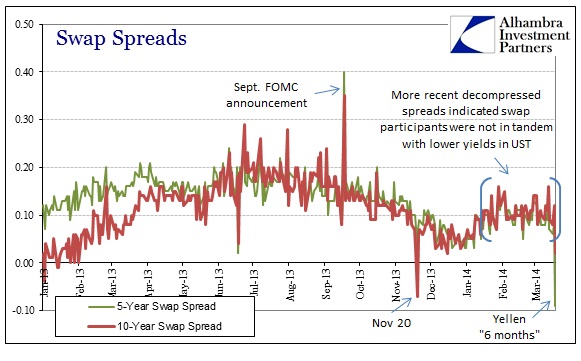
I have said on previous occasions this year that swap market participants are not synchronized with UST rates, as swap spreads have decompressed while treasury rates have fallen (particularly since January 9). That indicates to me wariness against policy changes of the kind we apparently saw on Wednesday. It also appears as if some agent, dealer or major participant got caught, yet again, positioned in the “wrong” direction against rate movements. There was clear desperation, evident more in the 5-year spread than 10-year (5-year spread dropped a massive 18 bps on Wednesday, settling at -.09 bps).
ABOOK Mar 2014 Credit Swap Spreads

If I had to guess, I would say that the extreme spread movement Wednesday related to the collapse in the curve – a massive flattening that no doubt ran over some positions. We have no idea who was affected and by how much, but to move spreads as much as it did suggests it wasn’t a minor “mistake.”

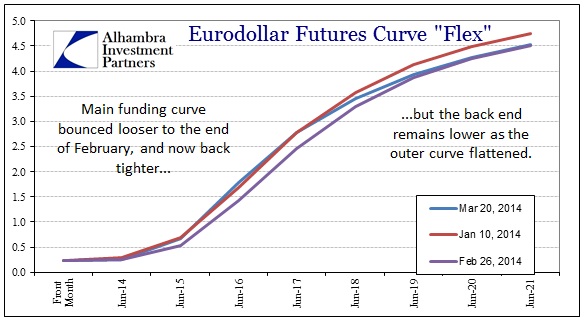
We can pick up some of that in funding markets, as dollars tightened more than a little in the “money” part of the eurodollar curve, but remained unperturbed in the outer years.
ABOOK Mar 2014 Credit Eurodollars

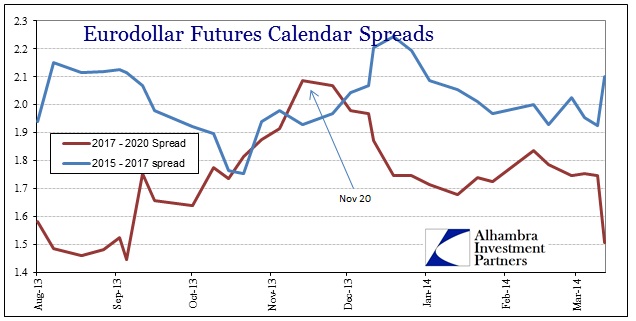
The net result was a rather obvious drop in calendar spreads out to 2020.
ABOOK Mar 2014 Credit Eurodollars Calendar Spreads

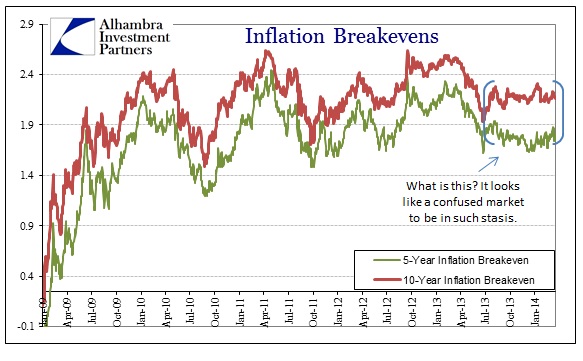
Given all of that “action”, you might expect some kind of change in expectations for inflation, particularly as that has been somewhat of a focus lately of both observation and policy. But the embedded inflation expectations in the treasury market have been more than docile ever since the summer selloff.
ABOOK Mar 2014 Credit Inflation Breakevens

Such a static inflation indication I think goes along with these divergences in various segments. On the one side, there is constant reassurance that inflation will pick up at some point, and that the Fed will “normalize” itself to that inflation paradigm. Yet, for all that talk there is the evident problem that inflation is actually going in the “wrong” direction without anything other than assurances that will change. The net result appears as neither position obtains momentum, and the “market” devolves strangely into this static state.

Credit markets appear almost confused about the most basic factors of credit and interest rates. Could it possibly be from too much monetary interference through the lack of clarity regarding stance? The FOMC talks about forward guidance as if it were almost a direct line to credit “markets”, but these strange indications show that there is very little consensus anywhere about anything.

I think that applies as well to the yield curve shape (not unlike the eurodollar curve shape recently). The entire frame of the credit selloff between early May 2013 and November 20, 2013, was a sharp steepening in the belly. Then that reversed in one day, in no small part due to the sudden interest of QE POMO in the 9-10 year maturities beginning November 20. The Fed is still buying there, with only a break in February.
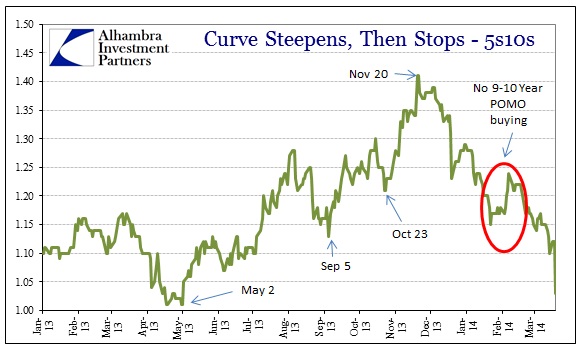
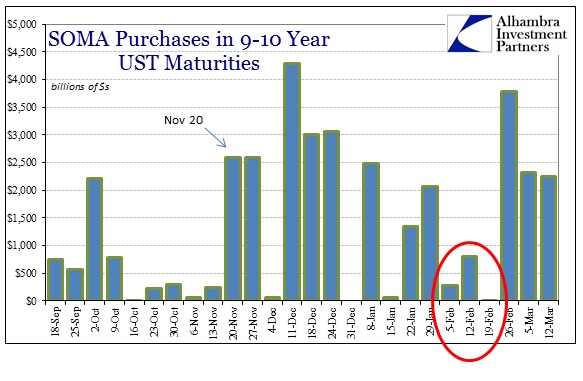
ABOOK Mar 2014 Credit SlopeABOOK Mar 2014 Credit POMO

Does that explain why the 5-year (where no POMO activity has taken place at all) is taking the greatest beating? Is the Fed, aware of its “need” to “support mortgage finance” trying to influence the curve shape, and thus manifesting more and more confusion? Or, more precisely, have the credit markets become more attuned to guesses about changes in policy rather than anything else?

I don’t think there is a clear answer to any of those questions, but I do think there is something to them. Between the swaps market, minimal changes in eurodollar curves, and the absolute sclerosis in inflation expectations, I cannot help but wonder what would cause such evident seizure, particularly as major policy changes correspond to each of these pieces. However, the commonality in all of it seems to be a hidden wariness that I don’t believe existed prior to last May, meaning credit was lulled into a false sense of security that is only now being appreciated for what it was.

See the original article >>

The Waiting Wall

by Marketanthropology

From our friends at the Wall Street Journal:
____________

"Is this a recipe for another period of financial excess or runaway inflation? Not necessarily. Real short-term borrowing rates also were negative for most of the 1940s. Some analysts say World War II jolted the U.S. out of Depression. That might be the case, but cheap credit also helped.

This little history sums up Fed Chairwoman Janet Yellen’s challenge. The Fed is effectively betting it’s replaying a financial history that looks more like the 1940s than the 1970s or 2000s. If officials are wrong in that diagnosis, the consequences could be rather unpleasant."

- By Jon Hilsenrath - Grand Central: Fed Likely to Signal Real Rates Will Stay Negative For Years

____________
As much as it makes us uncomfortable sharing a picnic bench with the Fed, from our perspective (see Here & Here) they're looking at the right parallel. To that point, we recognize that it is this visceral and underlying cynicism and disdain of the Fed's quite visible hand which will likely provide the counterintuitive market dynamics we described in our previous notes on the 40's.   

Another Fed meeting, another taper - and another wail with dramatic pause from the participant and pundit peanut gallery. Our general take is that despite the immediate reaction by the market and extrapolation of near-term rate hikes on the horizon, the truth is the sentiment picture towards and drawn by the Fed will likely change swiftly when the ebullient character in our own domestic markets turn down. From our perspective that seems increasingly likely as the Fed pivots further away from their extraordinary monetary support.  
You'll notice that although the Fed helped smooth the business and market cycle during the 1940's, by the time the Fed started walking back its purchases at the beginning of 1947, the bloom had already come off the rose in the equity markets. It was during this time period that the zeitgeist saw a return to the economic hardships of the Great Depression, which bolstered Treasuries despite the fact that inflation was beginning to find traction in the system. 
Although the timeframes are different (4/42-4/46 & 3/09-3/14) between the two SPX series, when you factor in the pauses the Fed made in their LSAPs this time around the block, the comparison is much closer.
While the performance of long-term Treasuries and equities since the initial taper have been similar, our outlook continues to be much favorable for Treasuries going forward. 

See the original article >>

Gold Completes Golden Cross

by Tyler Durden

For the first time in 13 months, gold's 50-day moving-average is above its 200-day moving-average. This so-called "golden cross" occurred in Feb 09 before gold surged over 100% in the following years (but also occurred 'falsely' in September 2012.

Some technicians are reflcting on the last big run that gold had...

See the original article >>

Stock Market Crash Fractal - Deja Vu 2000 All Over Again

By: Anthony_Cherniawski

The Crash Fractal is still alive and well in the Dow. Its peak was December 31

The peak in NDX was March 7. It is now reversing hard down, as anticipated.

The peak in the Russell 2000 was March 4. It, too, is reversing.

But we have a new peak high in the SPX. However this may be almost exactly equivalent to the Market in 2000 when the Dow made its high in early January, while the SPX did not make its high until March 22. What followed was a 17.2 market day decline to April 14. That, my friends, was the first Flash Crash of the 21st century.

Watch SPX carefully, as I don’t expect it to stay elevated very long. It is possible that traders are still unaware of the big reversal in the NDX.

VIX made a Minor Wave 2 low this morning and is quickly taking back its losses. We may see a breakout later in the day as traders start hedging.

See the original article >>

5 Things To Ponder: Yellin' About Yellen

by Lance Roberts

The biggest news this past week was Janet Yellen's first post-FOMC meeting speech and press conference as the Federal Reserve Chairwoman.  While I have the utmost respect for her accomplishments, every time I hear her speak all I can think of is my white haired, 75-year old grandmother baking cookies in her kitchen.  This week's "Things To Ponder" covers several disparate takes on what she said, didn't say and the direction of the Federal Reserve from here.

In order to give these views context, I have included Yellen's post-meeting news conference.  This is best viewed with a glass of milk and some warm, fresh chocolate-chip cookies...."just like Grandma used to make."


Quote Of The Day: "Bull Markets Are Just Like Sex, It Feels Best Just Before It Ends." by Barton Biggs

1) Dropping The 6.5% Unemployment Target by Howard Gold via MarketWatch

I have written many times in the past, most recently here, that the 6.5% unemployment target for the Federal Reserve was not a good measure of the true state of employment in the U.S.  Specifically I stated:

"The difference between today, and 1978, is that in 1978 the LFPR was on the rise versus a sharp decline today.  However, as I stated previously in 'Fed's Economic Projections - Myth vs Reality' this leaves the Federal Reserve in a bit of a predicament.

'The problem that the Fed will eventually face, with respect to their monetary policy decisions, is that effectively the economy could be running at 'full rates' of employment but with a very large pool of individuals excluded from the labor force.  Of course, this also explains the continued rise in the number of individuals claiming disability and participating in the nutritional assistance programs.   While the Fed could very well achieve its goal of fostering a 'full employment' rate of 6.5%, it certainly does not mean that 93.5% of working age Americans will be gainfully employed.  It could well just be a victory in name only"

This is particularly the case when roughly 1 out of 3 people are no longer counted as part of the work force, 1-out-of-3 individuals are dependent on some sort of social support program, and over 17% of personal incomes are comprised of government transfers."

Howard points to the Federal Open Market Committee dropping its 6.5% unemployment rate threshold for raising the federal funds rate, a target originally set in December 2012.

"Instead it would look at some 'qualitative' measures, 'including measures of labor market conditions, indicators of inflation pressures and inflation expectations, and readings on financial developments,' the FOMC’s statement said."

This move shouldn’t have surprised anyone. The official unemployment rate was 6.7% in February and keeping that 6.5% target would have tied the Fed’s hands before it’s even finished tapering.

Yellen must deal with an economy that’s slowly recovering, but leaving a lot of people behind."

2) Yellen And The Fed Go Dark by Matthew Klein via Bloomberg

This is a very interesting take on a change in how the Fed presents its decisions and is worth reading in its entirety.

"Unless you have a crystal ball that tells you what will happen with wages, this possible new target tells you almost nothing about when rates will be raised.

These developments suggest a desire to turn the clock back to a time when traders had to make bets without Fed hand-holding -- even if the Fed still does release its economic projections. A shift toward opacity might be wise. The economy is a complex system that no one fully understands, so it would be foolish to commit to any unbending numerical rule that limits policy makers’ flexibility to react to unforeseen events. That was why former Chairman Alan Greenspan was opposed to formal inflation targets.

An additional benefit of opacity is reduced predictability. Scholars have found that financiers take too much risk when they think they know what will happen in the future, so muddying the waters may be just what’s needed to promote a safer financial system."

3) Why The Fed Will Stop Tapering by Peter Schiff

"In reality, the Fed will keep manufacturing excuses as to why rates can't be raised. Whether it's a cold winter or a hot summer, a geopolitical crisis, or an unexpected sell off in stocks or real estate, the Fed will always find a convenient excuse to postpone tightening. That's because it has built an economy completely dependent on zero % interest rates. Even the smallest rate shock could be enough to push us into recession. The Fed knows that, and it is hoping to keep the ugly truth hidden.

Although Yellen followed the script on the QE tapering, by decreasing monthly purchases by an additional $10 billion to $55 billion, look for her to abandon her commitment to wind it down to zero just as easily as she has walked back the Fed's commitment to raise rates once unemployment hits 6.5%. Any additional weaknesses in economic data, or dips in stock or real estate prices, will cause the Fed to call a time out on its tapering plan."

4) Rising Risks To Fed's Policy Change By Mohamed El-Erian via CNBC

"Higher uncertainty premiums: The Fed is in the midst of not one but two policy transitions. It is pivoting from reliance on a direct instrument (QE purchases of securities in the marketplace) to an indirect one (forward policy guidance to convince others to devote their balance sheets) — thereby raising effectiveness questions. It is also moving from a readily-observable unemployment threshold to a set of indicators that include qualitative judgments — thereby raising less predictable interpretation questions.

Technical market conditions: Given the impressive multi-year rally, it doesn't take much these days to convince equity traders to book profits (and it hasn't taken long for buyers to buy on the dip). Similarly, over-extended front end rates positions can be destabilized in the immediate term even if the Fed is committed to maintaining low rates for long.

Reaction to the interest-rate selloff: With a significant part of the economy sensitive to short and intermediate interest rates, including housing, and with the economic recovery yet to broaden sufficiently, it is not surprising that the stock market would be concerned with a sharp selloff in the shorter-dated rates.

What about the longer-term?

Here, much depends on your assessment of the first factor — namely, Fed policy effectiveness during its policy transition. Unfortunately, there are no tested models, policy playbooks or historical data to confidently guide investors. What is clear, however, is that they will require quite a bit of evidence of ineffectiveness before abandoning their faith in an institution that has significantly supported markets in recent years."

Bye-Buy-BUY

5) Inside The Madness Of The Stock Market by Jason Zweig

Jason's articles are always worth reading and this is no exception.  The "madness of crowds" is always relevant and prevalent.  With the financial markets tied to the Federal Reserve, like a "fetus to its mother," these words of wisdom are worth remembering.

"In a guest essay published in the New York Times on Oct. 29, 1989, called 'Fear of a Crash Caused the Crash,' future Nobel Prize-winning economist Robert Shiller described a survey he had done of 101 market professionals the Monday and Tuesday after the tumble. Asked whether the drop was driven by 'a change in the stock market fundamentals' or 'psychology and emotion,' only 19% cited fundamentals; 77% blamed psychology and emotion. Shiller and his colleague William Feltus also asked the professionals if they thought the latest drop could turn into a replay of the 1987 crash; 35% thought it could, while 41% thought other investors thought so.

So, when KAL poked fun at traders overreacting to what others say, he was right on the money.

To this day, says KAL, brokers buying copies of the cartoon (featured above) 'inevitably' tell him, 'It was so funny because it was so true.'"

See the original article >>

Spring Forward?

by Bespoke

Happy Vernal Equinox!  The March equinox means the cold can't last much longer for those of us living North of the equator.  Today is the halfway point between the shortest day of the year and the longest day of the year, and is the traditional start of the spring season as defined by our planet's orbit.  12:53 PM today was the first minute of spring, at least as far as astronomers define it.  Spring has been a long time coming for the Eastern seaboard, and the market is ready to get the snow dusted off.  Below is a composite chart of cumulative performance in the S&P 500 dating back to spring of 1928, broken up by season and beginning with spring.

After a bit of a rough patch to start, historically speaking the spring months have been a good period for the market, with April especially showing strength.  Winter is the best time of the year to be in stocks, but over the last twenty years (1994 - 2013) spring has been almost as good or better depending on whether you use the median or average.  The real season of strength in the last twenty years, though, has been the fall.  While it has been the worst season for equities going back to 1928, in the last twenty years it has been the best season with the S&P 500 averaging a gain of 3.76%.  What does that mean for this year?  Historical patterns are never absolute, but if history does stick to its trend the next few months could be good ones for the market before we get into a summer lull.

See the original article >>

Follow Us