Friday, March 14, 2014

Buy Low And Sell High To Generate Significant Capital Growth

Super Commodity Strategy generates significant medium term capital growth with simple and strict risk management rules. Our Super Commodity Trading Signal Service takes + 251.85 % since 2009.


In addition we also provide automated intraday and short-medium term signals with some winning trading systems om your managed accounts.

gywxsncx.hyt
Daily e Monthly Equity


31t1laf0.a1h
                Download Historical Results Pdf


Material in this post does not constitute investment advice or a recommendation and do not constitute solicitation to public savings. Operate with any financial instrument is safe, even higher if working on derivatives. Be sure to operate only with capital that you can lose. Past performance of the methods described on this blog do not constitute any guarantee for future earnings. The reader should be held responsible for the risks of their investments and for making use of the information contained in the pages of this blog. Trading Weeks should not be considered in any way responsible for any financial losses suffered by the user of the information contained on this blog.

Natural gas stays in spotlight

By Erik Tatje

NATURAL GAS (NYMEX:NGJ14)

Natural Gas continues to steal the spotlight as price action continues to validate technical levels on the chart. The most significnat technical pivot heading into today’s session appears the be around 4335. After a relatively weak showing throughout the day yesterday, price did to find a bit of support around the 4380 and 4335 pivots on the chart.  Ideally, price should stay contained below the 3400 level and continue to probe lower.  The 4335 support pivot could serve as a “trigger point”, which if broken, could intrduce additional selling pressure into the market and quickly take prices down to the 4265 pivot. Both the intermediate term trend as well as near term momentum are pointing toward lower prices and selling rallies into resistnace looks to be the safest play in the natural gas market. Until price can rally back above the 4540 pivot on the chart, the intermediate directional bias will remain to the short side in natural gas.

Apr. ’14 Natural Gas 30-minute Bar Chart. Source: eSignal

E-MINI DOW

After multiple days of relatively quiet price action, the stocks took a hit yesterday after, what seemed to be, relatively positive economic data reports in Jobless Claims and Retail Sales. The positive reports were not enough to sustain record-high prices in the indices and shortly after the brief rally following the number, the US indices began their decent. The Dow fell over 300 points before eventually finding support around the 16094 pivot. Price has since retested this level and held in the early morning session, which could present a valid long entry pivot for those still confident in US stocks.  The two main technical levels of significance heading into today’s session seems to be the previously mentioned 16094 support pivot, as well as the 16048 level. In the event that the current correction continues lower, a breakdown below 16048 could confirm a bearish outlook in near-term momentum. Also important to note, the 15948–15978 support band has provided structure to the market on multiple occasions over the past few weeks and could come into play if this corrective pullback persists into next week. For those looking for resumption of the underlying bull trend, the 16180 is a solid initial upside target from here and the 16247 level represents a 50% retracement of yesterday’s big move. It is not uncommon for markets to “bounce” up to a Fibonacci retracement level after a big move like this, so keep these Fibo retracement pivots in mind when assessing long profit targets.

Mar. ’14 E-mini Dow 30-minute Bar Chart. Source: eSignal

SUGAR

May 14 sugar has spent some time digesting between the 1730-1847 area on the chart and the recent pullback in sugar could present a valid risk/reward entry level for traders looking to play the long side of sugar. Technically, the 1730–1745 support band appears to be the most relevant technical level for this market heading into today’s session. With an intermediate term trendline intersection the market around the 1730 level as well, this 1730 support now takes on added significance. Buying dips into this level seems to be a valid opportunity anticipating a bounce of support and a resumption of the underlying bull trend. If the market does produce a confirmed break below the 1730 support pivot, it may be advisable for traders to take a step back and reassess this market. Below this support pivot, the market could dip as low as 1670-1675 before encountering significant support. All things considered, the market has not made any significant lower lows to warrant a trend change and the recent corrective pullback into support could offer a high probability entry signal for traders.

May ’14 Sugar 30-minute Bar Chart. Source: eSignal

See the original article >>

Production growth battles geopolitical risk in energy space

By Phil Flynn

Markets across the globe are trying to price in a wide array of risk factors and as bad as that is it might have been a lot worse if it were not for the shale gas and oil revolution in the United States. The International Energy Agency seemed to say just that in their latest report. The EIA says that pressure on global oil markets will ease in spite of rising geopolitical tensions because of surging supply from Iraq and other producers like the United States. Iraqi oil production hit a whopping 30.49 million barrels a day which was the highest levels in 35 years.

This should be a stark warning to Vladimir Putin whose folly in Crimea could force his energy customers to seek a more stable supplier. Russia is very dependent on energy exports and the IEA says that at this point the West and Russia are mutually dependent on each other, but that could change in the near future with global supply on the rise. From a long-term view this invasion of the Crimea could do lasting damage to the Russian economy and while the Chinese may keep buying Russia’s oil they obviously are having problems of their own.

The Guardian reports that “China is braced for a wave of industrial bankruptcies as its slowing economy forces companies with sky-high debts to the wall, the country's premier has said. Premier Li Keqiang told lenders to China's private sector factories they should expect debt defaults as the world's second largest economy encounters "serious challenges" in the year ahead.

Speaking after the annual session of the national people's congress, Li Keqiang said: "We are going to confront serious challenges this year and some challenges may be even more complex."

He told lenders to China's private sector factories they should expect debt defaults. Li said China must "ensure steady growth, ensure employment, avert inflation and defuse risks" while also fighting pollution, among other tasks. "So we need to strike a proper balance amidst all these goals and objectives," he added. "This is not going to be easy," he said.

Li's warning followed the failure of Shanghai Chaori Solar Energy to make a payment on a 1bn yuan (£118m) bond last week. The default was the first of its kind for China and widely seen as pointing to the end of 11th-hour government bailouts for troubled enterprises”

Both China and Russian stocks have been hit hard but don’t look to the euro for safety. Mario Draghi, “Mr. Whatever it takes” is showing his displeasure with the currency’s resent assent.  He is warning that the assessment of price stability is becoming increasingly relevant. Worries about deflationary pressures could inspire stimulus from the ECB. This of course would be a new course for the European Central bank that in the past has been more focused on fighting inflation over everything else.

While the comments by Draghi seemed to slow gold’s epic and historic run it did not break it because it only will enhance gold’s stature as a safe haven in an increasingly unsafe world. Add to that the historic divergence that we have seen between stocks and commodities are reverting to the mean. Gold prices went inverse to stocks at a historic pace now looks poised to recapture everything it gave up last year.

Oil of course is falling as demand prospects are looking more-shaky. Brent crude which gained on WTI earlier on reversed as U.S. economic data suggest that our demand be a bit better that anticipated. Still with U.S. stocks taking a hit the Brent/WTI spread could widen as the show down over the Ukraine will wait for the vote that could provide cover for Vladimir Putin incursions into other countries.

Spring is springing and it has waged on Nat gas prices, still don’t look for prices to fall too far as to have high prices producers will have to be inspired to produce at a record pace. 

See the original article >>

Market Internals Show Deterioration, Trend Still Bullish For Now

by Lance Roberts

This past Monday I penned a piece entitled "10 Signs Of Stock Market Exuberance" which detailed some notes from the discussion that I recently had with another portfolio manager.  Interestingly, this article received a series of diametrically opposed opinions from "why are you so bearish" to "why aren't you recommending all cash in portfolios."   Of course, having two opposing sets of opinions is what makes a market in the first place but this does raise a good opportunity to take a look at the health of the current market rally.

If you are a regular reader of my weekly newsletter then you already know that we are currently at 100% of target allocations.  The mistake that many individuals make is assuming, with regard to Monday's post, is that if I express concern about particular aspects of the market that means I am "bearish" and must be "all in cash."  In fact, expressing a "bearish view" in the current market environment almost rises to the level of heresy (thank goodness that "burning at the stake" has been outlawed, at least for now.)  However, if you want the "bullish view" just turn on the television, pick up any financial editorial or scroll the internet; finding an unbiased non-bullish discussion is about as rare as a "Yetti" sighting these days.

In my view, the real risk is adopting a viewpoint that is inherently "bullish" or "bearish."  This is a trap that investors fall into that leads to "confirmation bias" where opposing opinions are disregarded.  For investors, this is ultimately fatal.  For me, the markets are either "rising" or "falling."   The financial media primarily exists as a coincident indicator only telling me what I already know.  What I need to know is what may cause the current "trend" to change.  More importantly, when is the current "risk" I am taking with my client's money outweighed by the potential "reward."

With portfolios currently fully exposed to the market, the "risk of loss" has been elevated.  Therefore, like a doctor/patient relationship, we can monitor several internal indicators of the markets health in order to gauge the when the "risk" exceeds the potential for "reward."

Net New Highs

The first internal measure I want to examine is the number of NET new highs.  This is the number of stocks hitting new highs less the one hitting new lows.  In an "exuberant" bull market, you would expect to see the number of net new highs at very high levels.

SC-Weekly-NetNewHighs-031314

What the chart above tells us currently is that the number of net new highs is declining.  This is typical as markets become exhausted during a bullish phase.  Unfortunately, net new highs are only useful in indicating a potential correction, but not when that correction turns into a more meaningful reversion.  Therefore, declining net new highs, as markets are rising, should be treated with equal caution.

Advancing Versus Declining Issues (Market Breadth)

Another measure of the internal health of the market is its "pulse."  One way to look at this is the "breadth" of advancing versus declining issues.

SC-Weekly-NYSEAdvDec-Ratio-031314

When the breadth of the market is advancing, as it is now, the markets are within a bullish trend meaning that investors should be exposed to risk.  The problem with market breadth is that it is historically not a very precise market timing indicator and, like net new highs above, doesn't distinguish between short term corrections and full blown reversions.  Therefore, declines in market breadth should not be ignored and evaluated within the context of the overall trend of the market.

Number Of Stocks Above Their 200 Day Moving Average

In a rising bull market the number of stocks above their 200 day moving average (dma) would be expected to be high.  The longer the bull market has run, the higher the number of stocks above their individual long term moving averages will be.  Deterioration in the number of stocks above their 200 dma is a warning that a potential correction is in the making.

SC-Weekly-StocksAbove200DMA-031314

The chart above shows historically when the percent of stocks above the 200 dma have peaked, and began a decline, market corrections have quickly followed.  The problem with this indicator, as with the other measures discussed herein, is the inability to determine when a correction becomes a "mean reverting" event.

Number Of Stocks On Bullish "Buy" Signals

Another measure of market "health" is the number of stocks on "bullish buy signals" as determined by "point and figure" analysis.  Again, the longer a bull market has been in process, the higher the number of stocks on bullish buy signals there should be.  Historically, as shown in the chart below, when this indicator has turned lower corrections were generally soon to follow.

SC-Weekly-BullishPercent-SPX-031314

The current period is the longest since 2004 where the bullish percent index has peaked and turned lower without a significant correction.  The deterioration in the index certainly suggests a much higher risk profile in the market as the bullish strength weakens.

Long Term Moving Average Convergence/Divergence

As I discussed in Monday's article, all of these indicators are "warning signs" that there is potential danger ahead.  That danger could range from a mild correction of 5-15% or something much more mean reverting in nature which could easily approach 30% or more.

What these indicators don't tell us is when the current trend is changing from positive to negative.  As Bill Clinton once stated "What Is...Is."  In the world of investing there really is no "bullish" or "bearish" view, it is simply what "is" until "it isn't."

SC-MACD-Longterm-BuySell-031314

The chart above shows the market as compared to a long term moving average convergence/divergence (MACD) indicator.  What this indicator clearly shows is when the "price trend" has turned from positive to negative and back again.

The current bullish trend remains intact which suggests that portfolios remain fully allocated at the current time.  However, the ongoing deterioration of the "market internals" also suggest "attention" be paid to portfolios.  The "easy money" is long behind us and we are only "marking time" until the next correction or major market reversion.

While the Federal Reserve may have inflated asset prices through continued rounds of liquidity, they have not repealed either economic or market cycles.  The sustained levels of investor complacency, a complete disregard of investment risk and fundamentals, and the continued stretch for yield is a toxic brew that has always ended badly.  This time will be no different.

That last paragraph is not a "bearish" viewpoint, it is just a fact of what currently "is." As a portfolio manager, I must remain invested in the markets when the trend is positive or suffer "career risk."  That is also a fact.  However, understanding when the light at the end of the tunnel is, in fact, an oncoming train is what defines the "long game" of investing.

See the original article >>

Breakout in Gold Price and Gold Mining Stocks!

By: Jordan_Roy_Byrne

Lately we’ve been writing about why we expected the rebound in precious metals to continue without any serious setbacks. After a major low, sentiment can remain muted for several months even in contrast to the improving market action. Yet, a look at history shows that rebounds from major lows can continue unabated and unscathed for more than a year. The rebound in precious metals thus far appears to be following this script. It has received a further boost with the breakout in Gold yesterday and as of now, the breakout in the gold miners.

First, let’s take a look at Gold. The chart below highlights the importance of $1350-$1360 which was major trendline resistance since April 2013 and November 2012. With the breakout past $1360, the next key target is $1420. Gold has weekly resistance at $1400 so keep that in mind as well. If Gold can takeout $1420 convincingly on a weekly basis then it could have legs to $1500.

Today we have the gold miners, both GDX and GDXJ breaking out of their consolidations. For several weeks both markets held in tight consolidations which appear to bullish flag continuation patterns. GDX’s upside target is $31 while GDXJ could reach $53. The 400-day moving averages could intersect with these targets to form strong resistance.

The gold stock bull analog chart shows that this current recovery in the HUI Gold Bugs Index is very much in-line with historical recoveries. The current recovery is in blue.

Last week we wrote:

It is incredibly difficult to buy at this juncture but, as we noted in our last editorial, the evidence favors doing so. Pullbacks, until we see much larger gains should be brief and should be used as an opportunity. ETFs such as GDX, GDXJ, and GLDX have spent the last 11 days consolidating and digesting gains.

When the market evolves according to your thesis you don’t do anything. You sit tight until you decide to take profits or something changes. Considerable near-term upside potential remains in play for the gold stocks. Silver and the silver stocks have lagged in recent weeks but they will perform well if this breakout is sustained as we expect. As the previous chart shows, there is potentially a lot more upside in play for the balance of the year. Be long, sit tight and have an exit strategy (to limit losses) in case things play out differently.

See the original article >>

Ticking Time Bomb: $1 Trillion Leveraged Loan/Junk Bond Issuance + Record Cov Lite

by Jeffrey P. Snider

There has been a lot of discussion about the Chinese credit markets, and rightfully so, as unusual events are in the midst of probing “market” sensibilities as they relate to great imbalances. Along that line, this passage in a CNBC article caught my attention:

Strict government controls, and the fact that state-owned companies own the bulk of government debt prevent the market from acting like a truly contested market, she said. Meanwhile, the same problem is prevalent in the corporate bond market, which is equally owned by banks, insurance firms and fund managers.

“The result is a manufactured spread between government bonds, state-owned firms’ bonds and private firms’ corporate bonds,” she said.

That really doesn’t tell us anything we don’t already know, as we have had good experience with artificial markets ourselves. And that is what interested me the most, mainly that how the analyst described the Chinese market in the two paragraphs above could easily pass for an accurate description of the US credit markets (and Europe, for that matter). We may think there is a free market difference between here and China, but with ZIRP and QE US banks and foreign banks operating onshore here are essentially “state owned.” And if anyone thinks corporate spreads are “market-based” instead of manufactured they live in a different world altogether.

This artificiality gives rise to the runaway situation where credit growth drives itself as a positive feedback loop – the more borrowing takes place after a certain point, the more borrowing needs to take place to keep it all together (I know, Minsky again). That is why I believe the housing market in the US is in serious jeopardy of retrenchment – the bursting of a second (albeit smaller) bubble in such a condensed period of time can potentially have a generational effect on housing.

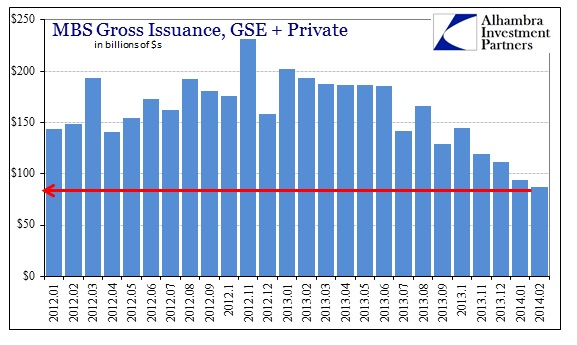
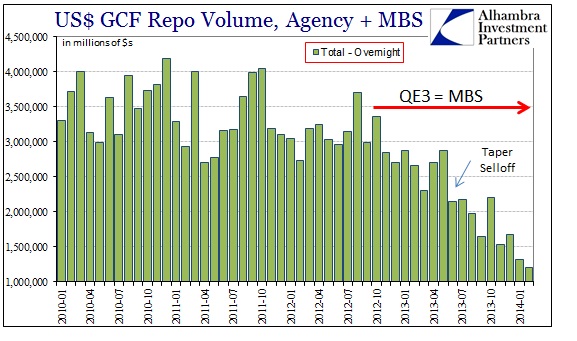
ABOOK Mar 2014 Credit MarketsABOOK Mar 2014 Credit Markets MBS Repo Volume

And this retrenchment was born not of manufactured spreads but of the sudden reappearance of markets awoken from QE-induced slumber. That more than hints at a certain and concerning fragility that is incorporated throughout the post-crisis financial rebuild effort, as you would expect as much since leverage created via “policy” is far less robust than leverage created via organic means. You cannot claim organic fundamentals when a relatively minor increase in the mortgage rate, from record lows to near record lows, produces a 60-70% collapse in MBS (issuance and finance).  Such incongruence is unambiguous evidence of fragility.

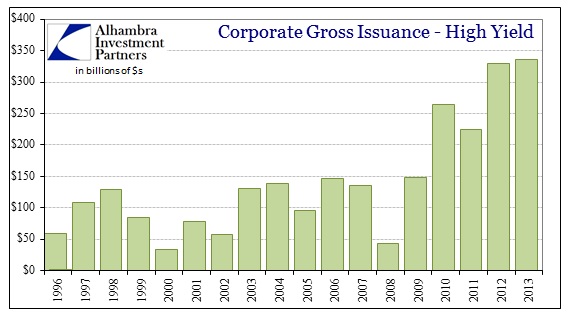
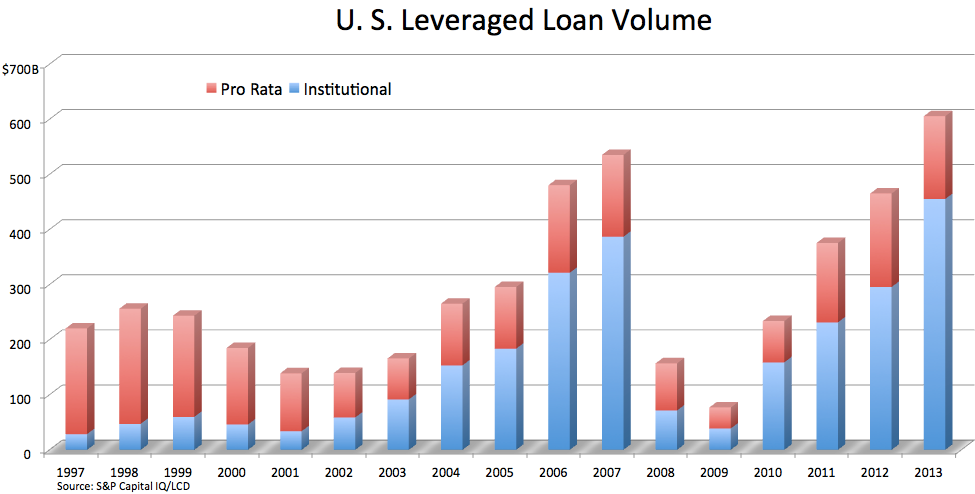
I think that is most evident in the new subprime, or at least the version that has taken on those characteristics within this latest policy “cycle.” High yield debt and leveraged loans (syndicated loans of “low quality” corporate obligors that are bought and sold in discrete packages) in 2013 obliterated the previous cycle peak in 2007.

ABOOK Mar 2014 Credit Markets Corp HY2013-leveraged-loan-volume1

Leveraged loan volume cited above includes only new issuance, meaning that is the marginal expansion of corporate “subprime” borrowing. There is a definite pace to it, as well as junk bonds, clearly moving in cycles that were accelerated beyond historical experience (2004-07, 2010-13). This leverage cycle features no mystery as demand for it is proportional the degree to which spreads and returns are manufactured toward “stimulus.”

Thinking about it in economic terms, there was almost $1 trillion in junk/leveraged loans issued in 2013 that did what, exactly, for the US economy?

It’s not just the pace of credit creation that catches the manipulated spreads here, as quality is assuredly one of the primary factors in determining “cycles.” According to Moody’s, via Barrons:

The average covenant-quality score for high-yield bonds in North America dropped to 4.36 last month from 3.84 in January on Moody’s five-point scale, in which 1 denotes the strongest investor protections and 5 the weakest.

We have been hearing for more than a year that this new subprime has been featuring reduced quality. In terms of leveraged loans, “cov-lite” is now more than half of high yield lending.

As of Jan. 31, the share of loans in the S&P/LSTA Leveraged Loan Index without maintenance covenants grew to a record 50.04%, from 46% at the end of 2013.

Clearly, financial covenants – once a hallmark of secured loans – haven’t been the norm for the new-issue market for some time. In January, 53% of new-issue institutional volume launched was covenant-lite, down from 68% in December.

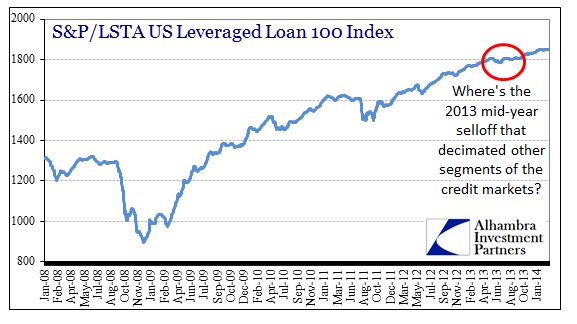
Despite that steady deterioration, there has been exactly zero in the way of perturbation in the leveraged loan market. In other words, the worse these loans get, the more stable prices have become – a telltale sign of bubble mania – which can only be interpreted as participants are convinced nothing bad can happen, ever. Instead, fear is not of loss but of missing out, the very inversion of basic investment fundamentals.

ABOOK Mar 2014 Credit Markets Lev Loans

In the space of only a year or so, the 10-year UST rate is about 100 bps higher, whereas junk bond yields and leveraged loans are about even or lower (particularly in the case of leveraged loans). How is that congruent to what we know about markets? Indeed, that inversion extends in almost every direction, where the riskiest markets have exhibited the most stable and rising prices (I would very much include US equities in that).

The primary problem with this inversion is that it all comes back to misinterpretations of liquidity. If you buy into the leveraged loan premise that exists right now, you are essentially thinking that you will be able to get out if you need to should conditions change (Greater Fool). But that assumption is based on artificial conditions of liquidity that are evident right now, itself manufactured by policy extension. In other words, the volume and bids that exists in these markets today are by no means an indication of what conditions might be like once an inflection is reached (which is inevitable). Narrow spreads like this are an illusion that conditions are favorable and will remain so, but what they really signify is this inversion where risk appears risk-free because leverage has been added solely to policy considerations. The artificiality almost guarantees that will not be the case in relatively short order as revulsion is geometrically more powerful on the downside than complacency on the upside.

It is perhaps the most conspicuous signal of such great imbalance (in dollars) evident at this moment. One final note: tangential to spreads and the rationalizations of them is the historically low default rate. While that may be used as more comfort to buy such junk with reckless abandon, low default rates, particularly this low, are instead indicative of cyclical peaks. But what may be more concerning is that low default rates that persist, due to manufactured spreads and abundant funding, only bunch defaults closer together at that inflection point in the future. In other words, liquidity does not solve solvency problems, only delays the reckoning. Doing so in systemic fashion is the very definition of pro-cyclicality.

See the original article >>

Follow Us