Tuesday, December 3, 2013

Possible rejection of U.S. corn sparks losses; soybeans, wheat slide

By Allendale Inc

Corn: Early talk in the day was that China had rejected one more cargo of U.S. corn from finding non-approved GMO again. This led to early weakness but again large support was seen at and just below contract lows. While this is the second round of China rejecting corn talk, in total we are still only talking three cargoes here, which is certainly not enough to spark large scale selling.

It should come as little surprise that once corn fell under the contract lows of 420, it quickly bounced back. We have seen this happen in March corn each time new lows were made since the lows were 460. There is little reason to expect the recent pattern to change. A long-term grind lower eventually pushes corn to new contract lows, then a technical bounce is seen, then the grind continues again.

Both corn bulls and bears can continue taking their shots at the appropriate times while looking for factors that could change this trend. Possible changes would be cancellations of sales and more rejected cargoes for the bear side while bulls look for even more bean buying to have support spill over to beans. Of course, the bulls can benefit from a sudden increase in sales as well, but that number would have to be close to 1.5 mmt of sales in a week. Bears will likely be quick to sell only a little further bounce than the one seen today. Bulls can buy, once again, on a move to or just under new contract lows of 418 1/2…Ryan Ettner

Soybeans: Soybeans started the week on a negative note as a Sunday night rally was faded by the pit opening and was under pressure the rest of the session. After news that China had rejected two loads of corn due to GMO issues pressed the corn lower, some in the trade booked profits in their bean positions. Most in the trade believe that it is just a matter of time before China will cancel some of the beans they have purchased. Last year they got burnt and had to pay premium for U.S beans when a short crop combined with shipping delays from S.A, forced them to buying beans from the U.S. when they traditionally buy S.A. Beans.

It looks like China might have overbought some of their winter/spring needs and will cancel some of the buys once they have faith the S.A. crop is “made” and the shipping of the crop goes smoothly. They have of 786 million bushels of beans purchased unshipped as Nov. 21. They have purchased 1.352 billion of bushels of beans year to date.

Export inspections Monday came in at 52.6 million bushels, which was way above the 21.8 million bushels needed to be shipped out to keep up with the USDA demand estimates of 1.450 billion bushels. The trade had anticipated the inspections to come in between 55 to 90 million bushels.

Weather in S.A. continues to look good. AgRural is the latest firm to increase its estimate of soybean production due to the good weather they have been receiving. They raised their estimate from 88.7 million tonnes to now 89.4. They see planting at 89% complete compared with 85% last year and 89% for the five-year average. The USDA’s Ag attaché in Argentina estimated their soybean crop at 57.5 million tonnes. This would be sharply higher than USDA’s official latest forecast of 53.5. The attaché also suggests soybean plantings could reach up to 21 million hectares at the expense of corn.

Between now and Christmas, Allendale research shows that soybeans have rallied nine out of 15 years for a 42-¾ cent average gain. As for the six out of 15 years that the market sold off, the average loss was 19-½ cents. With the weather looking so good in S.A., we are hesitant to chase the market over the $13.00 level and think eventually beans will work back down to the $12.50 level.…Jim McCormick.

Wheat: Wheat finished the day lower as trade saw pressure on technical selling and profit taking on the recent bounce. We rejected new highs for the move earlier in the session to finish near the lows but we still have a rounded bottom pattern intact. We could see a little more pressure to test the 20-day moving average. A strong dollar could have also led to pressure in this market. We could see fund traders take profits into the end of the year and in the wheat market this could mean a slight bounce as managed money may take profits to help their books look a little better into the end of the year.

See the original article >>

The House Always Wins

by Marketanthropology

We've held on to a few seemingly discordant ideas as the market has made its way above the Meridian and our demarkation of what's considered rational market performance. As much as we can appreciate the Tepper-esque simplicity of riding unbridled, bareback and bullish into New Year's, for better or for worst we try and keep things in perspective - even if the narratives have difficulty reconciling with each other in the short to intermediate term. 
One market that we have moved our guideposts with since early fall, but one we still find historically stretched even in this environment - is in Japan with the Nikkei and the yen. From a comparative perspective, you can see in the long-term chart below that the Nikkei is sitting directly beneath overhead resistance, yet stretched at such a historic extreme that one could argue the closest market environment from a performance perspective is 1987.

Our best guess is the Nikkei get's rejected once again for a spell before breaking free at a lower level of resistance from its epic long-term range.

With non-commercial speculators short the yen spiking to a fresh six year high last week, commercial traders have built their largest long position since June of 2007. Generally speaking, while day traders may win a few nice rounds at the table, the house typically get's it all back and then some.

Our Quantitative Cocktails concept was predicated on the perception of the governments ability to influence risk appetites through their respective currencies. The yen will need to make a new leg lower here for this cocktail to continue imbibing participants risk appetites higher. All things considered and now similar to the dollar in 2011 - we expect the yen to complete a test of the May low and reverse sharply higher.

See the original article >>

Dow 40,000, SPX 4,000: Is this Fed-Fueled Stock Rally Sustainable?

by Charles Hugh Smith

Since stocks rise when the Fed is adding assets and tank when the Fed pauses...

Now that financial pundits are claiming the current stock market rally is good to go until 2016, it's appropriate to see where the market will be in 2016 if current trends hold.

Let's start with the well-known correlation between the Federal Reserve's balance sheet and the stock market: stocks rise when the Fed is adding assets and tank when the Fed pauses. (Chart courtesy of STA Wealth Management)


Courtesy of Market Daily Briefing, let's look a little closer at the Fed's ballooning holdings of home mortgages (MBS) and Treasury bonds, and extend those trends into the future:


By mid-2016, the Fed will have nearly doubled its Treasury bonds from $2.16 trillion to over $3.5 trillion, and its mortgage holdings will double from $1.44 trillion to $3 trillion. This would represent about a third of total mortgages outstanding.
Here is the Fed's aggregated balance sheet, with the start of each quantitative easing (QE) program indicated:

Grab a ruler and pencil and extend this trendline--you reach about the same target of Fed assets $6.5 - $7 trillion by 2016:


If the S&P 500 (SPX) continues higher in lockstep with the Fed's expanding balance sheet:


Is that SPX 4,000 in 2016, or is it SPX 5,000? The upward trendline is so steep it's hard to project.
Is this uptrend sustainable? You're kidding, right? Don't fight the Fed, Baby--it's Dow 40,000 or 50,000/SPX 4,000 or 5,000 by 2016, guaranteed.
Please note this is sarcasm, not a forecast.

See the original article >>

Upcoming Macro Considerations

By Marc Chandler

The macro picture remains largely unchanged. Janet Yellen is expected to lead the Federal Reserve into a new phase by beginning to taper its long-term asset purchases early next year. The ECB is expect to move in the other direction, leaning against the tightening of financial conditions and the disinflationary forces. Although deflation appears to be being beaten back by the aggressive monetary policy by the Bank of Japan, in the face of capital gains and retail sales tax hikes, many expect the BOJ to have to do even more to achieve its 2% core (excludes fresh food but includes energy) inflation target.

Growth in the world’s second large economy, China, appears to have downshifted, but at 7.5% (Q3) or 7.8% (consensus for Q4), it is still among the fastest growing economies. To round out the five largest economic regions, the recent data shows that the German economy has recovered from the slowdown earlier this year, though at a little more than 1%, its growth is unimpressive. Even this overstates German demand contribution, as its exports about 40% of what it produces.

Within this general macro view, the fundamental picture has become more nuanced. The week ahead may be the last of the jam packed weeks of the year, assuming that our view that the FOMC (Dec 17-18) does not announce any new initiatives at what we suspect may be Bernanke’s last meeting as chair (even though his term extends until the end of January).

Five central banks from high income countries meet next weeks: Australia, Canada, Norway, Britain and the euro area. On balance, none are expected to announce a change in policy. That said, if there is a surprise, it would most likely come from the ECB. Since Draghi has taken the helm, he has surprised the market more than once by his aggressiveness in easing policy (recall the rate cuts at the first two meeting he chaired, OMT, and even the latest rate cut). However, the early estimate showing an uptick in inflation, we suspect the ECB wants to consider more its next step, which could include bringing the repo rate to zero, which might also have the benefit of slowing the LTRO borrowings, where the rate is tied to the repo rate.

Although many observers write as if forward guidance was recently discovered, we would argue this tool has been around for some time and has many forms. One such form will be the ECB staff forecasts. That these are staff forecasts are important. They are not owned by the policy makers, as they are at the Federal Reserve, but by the staff. However, we expect that the updated forecasts will be one of the key highlights of this week’s ECB meeting. The ECB staff will provide 2015 forecasts for the first time and will like cut the 2014 inflation forecast, which currently stands at 1.3%. The larger the cut, the greater the expectation for a stronger policy response.

While the Reserve Bank of Australia is not expected to change the cash rate which stands at a record low 2.50%, it may still keep the door open to further easing in 2014. The roughly 4% decline of the Australian dollar on a trade-weighted basis since late October, is still insufficient to bring it down to fair value.

The news stream may be dominated by two other events in Australia. First, the Australian government is expected to sell a A$1.5 bln 5-year bond in the nation’s largest sale in two decades. Second, investors are still digesting the implications of the government’s rejection of the ADM bid for GrainCorp. That said, as we noted in our technical outlook, the downside momentum on the Australian dollar looks to be easing and market positioning (illustrated by six consecutive losing weeks) vulnerable to a short squeeze.

The Bank of England meeting itself is not very noteworthy. Barring Carney’s first meeting in July, when the MPC doesn’t do anything, the BOE doesn’t say anything, unlike other central banks. However, there are two the developments in the UK that are noteworthy. First, Carney announced a change in the funding-for-lending scheme (FLS) that is important. Going forward it will be redirected away from mortgages and toward small and medium businesses. It is significant because it appears to be the clearest statement to date that the central bank (and any major central bank, that matter) is concerned about over-exuberance developing in the housing market. Recall that house prices rose 10% in the month of October.

Yet, to call the redirection of FLS an example of macro-prudential policies, as some observers have done, appears to be risking stretching the definition of macro-prudential. To include anything a central bank does outside of interest rate policy seems to dilute its significance. Moreover, it is not clear that this is really an alternative to a rate hike as some have suggested. The implied yield on the Dec 14 and Dec 15 short-sterling futures contracts rose 2.5 and 4 bp since the announcement was made. It is probably better understood as a shot across the bow. Investors and home owners have been put on notice.

Second, Chancellor of the Exchequer Osborne will deliver the Autumn Statement before the House of Commons on Dec 5, the same day the MPC 2-day meeting concludes. He is likely to celebrate the smallest deficit in five years and announce a sharp decline in borrowing requirements for the new fiscal year. In addition to the magnitudes projected, it will be important to see if part of the lower funding needs is offset with some increased spending.

The US employment report at the end of the week is the last data highlight. Its thunder appears to have been stolen to some extent by the ADP release. While some indicators, like the weekly initial jobless claims, show continued improvement in the labor market, broader measures of the labor market have not convinced the FOMC, where despite the dissent that the media plays up, the decision not to taper in Sept or Oct proved nearly unanimous with the one dissenter and a serial one at that.

The trend in private sector payrolls improved recently. The three-month average through October stood at 190k, which was above the six-month average (175k), though lower than the 12-month average (196k). The longer-term average will begin falling when the Q4 12 job growth drops out (private sector non-farm payrolls averaged 232k in Q4 12). The consensus looks for a net 175k private sector job growth in November. Anything below 207k will see the three-month average fall off and below 187k and the six-month average will also fall.

Since the US economy began recovering, it has experienced one quarter every year with growth exceeding 3%. The revisions to Q3 GDP due out the day before the employment data may lift the initial 2.8% estimate to something with a 3-handle on it. The more the upward revision is a function of inventory accumulation, the more economists will expect it to weigh on growth in Q4 and/or possibly Q1 14.

The news stream from the periphery of Europe has been generally favorable. Last week S&P upgraded its outlook for Spain to stable from negative. Over the weekend, Moody’s upgraded is Caa3 rating for Greece by two notches to C, citing the optimism regarding it achieving a primary budget balance this year and a surplus next year. Note that differences between Greece and its official creditors appears to be risking stalling the Troika’s next visit and tranche payment.

Separately, we’ll provide more analysis of it later, but suffice it is to say here in the context of a discussion of the investment climate that actions by the central bank of Italy and Spain recently took measures that will free up funding for at least some banks in their respective countries. The central bank of Italy has proposed (and the ECB looks disposed to approve) that it permit trading of equity in the central bank and pay a dividend to shareholders (out of reserves). Italy’s two largest banks own a little more than 50% of the shares. The dividend will increase its value of the shares, which can be used as regulatory capital. The move can be worth as much as 4 bln euros to Italian banks according to some estimates.

Meanwhile, Spain’s government has taken a bold preemptive move. It will allow Spanish banks to reclassify the deferred tax assets (DTAs), which can be used to reduce a future tax liability, to tax credits. The modest booking keeping move has far reaching implications. DTAs will no longer be able to count toward regulatory capital under the Basel III, but tax credits can, It will reduce the amount of capital Spanish banks would have to raise in lieu of the DTAs. It is worth an estimated 50 bln euros.

Turning to Japan, there two areas in which Japanese businesses are not cooperating with the Prime Minister’s economic agenda. First, businesses have been reluctant to pass along strong corporate profits to employees in the form of higher regular wages. Second, they have been reluctant to boost investment. The capital spending report due early Monday is likely to show an improving trend (3.2% in Q3 from flat in Q2 and -3.9% in Q1) . A Nikkei survey of over 1400 companies found plans to boost spending 13% in the next fiscal year, which would be the most since 2005.

China reported its official PMI was unchanged at 51.4 in November over the weekend. Many had expected weakness because the HSBC preliminary measure slipped to 50.4 from 50.9. The export orders sub-index rose to 50.6 from 50.4, but overall new orders slipped to 52.3 from 52.5. Production also fell. The hoarding of raw materials that seen in the past appears to have ended as stocks of new purchases fell to the lowest level since July (47.8), which many have knock on implications for some commodities, like iron ore and/or copper, for example.

Meanwhile, the scramble to respond to China’s claim of an air defense identification zone around the disputed islands continues. The US, South Korea and Japan are not officially recognizing the legitimacy of China’s claims, though the US has advised commercial flights to notify Chinese officials as requested to minimize the risks of a terrible accident and they have reportedly complied. It is not clear that these heightened tensions will have economic spillover and it is worth monitoring trade flows as this was the channel China used last time to punish Japan over the disputed islands.

From a larger point of view, this is is an attempt by China to assert itself even more in the region. Its challenge is not just over South Korea and Japan’s territorial claim, but to the US as the regional hegemon. Yet on the world stage, China is still clumsy. Its course will negate the good will achieved by the new government in its diplomatic offensive while US President Obama was stuck at home with a closed government.

UK Prime Minister Cameron begins the week in China. Given London’s desire to be an offshore center for renminbi trading and the new investment agreement that will bring Chinese money into the UK’s nuclear power, he will pretend he does not have a dog in that fight. US Vice President Biden will visit Japan, South Korea and China next week to diffuse tensions. However, it is not clear that the new Chinese government can afford to acquiesce, especially given that this dispute is only one of several it has in the region. Instead, it seems more likely that it will claim another airs defense identification zone. Moreover, for a number of reasons, Chinese officials likely will conclude that it can dominate any rung in the escalation ladder that the US is presently likely to take.

This is not a Bay of Pigs scenario. The air defense identification zone is not territory that is defended and they are not legally binding. Japan and South Korea already had announced their own air defense identification zones, which now overlap China’s claim. It seems likely a well-timed probe China. If it brings out Japanese nationalist roots of the Abe government, it will undermine Japan’s ability to form regional coalitions. The US seems war weary and President Obama’s support is near record lows. The domestic issues, like health care and fiscal policy dominate the agenda.

See the original article >>

Getting Ready for the Big One: February 2014

By tothetick

ready for Christmas? What’s Santa got in his sack for you this year? Well, if there’s one thing you should be preparing for, then it can only be the big crash of February 2014. The signs have been there for months now and it’s definitely now on the books for February next year. Santa will be emptying his sack and it won’t be presents that will be falling from the sky as his sleigh goes whizzing past us.

Preordained Events

Stick the date in your diary, pop it on your iPad and synch it with your iPhone. Use them while you can, because they will be relics of the past most undoubtedly in the coming months. You won’t be needing anything in the future, once the financial world implodes and it is set to happen in February 2014.

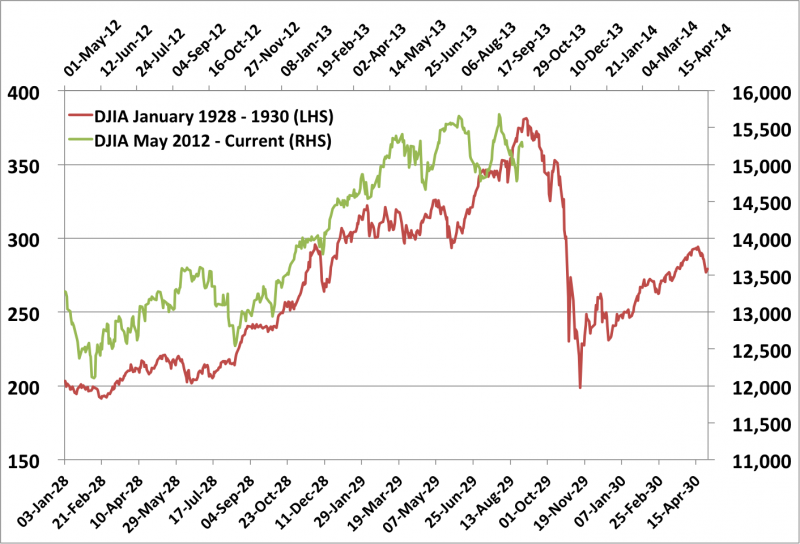
If we were in 1929, this would be June 1929, just a few months before the crash happened back then. Yes, we can say whatever we like with numbers, but like cameras, there are some calculations that never seem to lie. Businesssweek’s Tom DeMark, a financial analyst has put together indicators that are able to predict movements of the market with surprising accuracy. DeMark states that “the market’s going to have one more rally, then once we get above that high, I think it’s going to be treacherous. I think it’s all preordained right now”.

Some might be saying that we didn’t need a crystal ball and we had no need for mathematics either to show that. You just had to look at how the Federal Reserve has bounced the financial markets back into a false-sense of security without actually doing anything at all to change the economy. Where’s the employment, where’s the increase in industry? It’s in the past. The only thing that is there right now is the virtual prosperity of the financiers and the banks. The next US shutdown and arrival at the debt ceiling will be just in time too for the biggest crash in history and will probably be linked.

Cash in on the last rise of the financial markets before what has been set down long ago comes of age and ripens completely. After that, who knows! You’ll have to buy low and wait a long time before the markets move back up.

The chart that compares pre-1929 and today is uncannily identical. Take a look for yourself. Pooh-pooh it, refuse to see it, do whatever you wish, but the crash will be coming and it’s the banks that started it all. The government will finish it all. God bless America! Game over! Goodnight!

DeMark's Market Predictions

DeMark's Market Predictions

It’s something when you end up witnessing the downfall of your own country. Some have been predicting it for years now and have been shouted down. They will be consoled by ‘I-told-you-so’ vociferating. But, it’s doubtless if that will help them anymore than anyone else.

The number of companies that is pushing the stock markets higher is narrowing at an alarming rate and there are a handful today that are taking the markets higher. That handful will gradually reduce and collapse. The eggs that were put into one basket by Ben Bernanke will end up being splattered on Janet Yellen’s face as she takes over. She should get out now while she can! The few companies that are dragging the financial market up by the collar are distorting the perception of the rest of the companies there and so speculation is becoming greater and greater.

January will see the bull rush on the financial markets for the last time. Then things will fall dramatically. You’ve been warned.

Yet again, those that believe they know will turn their noses up and say it’s never going to happen. Granted, the markets are unpredictable. But, there is one thing we all have to agree on, they are buoyant on nothing right now. They are increasing without any reason to do so. That won’t last at all.

January is named after the ancient Roman mythological God Janus. He’s the god of beginnings and transitions, changes and endings or new beginnings. This year Janus, the gateway god, will be looking back into the past to 1929, stopping off on the way at the financial crisis of 2007/2008. But, he isn’t two-faced for nothing.

He’ll be looking into the future and pin-pointing February as the time you’ll need to take cover. Forget the financial crisis of yesteryear or yester-century. This one will be the biggest, the best, the most of everything you could imagine.

The Americans always did excel in verbose language and hyperbole. They always did excel at showing the world that they were the top of the roost and the best at whatever they did. As the last beats of Auld Lange Syne play out, ringing in your ears, the Americans will be surely remembered as those that started it all. Well done the Federal Reserve; well done the successive governments.

See the original article >>

Morning markets: hedge fund bearishness stabilises wheat

by Agrimoney.com

Wheat futures found a couple of important price supports to keep their head just above water in early deals, despite what looked a big blow from an upgrade to Australia's estimate for its harvest.

Analysts in Australia, the southern hemisphere's top wheat producer and exporter, have been on a slight downward trend in their crop estimates, with the US Department of Agriculture attaché in Canberra last month forecasting the harvest at 23.5m tonnes.

However, Australia's official Abares commodities bureau on Tuesday raised its forecast for the crop, by 1.75m tonnes to 26.213m tonnes.

"In Western Australia and Victoria, generally favourable conditions and timely rainfall during spring increased prospective yields, particularly in southern and central Western Australia," Abares said.

Egypt returns

That might have been expected to put a downward slant to Chicago wheat prices.

"With an increase in wheat output from other wheat exporting countries, U.S. wheat supplies could face competition going forward," Vanessa Tan at broker Phillip Futures noted.

But futures received support from a fresh tender by grain officials at the Gasc authority in Egypt, the top wheat importing country, the fifth tender in the last month, and a sign of resilient demand.

There is also an idea that strong Chinese needs will soak up much of Australia's export availability.

Certainly, wheat prices in Australia itself seemed little perturbed by the Abares number, with Sydney's January contract for east coast wheat adding 0.7% to Aus$297 a tonne, matching the contract's highest close in more than a year.

The March lot edged 0.1% higher to Aus$296.80 a tonne, a three-month closing high.

Bearish hedge funds

And, on the technical side, data overnight from the Commodity Futures Trading Commission, the US regulator, showed hedge funds raising their short position in Chicago wheat futures to a record high, of 66,000 contracts.

That actually can be interpreted as a bullish signal, in that it raises questions over the degree of hedge fund selling pressure left unspent.

"There's some question as to whether or not the trade is going to be willing to press the wheat markets in the face of the net short fund position in Chicago continuing to grow," Benson Quinn Commodities said.

Egypt's tender, combined with the size of the fund position in Chicago, "could offer support" to prices overnight.

Not that all technical factors were in wheat's favour, with the best-traded March contract signally bouncing back below its 100-day moving average in the last session, suggesting this line could continue to provide a headwind to upward price movement.

Furthermore, official Canadian data due later this week are expected to show the country's wheat crop at a record 33.8m tonnes, even higher than the 33.2m tonnes that the USDA has already factored in.

And, as Benson Quinn Commodities noted, "the trade hasn't warmed up to ideas" that Argentina's wheat crop will come in at a lowly 8.5m tonnes, as the country's farm ministry said last week.

"Most continue to believe a 10m-10.5m-tonne figure is more accurate."

Still, wheat futures managed a 0.2% gain to $6.63 a bushel in Chicago for March delivery as of 09:50 UK time (03:50 Chicago time).

Seasonal trend

Even so, that wasn't enough to wrestle back much of the premium over corn lost in the last session, with the yellow grain adding 0.2% to $4.25 ¼ a bushel for March delivery.

Corn too is receiving some support from a hefty hedge fund net short position, of 141,000 contracts, if one short of the record 180,000 lots set in October.

But it has another technical support too, in a seasonal trend.

Richard Feltes at RJ O'Brien, quoting Moore Research, highlighted a "strong tendency" for March wheat futures to lose ground against March corn futures "through December 10 and from early January through March".

In fact, March corn futures have gained on March wheat futures "from February 2 to March 1 in seven of last 10 years and in 65% of last 20 years", he said.

'Shut the bin doors'

And the idea of resilient corn prices, for now, is gaining support from a lack of producer selling, even against Chicago's expiring December contract.

"Producers have shut the bin doors, hoping to help rally the market and this has been seen in strong basis levels," US Commodities said.

This has provided some counterbalance to the caution injected by further rejections by China of US corn cargoes.

"This has caused uncertainty among cash traders as they scramble to resource these unaccepted shipments," one US broker said.

"As we move forward the trade will be closely monitoring any new rejections and also possible cancellations that could show up in this week's export sales report."

'Favourable South American weather'

Soybeans rose too, by 0.3% to $13.24 ¾ a bushel, and without any help from Commodity Futures Trading Commission data, with hedge funds actually raising their net long position in Chicago futures and options in the week to last Tuesday by nearly 17,000 contracts.

And there is plenty of talk around of a bumper South American harvest ahead, with the USDA attaché in Buenos Aires raising hopes for the Argentine harvest, pegging it at 57.5m tonnes, 4.0m tonnes above the department's official guess, and ideas of the Brazilian crop approaching 90m tonnes.

"Mostly favourable South American weather weighs on the market with Brazil receiving beneficial rains over most of country this weekend and Argentina to experience dry week to get aid planting pace," Benson Quinn Commodities said.

'Bearish background talk'

Anne Frick at Jefferies Back said that "concerns about China overbooking US soybeans, making cancellations a possibility and a favourable weather outlook for the South American crops are combining to dampen the usage-led rally.

"There is also talk about the weakening price outlook for commodities in general providing some bearish background talk," she added, also flagging a weak technical point in that futures in the last session recorded "an outside range reversal lower", meaning that they traded beyond the range of the previous session but closed weaker.

This shows "that the post-harvest high may be in place".

Still, while US export data on Monday were disappointing, if not poor, it appears too early yet to write off the impact of tight US supplies.

"China soybean imports in November and December are expected to be record large," Benson Quinn Commodities said, adding that the market is treading "fine line balancing between a tightening US outlook and record availability expected with South American harvest".

'Fundamentals remain soft'

Among soft commodities, one of the big questions is whether sugar will continue its downswing, which is now getting within sight of taking New York's March lot to its contract low, at 16.70 cents a pound, and potentially beyond.

In fact, the lot shed a further 0.2% to 16.93 cents a pound

"Fundamentals remain soft," Luke Mathews at Commonwealth Bank of Australia said, noting the prospect of a 10% rise to 11.0m tonnes in output from Thailand, the second ranked exporting country, with hopes revived for India too after the resolution of a dispute between mills and producers.

"The National Federation of Sugar Factories indicates that output will still reach a very comfortable 25m tonnes, meaning India continues to export," Mr Mathews said.

White sugar no help

He also clocked the loss in white sugar futures, down 0.2% to $454.10 a tonne in London, and setting a contract low of $435.50 a tonne earlier.

"The implication is that a white-led recovery in the global sugar market appears unlikely, at least in the near term."

And profit-taking weighted on cocoa in early deals, with the March contract, which in the last session hit two-year highs for a nearest-but-one contract, down 0.1% at $2,811 a tonne.

See the original article >>

Follow Us