Saturday, September 7, 2013

Growth in low paying jobs and wage deflation for low-income groups - a painful trend

by SoberLook.com

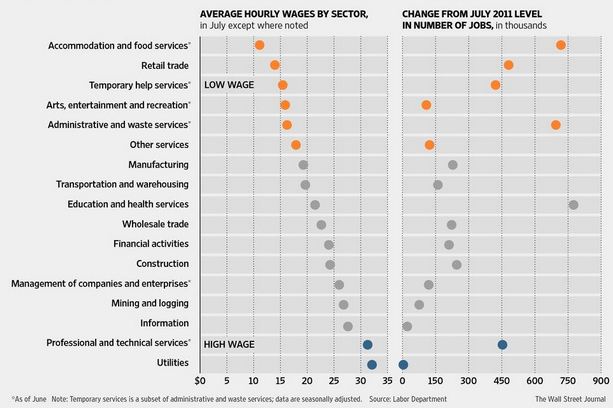
A few weeks back the WSJ published a chart showing that growth in US payrolls has been dominated by low wage jobs (see chart). It's worth exploring the topic some more. Though not precise, one way to confirm this trend is to look at the "indexes of aggregate weekly hours and private payrolls by industry sector" from the U.S. Bureau of Labor Statistics (here). Over the past 5 years the indexes show non-supervisory hotel jobs for example outpacing the overall private payrolls growth. The higher paying construction and factory jobs on the other hand lag the overall index.

Source: US BLS

What's particularly worrying is that according to at least one study (here), it is the low wage workers who have experienced the highest wage deflation.

Source: National Employment Law Project

This combination of more payrolls in low paying sectors and higher wage deflation for many of those same employees is contributing to weakness in the overall US real wage growth (see discussion).

See the original article >>

BASTA!!

Basta .. stop it .. report it for stalking …


Basta

FOMC members fret over deflation risks

by SoberLook.com

Some FOMC members continue to focus on the historically low inflation levels in the US (see post). They are worried about repeating the Japan experience of being stuck in a deflationary regime for years. They want to see some inflation return before changing policy.

Chicago Fed President Charles Evans: - "For me, to start the wind-down, it will be best to have confidence that the incoming data show that economic growth gained traction during the third quarter of this year and that the transitory factors that we think have held down inflation really do turn out to be transitory."
But it's not just the current level of inflation that the Fed is monitoring. As important (if not more) for policy decisions are inflation expectations - the markets' consensus of future inflation. The Cleveland Fed has developed a methodology to track expectations of future inflation (described here). It's basically the breakeven (market implied) inflation minus what they refer to as "risk premium" - a historical volatility based measure ("GARCH processes" for those who are interested). And the last time this number was published, inflation expectations picked up - which must have made some of the FOMC members quite happy. The US is not becoming another Japan ...

Source: Federal Reserve Bank of Cleveland

But since this inflation expectation result was last published in mid August, the situation has changed. While the "risk premium" adjustment in the calculation is a bit "over-engineered", the measure is relatively constant.  This makes it possible to estimate intramonth moves in the Fed's inflation expectations using simple breakeven rates based on TIPS (inflation protected treasuries). And the breakeven rates have been declining lately.

Source: Ycharts

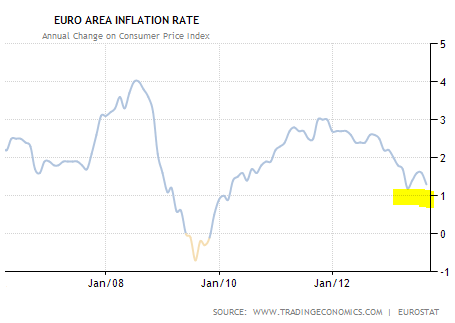
This may make some of these FOMC members jittery again as the "Japan fears" return. What may add to their concerns is that the Eurozone is now also showing potential deflationary risks. The EMU inflation rate has been surprisingly low.

The next inflation expectation numbers come out the same day as the CPI - September 17th (8:30 AM). On that same day the FOMC begins its meeting. Will the "Japan fears" dominate the debate? The breakeven trajectory in the next week should tell us.

See the original article >>

The ELLIOTT WAVE weekend update

by tony caldaro

REVIEW

For a four day trading week this one certainly had some volatility. After ending last week only five points from the downtrend low the market gapped up on Tuesday hitting SPX 1651. Then it dropped to SPX 1633, rallied to 1662, dropped to 1641, then rallied to 1665. For the week the SPX/DOW were +1.10%, the NDX/NAZ were +1.95% and the DJ World index closed +2.1%. Economic reports again had a positive bias. On the uptick: ISM manufacturing/services, construction spending, monthly payrolls, the monetary base, and both the unemployment rate plus weekly jobless claims improved. On the downtick: the ADP index, factory orders, the WLEI and the trade deficit worsened. Next week we get consumer credit, retail sales and consumer sentiment.

LONG TERM: bull market

Despite the market’s roller coaster ride over the past few weeks the long/medium term count remains unchanged. The stock market is still advancing in a Cycle wave [1] bull market from the Super cycle wave 2 low in March 2009. This bull market appears to have gone through the normal investor sentiment cycle as well. Two years off the lows, most did not believe this was a bull market. Three years off the lows, a shift from disbelief to neutral occurred. Four years off the lows, when the DOW made all time new highs, most accepted it was a bull market after all. Now, many are not expecting another bear market for years to come. It appears we went through the same exact investor sentiment cycle during the last bull market.

SPXweekly

Cycle wave [1] bull markets unfold in five Primary waves. Primary waves I and II completed in 2011, and Primary wave III has been underway since then. Primary I divided into five Major waves with a subdividing Major wave 1. Primary wave III is following a similar pattern, but both Major waves 1 and 3 have subdivided. Major waves 1 and 2 ended by mid-2012, and Major wave 3 ended in August 2013. Major wave 4, of Primary wave III, is currently underway. When this correction concludes, some time this month, a Major wave 5 uptrend should take the market to new highs to end Primary III. Then after a Primary IV correction, a Primary V uptrend should take the market to higher highs completing the bull market. We expect the top to occur by late-winter to early-spring 2014.

MEDIUM TERM: downtrend

For the most part the SPX and DOW have remained in lock step throughout this bull market. There was one exception however: the spring of 2012. Then the DOW confirmed a downtrend, while the SPX did not. The DOW then rallied to new highs, while the SPX did not. After this they both corrected in unison about 10%. The NDX/NAZ, however, have been in a bull market pattern all their own.

We are not suggesting the DOW will make new highs before the entire market corrects further. We are only noting that the four major indices can diverge for a short period of time, which generally produces no net real progress. Then when they re-sync the main trend is usually sharp and swift. Currently we have the bellwether DOW in a confirmed downtrend. While the SPX/NDX/NAX appear to be trading between bull market highs and their recent lows. In the end, before much upside progress is made, the DOW’s downtrend will exert itself and take the market lower.

SPXdaily

When this downtrend began we guesstimated a three Intermediate wave decline in the SPX: 1630-1670-1540. The SPX dropped to 1639, and then rallied to 1670 before heading to 1627. Naturally we assumed SPX 1639 ended the first wave down, 1670 ended the counter-trend rally, and the drop to 1540 was next. When the market reached SPX 1627 it bounced around before rallying this week to 1665. This last rally was quite clearly the best rally, since the downtrend began, in both the SPX and DOW. Therefore SPX 1627 looks like the Intermediate wave A low and we have rallied in Int. wave B. When this rally concludes, Intermediate wave C should be next. Medium term support is at the 1628 and 1614 pivots, with resistance at the 1680 and 1699 pivots.

SHORT TERM

This tricky initial decline for Major wave 4 has unfolded in five Minor waves SPX: 1685-1700-1639-1670-1627. We have labeled this Intermediate wave A. Intermediate wave B, however, has been extremely choppy. With the rallies and pullbacks getting larger and larger as the rallied has unfolded. As it has unfolded the wave pattern has fit into a rising wedge, or ending diagonal. The DOW, btw, ended its uptrend with an ending diagonal. The Int. wave B wave pattern can also be counted as a double three: [1646-1628-1651]-1633-[1662-1641-1665]. However one looks at this rally it does not look impulsive at all. So where does it end.

SPXhourly

Short term resistance is at SPX 1658-1667 and the 1680 pivot range. The rally hit the lower range on Friday. Fifty percent and 61.8% Fibonacci retracements of Int. wave A suggest SPX: 1669 and 1678. Again just about the same ranges. The Minor fourth wave of Int. wave A was at SPX 1670. So all indications are that Intermediate wave B should be topping out soon. Also of note, Friday ended the day with a short term negative divergence. This is the first negative divergence since the uptrend high at SPX 1710. So Friday’s high at SPX 1665 can not be ruled out as the high either. Overall, it would appear there is little upside ahead before Int. wave C asserts itself and the market heads lower.

FOREIGN MARKETS

The Asian markets were mostly higher gaining 2.1% on the week. India, Indonesia, Japan and Singapore remain in downtrends.

The European markets were all higher gaining 3.0%. No confirmed downtrends here yet.

The Commodity equity group were all higher gaining 4.4%. Russia is still in a confirmed downtrend.

The DJ World index is still uptrending and gained 2.1% on the week. Thirty percent of the world’s markets are in confirmed downtrends.

COMMODITIES

Bonds continue to downtrend losing 1.0% on the week. 10YR yields have now risen from a record 1.39% low in July 2012 to 2.98%.

Crude remains in a volatile uptrend gaining 2.4% on the week.

Gold is still uptrending but lost 0.4% on the week.

The USD is now uptrending gaining 0.1% on the week. The downtrending EURUSD lost 0.3%, and the JPYUSD lost 0.9%.

Next week

Monday: Consumer credit at 3:00. Wednesday: Wholesale inventories. Thursday: weekly Jobless claims, Export/Import prices, and the Budget deficit. Friday: Retail sales, the PPI, Consumer sentiment and Business inventories. The FED remains unusually quiet with no public scheduled meetings/speeches until the FOMC on the 17th and 18th. QE tapering starting in October? Best to your weekend and week!

See the original article >>

Stock Market Corrective Bounce - Elliott Wave Forecast

By: Gregor_Horvat

S&P has been trading lower last week but then it reversed higher from 1625 area which is fine because we had five sub-waves down in wave (A), but we know that after every five wave move correction will follow and that is exactly what has been happing in this week.  Market rallied higher with corrective personality; wave (B) as labeled on the chart. In Elliott Wave theory wave (B) are against the larger trend which means that sooner or later we expect move to the downside!

The important thing that we need to understand is a five wave of decline from 1705, which in Ellliott Wave theory show us current direction of a trend. It means down!

S&P 500 4h

On the intra-day basis we can see some sharp reversal in trend after the NFP report. Well, there were speculations that if NFP will be better than expected then we could be look for tapering, but numbers came out worse than expected: 169K suggesting no tapering so soon, so USD is moving lower. Data also has a negative impact on stocks while the US bonds are rising. On US stocks futures we can see sharp sell-off, with the S&P Futures now testing the lower support line of an upward channel. If stocks will remain weak at the close today, then be aware of a 1620 break on the S&P early next week.

S&P 500 1h

Written by www.ew-forecast.com | Try our 7 Days Free Trial Here

Ew-forecast.com is providing advanced technical analysis for the financial markets (Forex, Gold, Oil & S&P) with method called Elliott Wave Principle. We help traders who are interested in Elliott Wave theory to understand it correctly. We are doing our best to explain our view and bias as simple as possible with educational goal, because knowledge itself is power.

See the original article >>

Gold: An Attitude Adjustment For Institutional Banks

By: Clif_Droke

The last couple of weeks have witnessed changing attitudes of large institutions concerning the gold price. A growing number of institutional analysts are become bullish - some them ultra bullish - on gold's near-term outlook. What makes this unusual is the fact that only a few weeks ago they were singing a bearish tune. The swift attitude adjustment is a testament to the strong impact of rising prices on the investor psyche.

For instance, it was recently reported that Citigroup expects gold will rise to $1,500-$1,525 - a gain of over 6% from today's prices. Moreover, Citigroup's Tom Fitzpatrick's forecast that gold could reach $3,500 "in the next couple of years." He also sees silver jumping to $100/oz.
Joining the bullish bandwagon for gold is Societe Generale, but with a twist: SOCGEN analyst Albert Edwards foresees a stock market crash on the horizon; he also believes the gold price will climb to $10,000 as investors rush into safe haven investments. Back in June, SOCGEN analysts Michael Haigh, Jesper Dannesboe and Robin Bhar argued that ETF selling and plummeting jewelry demand would result in a Q4 gold price of $1,200/oz. SOCGEN also recommended dumping safe havens like gold in exchange for buying bank and consumer retail stocks back in June. Talk about a reversal of sentiment!
Sounding a more level-headed note, Goldman Sachs recently weighed in on gold's near-term prospects. Goldman has been rather quiet after correctly predicting the May-June gold sell-off and subsequent market bottom. Of the major institutions, Goldman is by far the most accurate when making forecasts, though I should point out that even mighty Goldman sometimes gets it wrong. (Remember the blown $200/barrel oil forecast in 2008?)
According to The Economic Times, Goldman Sachs raised its gold forecast for the second half of 2013 to $1,388/oz. from $1,300/oz. based on the metal's recent price action. The firm is maintaining its intermediate-term and long-term price forecasts, however. Of the major institutions that have made gold price forecasts, Goldman Sachs seems to be the most balanced and realistic.
"We believe the recent uptick is a result of investors positioning themselves for an increase in inflation rates and speculation regarding a potential military strike on Syria," the bank said in an equity research note dated Sept 2.
According to The Economic Times, Goldman said it expects gold prices to ease, longer term, on improvement in the U.S. economy and the reining in of an accommodative Federal Reserve monetary policy.
As noted previously, the implication of these high-profile institutional predictions is that sentiment among the big banks on the metals is becoming optimistic bordering on giddy. This isn't exactly a good sign from a contrarian perspective. Already gold has violated its 15-day moving average to technically break the immediate-term uptrend. While this may prove to be merely a temporarily "pause that refreshes" for the metal, conservative traders should treat the signal with respect and wait for the buyers to reassert themselves by retaking the 15-da MA.


I would also point out that the non-commercial short position among gold speculators, after rising to a multi-year record level recently, has dropped precipitously in recent weeks. Analyst Tyler Durden has pointed out that short positions in the gold futures and options market have dropped for six of the last seven weeks. "The 60% drop in the non-commercial short position represents a massive 81,700 contracts (8,170,000 ounces or ~$10.6 billion worth of notional 'paper' gold)," he wrote. He further noted, "Gold's 21% rise from the lows in the last 2 months is among the fastest rises since 1999 ; and GLD holdings have risen for the last 6 days in a row."
The sharp decline in gold short positions gives us another reason to exercise caution in the near term since bearish sentiment is rapidly being replaced by bullish sentiment. This can create irrational expectations for short-term gains among speculators. Should these gains be disappointed it can result in a potentially sharp pullback in the gold and silver prices.

High Probability Relative Strength Trading

Traders often ask what is the single best strategy to use for selecting stocks in bull and bear markets? Hands down, the best all-around strategy is a relative strength approach. With relative strength you can be assured that you're buying (or selling, depending on the market climate) the stocks that insiders are trading in. The powerful tool of relative strength allows you to see which stocks and ETFs the "smart money" pros are buying and selling before they make their next major move.

See the original article >>

Follow Us