Tuesday, July 2, 2013

Coffee higher as roasters show buying interest

By Jack Scoville

COFFEE

General Comments: Futures were higher in range trading.  The cash market remains very quiet.  However, roasters are showing more buying interest and it is possible to get some business done.  Sellers, including Brazil, are quiet and are waiting for futures to move higher.  Buyers are interested on cheap differentials, and might start to force the issue if prices hold and start to move higher in the short term on ideas that the market made a bottom.  Brazil weather is forecast to show dry conditions, but no cold weather.  There are some forecasts for cold weather to develop in Brazil early next week, but so far the market is not concerned.  Current crop development is still good this year in Brazil.  Central America crops are seeing good rains now.  Colombia is reported to have good conditions.

Overnight News:  Certified stocks are higher today and are about 2.747 million bags.  The ICO composite price is now 116.15 ct/lb.  Brazil should get dry weather except for some showers in the southwest.  Temperatures will average near to above normal.  Colombia should get scattered showers, and Central America and Mexico should get showers, and rains.  Temperatures should average near to above normal.  ICE said that 7 delivery notices was posted against July today and that total deliveries for the month are now 799 contracts.

Chart Trends:  Trends in New York are down with no objectives.  Support is at 117.00, 116.00, and 113.00 September, and resistance is at 123.00, 125.00, and 126.00 September.  Trends in London are mixed to up with objectives of 1835 and 1900 September.  Support is at 1755, 1720, and 1705 September, and resistance is at 1800, 1855, and 1870 September.  Trends in Sao Paulo are down with no objectives.  Support is at 140.00, 137.00, and 134.00 September, and resistance is at 148.00, 151.00, and 155.00 September.

COTTON

General Comments:  Futures were higher after holding support on the charts.  It was a low volume session with the holiday this week.  Futures held the short term range.  It is possible that futures can work lower again as demand has turned soft.  Ideas of better production conditions in the US caused some selling interest.  Texas is reporting light precipitation, mostly in southern areas.  Dry weather is being reported in the Delta and showers and storms are seen in the Southeast.  The weather should help support crop development in the Delta and Southeast, and could help in Texas.  Weather for Cotton appears good in India, Pakistan, and China.

Overnight News:  The Delta should be dry and Southeast will see showers and rains.  Temperatures will average near to below normal this week, but near to above normal this weekend.  Texas will get a few showers early this week, but will be mostly dry.  Temperatures will average near to below normal, but near normal this weekend.  The USDA spot price is now 82.55 ct/lb.  ICE said that certified Cotton stocks are now 0.623 million bales, from 0.623 million yesterday.  ICE said that 757 notices were posted today and that total deliveries are now 2,317 contracts.

Chart Trends:  Trends in Cotton are mixed.  Support is at 85.10, 84.00, and 82.80 October, with resistance of 86.40, 86.90, and 88.00 October.

FCOJ

General Comments:  Futures closed higher in recovery trading.  There has been little selling pressure on the market in the last week since the dramatic move lower.  Better weather in Florida seems to be the big problem for the bulls at this time.  Futures have been working generally lower as showers have been seen and conditions are said to have improved in almost the entire state.  Ideas are that the better precipitation will help trees fight the greening disease.  No tropical storms are in view to cause any potential damage.  Greening disease and what it might mean to production prospects continues to be a primary support item and will be for several years.  Temperatures are warm in the state, but there are showers reported.  The Valencia harvest is continuing but is almost over.  Brazil is seeing near to above normal temperatures and mostly dry weather, but showers are possible later this week.

Overnight News:  Florida weather forecasts call for showers.  Temperatures will average near to above normal.  ICE said that 0 delivery notices were posted today and that total deliveries for the month are now 0 contracts.

Chart Trends:  Trends in FCOJ are mixed to down with no objectives.  Support is at 125.00, 122.50, and 121.50 September, with resistance at 130.00, 131.50, and 132.50 September.

SUGAR         

General Comments:  Futures closed lower despite the smallest delivery in seven years against July contracts in New York.  Ideas are that mills had not had time to amass more Sugar due to a delayed harvest in Brazil because of rains and also because they are concentrating on producing ethanol.  Futures might try to work lower this week.  There is still talk that a low is forming or has formed for at least the short term, but there is still a lot of Sugar around, and not only from Brazil.  The Indian monsoon is off to a good start and this should help with Sugarcane production in the country.  But, everyone is more interested in Brazil and what the Sugar market is doing there.  Traders remain bearish on ideas of big supplies, especially from Brazil.  Traders in Brazil expect big production to continue as the weather is good.

Overnight News: Showers are expected in Brazil, mostly in the south and southwest.  Temperatures should average near to above normal.  ICE said that 2,835 lots were delivered against July Raw Sugar futures.

Chart Trends: Trends in New York are mixed to down with objectives of 1640 and 1580 October.  Support is at 1650, 1620, and 1600 October, and resistance is at 1690, 1715, and 1750 October.  Trends in London are mixed to down with objectives of 475.00, 465.00, and 448.00 October.  Support is at 478.00, 475.00, and 470.00 October, and resistance is at 490.00, 496.00, and 499.00 October.

COCOA        

General Comments:  Futures closed lower on ideas of good harvest weather and active movement of beans to ports in western Africa.  Internal prices are reported weak in much of Africa.  Ideas of weak demand after the recent big rally kept some selling interest around.  The weather is good in West Africa, with more moderate temperatures and some rains.  It is hotter and drier again in Ivory Coast this week, but the rest of the region is in good condition.  Ivory Coast is starting to see showers, but will need more rain soon.  The mid crop harvest is about over, and less than expected production along with smaller beans is reported.  Malaysia and Indonesia crops appear to be in good condition and weather is called favorable.

Overnight News:  Scattered showers are expected in West Africa.  Temperatures will average near to above normal.  Malaysia and Indonesia should see episodes of isolated showers.  Temperatures should average near normal.  Brazil will get mostly dry conditions and warm temperatures.  ICE certified stocks are lower today at 4.934 million bags.  ICE said that 22 delivery noticies were posted today and that total deliveries for the month are 294 contracts.

Chart Trends:  Trends in New York are mixed.  Support is at 2130, 2100, and 2080 September, with resistance at 2190, 2200, and 2230 September.  Trends in London are mixed.  Support is at 1440, 1420, and 1360 September, with resistance at 1470, 1490, and 1520 September.

See the original article >>

Active Money Managers run away from risk assets!

by Chris Kimble

CLICK ON CHART TO ENLARGE

The Power of the Pattern shared with Sector/Commodity Sentiment Extreme members last week that Active Money Managers were pairing back risk asset exposure quite a bit of late. This decline is reflecting a decent shift in sentiment among the active managers at the time the S&P 500 was on rising support. As you can see above, more often than not over the past few years, when risk managers pair back risk assets, the market was near a time that a rally took place!

CLICK ON CHART TO ENLARGE

The above chart of Apple was produced last Friday (see post here), reflecting a combo of.... potential double bottom and bullish falling wedge in Apple, with bullish sentiment currently at 39%. Apple was trading at $398 at the time of the posting, currently it is trading $19 higher since the Friday chart.

See the original article >>

Our Energy Slaves Are in Recession

by Charles Hugh Smith

Charts of energy consumption are screaming "recession."


To get a feel for how many energy slaves you have, imagine hiring 40 people to drag you and your car down the street at 3 miles per hour. Replacing the energy in a gallon of gasoline with human labor is imperfect, of course, because the people you hire to drag your vehicle down the street cannot run 70 miles an hour.

The gallon (or four liters) of petrol will push your car about 25 to 30 miles at high speeds at a market cost of about $4. Imagine how much it would cost to pay 40 people to drag your 1.5-ton car 25 miles--a lot more than $4. (Weight of 2012 Ford Fusion: 3,285 pounds. Weight of 2012 Honda Civic: 2,765 pounds.)

You get the idea: every bit of fossil fuel you consume is the equivalent of an energy slave. Correspondent David P. (Market Daily Briefing) describes the concept thusly: "Your personal standard of living is derived (largely) from the number of energy slaves you have working for you." Energy Slaves - 5 charts

David kindly shared three of his five charts of energy consumption per capita (i.e. per person). This first is total energy consumption in the U.S. per capita.

The key takeaway here is how closely energy consumption tracks recession: notice how energy consumption cratered in the deep 1980-82 recession, and how it fell off a cliff in 2009, and has continued to weaken despite the official return of "growth."

Clearly, improved efficiency of transport, furnaces, electrical appliances, etc. leads to lower consumption while delivering the same output (miles driven, refrigeration, etc.). Just as clearly, higher efficiency cannot possibly account for the steep declines in recessionary periods. People use less energy because they have less money and are feeling less wealthy:

Next up: energy consumption in the residential household sector of the economy.While the downtrend since 2000 (lower highs and lower lows) could be attributed to improved efficiency, that cannot be the reason behind energy consumption's waterfall decline in 2011. That says one thing: recession.

How about the lifeblood of American life, transportation? Once again, the sharp decline in consumption says "recession." Consumption rose slightly in post-recession 2010, but then resumed its dramatic plunge:

Here is David's commentary on his charts. (The charts for the commercial and industrial sectors also show recessionary declines.)

Concept: personal standard of living is derived (largely) from the number of energy slaves you have working for you. Likewise, increasing or decreasing activity can be tracked by energy (slave) consumption in each sector.
The series are produced monthly by EIA that totals the energy consumption in the US in 4 sectors (Industry, Transport, Commercial, Residential) from all energy sources. They are a very seasonal noisy series, so we use a 12-point moving average to smooth things out. We then divide this by population to arrive at - energy slaves per person per year for each sector in BTU. The MA makes it lag a bit, but the series are so noisy you would likely not see anything interesting if you didn't have some sort of adjustment.
Industrial: 40% (per capita) drop since 1975 points at long-term deindustrialization
Residential: 12% (per capita) drop since 2008 points at real losses in standard of living
Transport: 14% (per capita) drop since 2008 - more standard of living losses
Over a longer time period an argument might be made for decreasing energy use based on increased efficiency. Over shorter timeframes - not so much. And if you look at all the sectors, things are all still trending down except residential.

Thank you, David. Other than a decline in the standard of living (otherwise known asrecession), what other dynamics could be in play? There are at least three, though their effects are on the margins of consumption:

1. Telecommuting/working remotely. Working at home eliminates commuting and many business meetings.

2. The "Brown Truck Store": purchasing goods online and having them delivered by UPS, USPS, etc. saves energy by consolidating delivery to the end buyer.

3. Generational shift away from private auto ownership. Gen Y is far more comfortable with car-sharing (ZipCar, City Car Share, etc.), i.e. the access not ownership model: having access to a private vehicle no longer requires the immense expense of owning a vehicle.

This generational shift may be one reason miles driven per person has been declining: (via Doug Short): Vehicle Miles Driven: Population-Adjusted Fractionally Off the Post-Crisis Low. Adjusting for population growth, total miles driven in the U.S. is back to the levels of 1995, almost two decades ago.

While there are many positives to declining energy consumption, the question is:does this reflect a better standard of living or a lesser standard of living? In terms of replacing the ownership model with the access model and replacing long commutes with remote work, the answer is "better." In terms of overall economic activity, these charts scream recession, i.e. a declining standard of living.

See the original article >>

China's oilseeds crop to fall to 'multi-year low'

by Agrimoney.com

Oil World offered support to sagging hopes for Chinese soybean imports, warning of a decline in the country's domestic oilseeds harvest which will whet its appetite for purchases of foreign supplies.

Many investors, both in Beijing and abroad, are dubious over a US Department of Agriculture estimate that China's soybean imports, the world's biggest, will surge some 10m tonnes to a record 69m tonnes in 2013-14.

One major European commodities house said at the weekend that "the trade is unconvinced" by the USDA forecast, which has gained particular scepticism amid signs of a slowdown in China's important manufacturing sector, and with concerns over bank lending too.

"Although they expect them to rise to 62m-65m tonnes," a figure at this level, in falling short of USDA forecasts, "could add volume back to global ending stocks", implying lower price potential.

'Multi-year low'

However, Oil World said on Tuesday that China's imports of oilseeds overall faced pressure from a harvest set to fall to a "multi-year low" of 48m tonnes, "down 2m tonnes from a year earlier and down 3.8m tonnes from two years earlier".

Parts of China have been unduly dry, including the southern North China Plain where weather service MDA warned that "some dryness continues to develop", although recent rains – which have hurt the quality of the wheat harvest – have improved conditions in many areas.

The fall in domestic oilseeds production, "along with the comparatively low Chinese soybean stocks at the start of the new season, will result in a pronounced increase of total Chinese oilseed imports in 2013-14", the analysis group, referring to an August-to-July crop year.

Indeed, China looks set for a strong finish to 2012-13 too, with the country seen importing 8.0m tonnes of soybeans last month, a rise of 57% month on month and 43% year on year.

The country has also been raising imports of rapeseed, which hit a record 1.66m tonnes in the first five months of 2013, Oil World said.

See the original article >>

U.S. dollar looks strong with rising U.S. rates

By Anthony Lazzara

The Commerce Department reported a 2.1% gain in factory orders following a revised 1.3% advance the prior month. New York Fed President William C. Dudley speaks on the economy at 12:30 p.m. in Connecticut. Key jobs reports come tomorrow morning with the ADP release and then the important monthly non-farm payrolls report with the unemployment %.

Equities: The SEP13 E-mini S&P 500 is up 9.25 points today, trading at 1616.25. We are still focused on our 1643 key target level. The market has made a convincing rally from last Monday’s opening sell-off down to the 1550′s. It seems as though investors still want to be long stocks and furthermore may be looking at these levels in the high 1500s and the low 1600s as good spots to load up again on the long side. The U.S. economic numbers have continued to impress as of late, and even though that could convince the Fed to indeed lower the stimulus, overall the market seems to think the economy can handle a lowered stimulus and still perform. 1607 is our key line in the sand.

Bonds: The Bond market is up slightly today, with the SEP13 30yr futures up 10 ticks to 136’01. Our key high volume support/pivot level is 135’27. The short term structure of the market profile looks bullish with an upside target of 137’02. Of course the upcoming employment #’s will likely play a key part in determining the next move in the bond futures. If the #’s on Wednesday and Friday come in weak, we would not be surprised to see a short covering rally to 137. If the #’s continue the recent trend of strong economic performance and surprise to the upside, we could see the 30yr futures go quickly below the key 135’27 level and head lower.

Commodities: The AUG13 gold futures are back down a bit today, after a very big short-covering rally from $1,179 all the way to the high $1,260s. Now, gold is down $6 to $1,250. We believe gold could head lower as the U.S. dollar potentially keeps rallying. We have a key support level for gold in the short term at $1,231. $1,224 and then $1,214 are also key market profile support levels. Crude oil continues to trend upwards, and today the AUG13 crude oil futures are trading up $0.88 to $98.88. We have our next upside target at $99.70, but we actually believe crude oil will head over $100 soon with the issues in the Middle East likely causing the “fear premium” to cause upward price bias.

Currencies: The Japanese Yen has been trending down recently, and today is at a new low for June and July. The Yen is down 64 ticks to 99.67. 99.30 is a near term downside target, and 100.30 is a short term resistance level. If the Yen picks up steam to the downside, it could surprise people with making new lows. However, the #’s out of Japan recently have been better than expected, so perhaps the Yen will stop before making new 2013 lows on this move down. We focus more on the U.S. dollar index. The USD is trading up 26 ticks to 83.52, and has been in an uptrend ever since the most recent FOMC meeting. Ever since the beginning of 2012, the USD has been making higher highs and higher lows, thus indicating an uptrend in that time frame. We believe this trend could continue throughout this year. We look to the key 87-89 region as a potential first target, as the overall trend of higher US interest rates could very well continue.

See the original article >>

Why Those Hoping For More QE Now Are In For a Rough Surprise

by Graham Summers

Yesterday was another day of bad economic data with the ISM report showing the worst employment figure since September 2009.

The bulls believe that bad economic data means more QE. The problem with this is that they’re ignoring the fact that this current spat of bad data is coming out while QE 3 and QE 4 are occurring.

At any other time in the last four years, bad news could open the door to more QE as every QE plan had a fixed timeline in place. So there was always the possibility of more QE coming if economic data worsened once a particular program came to an end.

However, today the Fed is already running two QE programs that are correctively pumping $85+ billion into the system per month. So the fact that bad economic data is coming out now indicates QE is losing is effect.

This does NOT open the door to more QE now. If the Fed tapers QE in the future then yes, it might engage in more QE later down the road. But the idea that the Fed will increase QE when it’s already running $85 billion a month is misguided.

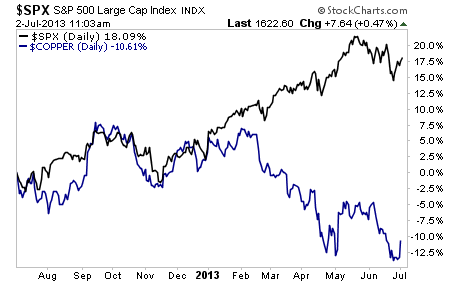
Copper, the commodity with a PhD in economics, gets this. Stocks do not.

See the original article >>

Follow Us