Sunday, September 25, 2011

CDS Implied Probability of Default – Be Careful

by Peter Tchir

Unless something changes in the next 24 hours, I expect we will hear more and more talk about default, not only of Greece but of other countries and of banks. Just in case that happens, here is some information that may help you make good decisions. There will be lots of chatter about the “likelihood of default” the CDS market is implying, but although it can be a useful statistic, it can also be very misleading. Before jumping into trades based on erroneous assumptions, it is worth spending a few minutes reading this. If all it does is confuse you, maybe that is a good thing in itself, because you won’t take a headline about default probability as fact.

Recovery is Key and is often assumed away making default probability calculations less useful
Let’s start with a simple example. You have bonds of 2 different companies, each maturing in the near term, both trading at 70. What is the probability of default of each of these companies? You don’t know because that isn’t enough information. You know the bonds are trading at 70, and without a default they would pay par, providing a 30 point return. What you need to know to figure out the probability of default, is what the recovery value will be. Let’s assume that the recovery value for one company is going to be 60 and for the other will be 10. Then in the first case, the default probability is 75%. There is a 75% chance an investor would lose 10 points, and a 25% chance that they would lose 30 points, giving an “expected” value of 0 (today’s risk free rate). In the second case the default probability is only 33% (66% chance of 30 point gain plus a 33% chance of a 60 point loss).

So recovery is a key element of determining what default probability the market is pricing in. Yet, although it is key, it is often assumed to be 40% or some other number based on historical averages. That is a reason to be very concerned when you see a default probability mentioned. It is useless without looking at the recovery value, and recovery value isn’t easy to figure out. Recovery value is figuring out the enterprise value of a company after it has defaulted. It is not any easier than figuring out enterprise value of a company that is not in default, so treat estimated recovery values with the respect they deserve.

In the CDS pricing model, there are 3 key variables: the spread, the recovery value, and the up-front premium. If you know any 2 of those 3, then you can solve for the other. The market trades with the assumption of 40% recovery. That let’s traders quote a spread, and then the up-front premium is just a calculation. This is done more out of convenience than anything else. Agreeing to a recovery rate on each trade would be time consuming, and 40% seems reasonable enough for the purposes of calculating the up-front.

For high quality (tight spread names) the up-front premium is not very sensitive to recovery.
For names that trade at 400 over (BAC for example), the probability to default over 5 years is 21% with a 10% recovery, and 51% with a 70% recovery. So you need to take any probability of default derived from CDS prices with a grain of salt. Without a rational assumption for recovery, the probability of default is somewhat meaningless. Since changing recovery would change the “up front” premium, you could try and argue that the recovery must be valid. I would argue that the smartest credit investors figure out what premium they need to earn to take the risk, based on their assumptions, and then figure out what spread in a 40% recovery model world gives that up-front premium.

At the other extreme, names will eventually trade in “points”. With a 40% recovery in the model, there is no spread that can give an up-front premium of more than 60. If a dealer was willing to buy protection and pay 55 points up front, or sell that protection at 57 points up front, most investors wouldn’t complain about the liquidity. It would be as good as in the bond market. On the other hand, if the same dealer quoted that market as 3470/4430 some client might argue that 1000 bps seems egregious. Also, if a company has a bond trading at 35, dealers will not want to floor recovery at 40 since a bond trading at 35 shouldn’t exist if recovery is 40. So as default becomes more likely, the model becomes less useful.
The Curve is also important

For simplicity and market convention, the 5 year cumulative default probability is based on a flat curve. As a situation deteriorates it becomes more important to look at each point on the curve. Two names trading at 1000 in 5 year CDS would have the same implied probability of default from the standard model. But if one is trading “inverted” at the short end, and the other is steep, then at the very least the timing of default that is being priced is very different. An inverted curve means the risk of default in the near term is much higher. If you, as an investor are going to make decisions based on default probability headlines, you need to look at the curve. The 5 year default probability is a nice headline, but the devil is in the details.
Sovereigns are even more problematic when divining default probabilities

Sovereign CDS for Eurozone countries trades in USD. CDS on US government debt trades in Euros. This helps explain why CDS trades so wide for many sovereign names. If you bought €10 million of a European sovereign at par, and it defaulted, recovering 40%, you would have lost €6 million. If you had bought CDS in Euro that trade would basically offset it. If you bought protection in $’s and the exchange rate was unchanged, you would break even on the trade. But many investors believe that a default of a European sovereign would cause the Euro to get a lot weaker. So let’s say at the time of the trade the FX rate was 1.40. You would need to purchase $14 million of CDS to cover the €10 million bond position. If the default occurs and the FX rate went to 1.20, then you would have made $8.4 million on the CDS trade, which when converted back to Euros at 1.2 is now €7 million.

If investors believe an FX move is highly correlated with default, they will pay more for CDS. They make more on their negative view than they would if the FX trade wasn’t embedded. Similarly they lose less if the market rebounds. Their position in the bonds will go up, while their losing position in CDS gets converted back into more expensive Euros, thus mitigating their losses.

So on sovereign CDS, particularly at times of stress where the market clearly believes that a default is bad for the currency, the CDS spread is not just pricing in default, it is pricing in default with a currency move, making implied default probability less useful.

On top of that, recovery for sovereigns is purely guesswork. Creditors have NO rights. There is nothing they can do to try and collect on their bad debts. It is purely a negotiation. That is why the distressed investors don’t do much in sovereigns, because they are used to playing by rules, and in a sovereign default there are no rules. In some sovereign defaults, shorter dated bonds have received better treatment than longer dated bonds. That is uncommon in corporate defaults, but not uncommon in sovereign defaults, making picking a recovery value even more difficult.
Cheapest to Deliver Bonds

For banks, financials, and sovereigns the cheapest to deliver option embedded in CDS has less impact on daily CDS prices because they are such frequent issuers. For companies with fewer bonds, the cheapest to deliver option can impact CDS prices, without really impacting probability of default in the real world. If two very similar companies existed, but one had only issued bonds at times of high coupons, and the other had issued when rates were very low, the CDS on the low coupon bond company should trade a bit wider. Investors who like the “basis package” where they buy bonds and buy CDS generally prefer to buy lower priced bonds because they can benefit from a “jump to default” and lock in their basis trade profits sooner than later.

SPY Trends and Influencers 9/24/2011


Last week’s review of the macro market indicators looked to bring more consolidation for Gold ($GLD) in a broad range, but with the bias to the down side if forced to pick a break direction. Crude Oil ($USO), the US Dollar Index ($UUP) and US Treasuries ($TLT) all also look to be headed lower in the short run. The Shanghai Composite ($SSEC) looks to continue lower while Emerging Markets ($EEM) consolidate further. Volatility ($VIX) looks to remain elevated with any break bias to the downside as Equity Index ETF’s $SPY, $IWM and $QQQ are set up to extend their gains. The QQQ is by far the strongest of these index ETF’s and should be watched for broad direction. The correlations to watch for driving the Equity markets this week are the inverse relationship to the US Dollar and US Treasuries. Should these areas reverse and move strongly higher Equities will likely fall. Gold should play less of a role as it is moving in a broad range.

The week began with Gold moving sideways before a massive collapse and Crude Oil falling lower. The US Dollar Index and US Treasuries also drifted before launching higher and as warned knocking the Equity Indexes lower. The Shanghai Composite continued to consolidate while Emerging Markets were sucked into the downdraft again. What does this mean for the coming week? Lets look at some charts.
As always you can see details of individual charts and more on my StockTwits feed and on chartly.)

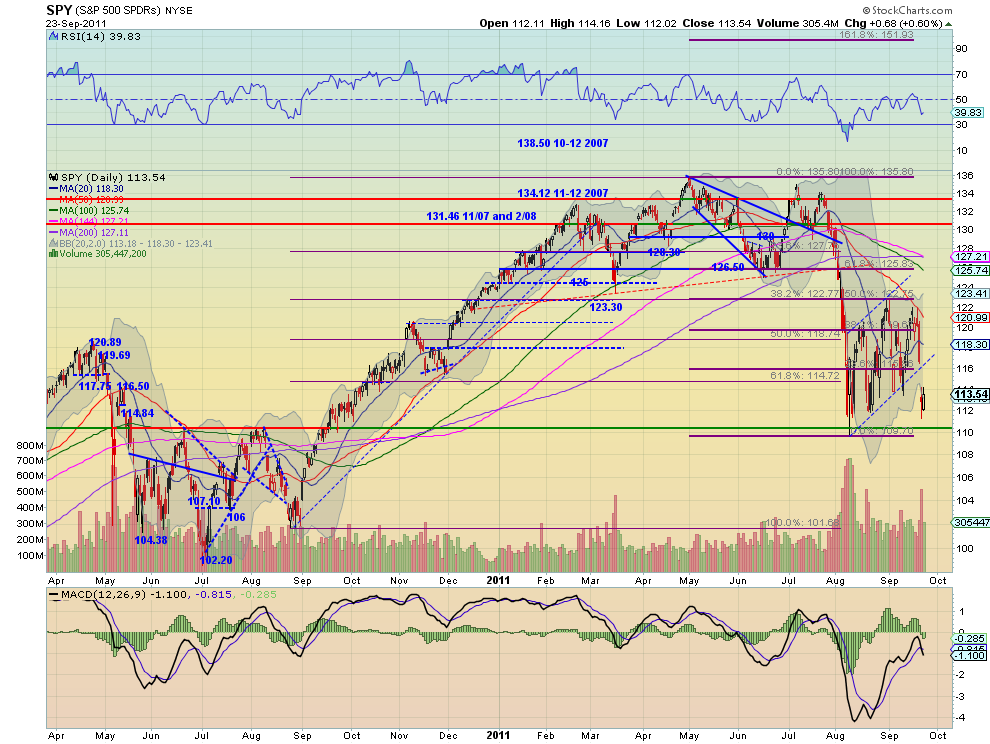
SPY Daily, $SPY

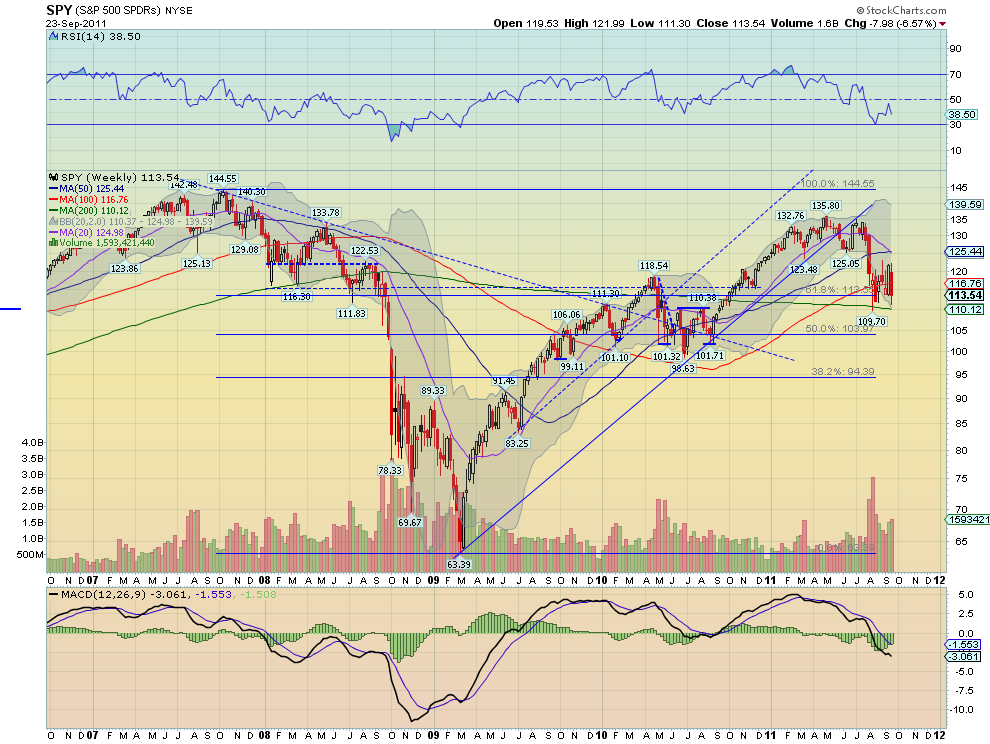
SPY Weekly, $SPY

The SPY gapped lower out of its bear flag Thursday and then held that range Friday, at the closing low support since early August. The RSI is pointing lower and the MACD crossed negative on the daily time frame. All of the SMA’s are sloping lower on both time frames except for the 100 week SMA. The weekly chart also shows a bearish RSI but the MACD is diverging, starting to improve. It is not as certain of the flag break on the weekly chart. The bias is to the downside for next week with support below 112 at 110.26 and then 108 and 104. Any bounce above the gap level of 114 should see resistance within the bear flag and first near 116.

Rolling into the last week of the third Quarter, Gold and Oil are ready for more downside. The US Dollar Index and US Treasuries look to continue higher. The Shanghai Composite and Emerging Markets also look to continue their down moves. Volatility looks to remain elevated and possibly break higher. The equity Index ETF’s, SPY, IWM, and QQQ are all looking better to the downside. The QQQ again may be the key to holding the market together. If it loses support of the flag, the SPY and IWM could take the whole market lower. A spike in Volatility and continued moves higher in Treasuries and the Dollar Index should ensure it. Use this information as you prepare for the coming week and trade’m well.

See the original article >>

The 3 Most Vulnerable Sectors


These major market sectors are still looking very vulnerable and are likely to continue to underperform the S&P in the months ahead. Use careful risk controls to avoid big losing positions.

The late-in-session drop in the stock market after the Fed announcement was consistent with the deterioration in the technical outlook discussed yesterday. The McClellan Oscillator has broken below support, which makes a further drop very likely.

Three of the major sectors look most vulnerable to further selling and they are likely to underperform the S&P 500. Even though technology was also lower, it continues to show better relative performance, or RS analysis, which suggests the tech sector will hold above the August lows.

For the Select Sector SPDR – Energy (XLE), it is important to keep an eye on crude oil prices. As I have frequently pointed out, crude oil often leads the stock market on both the up and down side. November crude oil was down over $2 yesterday, and a break of key support would be a negative for the energy sector and stocks in general.

Chart Analysis: November crude oil completed its flag formation, lines a and b, on Monday, but so far, the short-term lows in the $84.65-$84.90 area are holding. The key chart support is now at $83.47.
  • There is further support at $79.76 and then at $76.61. The 127.2% Fibonacci retracement target is at $72.53
  • The on-balance volume (OBV) broke its uptrend, line c, on September 9 before rebounding sharply
  • Volume has been heavy over the past three days and the OBV now shows a pattern of lower highs and lower lows
  • Crude oil has resistance at $88 with stronger resistance in the $89-$90.63 area
The weekly chart of the Select Sector SPDR – Energy (XLE) shows that it is not far above the weekly uptrend (line d) and the 50% retracement support in the $59-$59.40 area. XLE completed a daily head-and-shoulders top formation in May.
  • The major 61.8% Fibonacci support stands at $54.50
  • The relative performance, or RS analysis, turned positive in October 2010, signaling that XLE was going to be stronger than the S&P 500. The RS analysis topped in May and is negative, as it is still below its declining weighted moving average (WMA)
  • The weekly OBV formed a negative divergence, line f, at the late-April highs. The OBV needs to break this downtrend to turn positive. The OBV is below its weighted moving average
  • There is initial resistance for XLE at $67.76-$69.90

The Select Sector SPDR – Industrial (XLI) has been one of the weakest sector ETFs, down 24.6% from the April high at $38.98. The daily chart shows a completed head-and-shoulders top formation, as the neckline (line a) was broken in July.
  • The daily chart shows next support at the uptrend (line b) in the $29.50 area
  • Major 50% retracement support stands at $27.40 with the downside target from the daily chart formation at $26.40
  • The daily uptrend in the RS (line c) was broken in May and still looks negative
  • Daily OBV confirmed the completion of the top formation when it dropped through long-term support at line d
  • Weekly OBV formed a negative divergence at the May highs and is still negative
  • There is initial resistance for XLE at $32.20 and then at $32.89
The Select Sector SPDR – Materials (XLB) closed below short-term support, line g, on Wednesday. This suggests it will continue to lead the market lower. The daily chart shows a completed top formation, lines e and f.
  • Major 50% retracement support is at $29.70
  • The daily chart formation has downside targets in the $28.50 area
  • The daily uptrend in the RS, line h, that goes back to the 2010 lows, was broken in early May. The RS is now dropping very sharply and XLB is acting weaker than the S&P 500
  • The OBV is in a solid downtrend, line i, though we may have seen a selling climax in early August
What It Means: These three key sectors have been the weakest over the past four months. The weakness in crude oil suggests it is ready for one more decline, but the longer-term technical analysis for crude oil suggests that this could complete a bottom formation. Therefore, the energy sector may bottom out first.

The industrials and materials sectors gave weekly sell signals in May (see “2 Key Sectors Top Out”). Both now look ready to lead the markets lower, and a resurgence of growth in the emerging markets is likely necessary before these sectors turn around.

How to Profit: I see no real profit opportunities at this time, but those holding stocks in these sectors should be sure to use stops on all positions to limit the risk. It is tough to come back from a 30%-40% hit in one position.

Dollar breakout ...

by Kimble Charting Solutions


Dow Reaches Lower Channel Line


The Dow has reached the lower parallel channel for the entire rally from the March 2009 low. The channel lines were created using the Andrew's "pitchfork" method with the November 2008 low as the origin and the January 2009 high and March 2009 low for the base. It is easy to see how well the Dow has followed the channel lines over the last two and half years. There is every reason to believe that some sort of intermediate term low is imminent near term based on this chart. A rally to the median line somewhere around 12,000 by late this year or early next year is the most likely next move.


I expect that after that rally the currently developing low will be retested by mid 2012. If that test is successful, another leg up in the stock market should follow. At the risk of sounding repetitious this process will last several more months. Be prepared for difficult choppy conditions and use more conservative trading targets.

Choppy Stock Market May Bottom Soon


After some big gains last week and a SPX 1216 close, the market gave it all back this week with a SPX 1136 close. Economic reports were light, but still mostly to the downside. On the positive were building permits, existing home sales, the monetary base and a downtick in weekly jobless claims. On the negative were declining housing starts, FHFA/NAHB housing prices, leading indicators, excess reserves and the WLEI. The big news for the week was the ‘sterilized’ Operation Twist. A $400 bln program to purchase long term debt with short term debt. The market apparently wanted more liquidity in the form of outright purchases. For the week the SPX/DOW were -6.45%, and the NDX/NAZ were -4.85%. Asian markets lost 5.0%, Europeans markets lost 5.2%, the Commodity equity group lost 10.3%, and the DJ World index dropped 7.7%. Next week will be highlighted by Q2 GDP, the Chicago PMI and Case-Shiller.

LONG TERM: bear market highly probable

When the markets start displaying a bunch of mixed signals it is best to step back and look at the overall picture. Between March 2009 and May 2011 the stock market doubled in a five wave advance, (SPX 667-1371). After the peak the stock market experienced a modest decline to SPX 1258 and then a fairly good rally to SPX 1356. While this was unfolding many foreign markets were starting to break down. After a review of the long term technical indicators we concluded these two waves represented the beginning of a new bear market. After posting these findings the US stock market started breaking down. The decline was quite swift, and within a month the SPX dropped from 1356 to 1102, or 18.7%.


The weekly chart signalled there was potential trouble ahead when the first decline, SPX 1371-1258, was quite oversold, (RSI red arrow). This typically does not occur during bull markets, as you can observe on the chart. When the market started breaking down the MACD turned negative. This also does not occur during bull markets. While OEW quantitative analysis has yet to confirm a bear market it certainly looks like we are in one. This is the reason we have been posting, since early August; “bear market highly probable”.

All bear markets unfold in three significant waves, ABC, not five. They are corrections to previous bull markets of a greater wave degree. The declining A and C waves may take the form of a five wave structure, as demonstrated by the 2007-2009 bear market. Or, more typically, a three wave decline, as demonstrated by the 2000-2002 bear market. Until the first signficant wave completes, wave A, either combination is possible. To cover these two possibilities we have been tracking an ABC decline on the SPX charts, and a 1-2-3 decline on the DOW charts.

Also of note on the weekly chart is the two green, wave structure, support lines. The first is at SPX 1011, the Primary wave II low. This level also represents a Fibonacci 50% retracement of the entire bull market. The 38.2% retracement level was hit exactly at the August low of SPX 1102. The second green line is posted at SPX 869, Major wave 2 of Primary I. This would be the logical wave structure support, should the first one fail. It represents a 70.7% retracement of the bull market. For the record there is one intervening level of support, the Fibonacci 61.8% retracement: SPX 936.

The overall picture suggests we are in a bear market with the first level of support at SPX 1011, the next level at SPX 936, and the likely maximum level at SPX 869. The market closed at SPX 1136 on friday.

MEDIUM TERM: July downtrend likely still underway

From the SPX 1356 uptrend July high this market declined in three waves: SPX 1296, 1347 and then 1102 on August 9th. After that the market went into a trading range between SPX 1121 and 1231 for five weeks. This week it took out the 1121 low on thursday when it hit 1114. Our first thought was the low of the range, SPX 1121 on August 22nd, ended the downtrend with a failed fith wave, (higher than the third). We then tracked the market as if it were a counter-rally uptrend. This approach worked quite well for the past four weeks, until the market started breaking down after the FOMC meeting.


Our counter-rally uptrend scenario suggested the market would hit the OEW 1240 pivot, and higher, from the September 12th SPX 1136 low. On tuesday, however, the market made a double top at SPX 1220 and started to decline. When it dropped through the OEW 1187 pivot, the previous short term support, on wednesday afternoon we knew something was amiss. Anticipate, monitor, and adjust. On thursday the SPX found short term support at 1114 and then rallied, from extremely oversold levels, to 1142 on friday. On thursday, however, the DOW made a new print low for the July downtrend suggesting it had resumed after several weeks of sideways activity. We then posted a special thursday night update: http://caldaro.wordpress.com/2011/09/22/thursday-night-update/.

When we take into account these recent events. The new print lows in the DOW, TRAN, and NYSE. The fact that OEW has yet to confirm an uptrend. And, the somewhat sloppy wave counts on the SPX charts. We have shifted the short term count posted on the DOW charts to the SPX charts. This is now the preferred short term count. The alternate count is now posted on the DOW charts. We should know for certain, in a week or so, which of these two counts is the market’s count.

The updated SPX chart is as follows. From the July SPX 1356 high the market has declined in four waves: Int. i SPX 1296, Int. ii SPX 1347, Int. iii SPX 1102 and Int. iv SPX 1231/1220. Int. i and iii were five wave declines, Int. ii was a zimple zigzag, and Int. iv was a complex inverted failed flat ending at 1220. We had observed these inverted failed flats during the previous bear market.

SHORT TERM

Support for the SPX is at 1136 and then 1107, with resistance at 1146 and then 1168. Short term momentum ended the week around neutral. Anticipate, monitor and adjust. When we take into account the preferred short term count the anticipated medium to long term wave structure changes just a bit. The long term supports, noted in the long term section, remain the same. The wave structure for this bear market, however, can now be either a 5-3-5 ABC, or an abA-B-abC ABC. Both options are again possible.


We did a Fibonacci analysis on the relationships between the Intermediate waves and arrived with the following numbers: @ SPX 1093 Int. waves iii thru v = 2.618 Int. i, @ SPX 1080 Int. v = 0.618 Int. iii, @ SPX 1074 Int. v = 2.618 Int. i, and finally @ SPX 1060 this third wave (trend) down = 2.618 the first wave (trend) down. Since we have OEW pivots at 1090 and then 1058, we’re probably looking at either the SPX 1093 relationship, or the 1060 relationship, for the end of this Int. wave v and downtrend. Best to your trading!

FOREIGN MARKETS

The Asian markets were all lower on the week for a net loss of 5.0%. China and Hong Kong made new downtrend lows.

The European markets were also all lower on the week losing 5.2%. The Stox made a new downtrend low.

The Commodity equity group all dropped substantially for a net loss of 10.3%. Canada and Russia made new downtrend lows.

The DJ World index made a new downtrend low as well and lost 7.7%.

COMMODITIES

Bonds continued their extended uptrend gaining 1.2% on the week. The 10YR dropped to 1.70% before ending the week at 1.81%. The 30YR hit 2.75%.

Crude tumbled 9.0% as its choppy attempt at an uptrend ended with a continuation of the ongoing downtrend.

Gold also tumbled, losing 8.4%. We had expected both Gold and Silver to be in downtrends and this week’s action confirmed it. In fact, Gold has already come down to our anticipated support zone $1650-$1700, and even dipped below it on friday. As soon as this downtrend ends the bull market will resume.

The USD continued to uptrend, especially against the Euro, and gained 2.5% on the week. The EURUSD lost 2.2%, and the JPYUSD gained 0.1%.

NEXT WEEK

New home sales kick off the economic week on monday at 10:00. On tuesday we have the Case-Shiller index and Consumer confidence. On wednesday Durable goods orders, and then on thursday Q2 GDP, the weekly Jobless claims and Pending home sales. Friday closes out the week with Personal income/spending, PCE prices, the Chicago PMI, and Consumer sentiment. The FED has two speeches scheduled. FED governor Raskin on monday before the open at 9:15 AM. Then FED chairman Bernanke on wednesday after the close at 5:00 PM. With this week representing the end of the month, and the quarter, it should be quite interesting. Remember we’re probably in a bear market, so tread lightly.

Follow Us