
Thursday, September 22, 2011

The Fed Disappointed… The Great Collapse Is Here
by Graham Summers
I’ve been warning for weeks now that the Fed would disappoint with its
September meeting. And boy did it.
As I forecast, the Fed didn’t announce QE 3. In fact, it didn’t announce
any new policy of note. Instead it is simply reshuffling its holdings
to focus more on the long end of the bond markets.
On top of this, the Fed announced it will only be moving roughly $400 billion
of its portfolio around. This is the smallest major intervention the Fed has
announced since it began implementing QE in 2009 (QE 1 was $1.25 trillion while
QE 2 was $600 billion). Indeed, this move is on par with the Fed’s
implementation of QE lite which to date has been about $300 billion give or take
in scope.
Even more striking, while announcing this disappointing move, the Fed
downgraded its view of the economy stating, “there are significant downside
risks to the economic outlook.”
Previously, any admission of economic deterioration from the Fed resulted in
the US Dollar selling off sharply as traders expected additional easing/
printing. This time around, the market senses that the Fed has disappointed and
that the Fed’s move is largely symbolic more than anything else.
The end result of this: the market is Crashing just as I warned. The S&P
500 has gone from 1,200+ to 1,136, a 6% drop, in the overnight session.
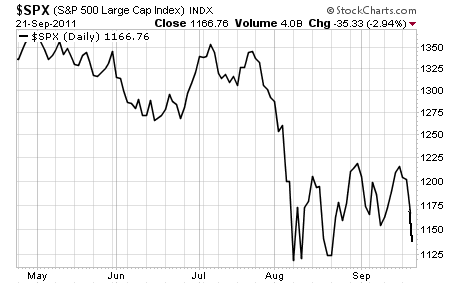
We’re just getting started here. Today we got a
confirmed SELL on my proprietary Crash indicator. This is the SAME indicator
that registered before the 1987 Crash, the Tech Crash, and the 2008
collapse.
It’s just triggered again… which means that today’s sell off is JUST the
beginning of what’s coming.
Yes, the GREAT COLLAPSE has begun. The markets will be going to new lows
(below the March 2009 lows) in the coming months.
We’re also going to be seeing major banks go under, market crashes, food
shortages, government shutdowns, and SYSTEMIC FAILURE.
Yes, I believe that before this mess ends, the financial system as a whole
will have collapsed. What’s coming is going to make 2008 look like a joke.
Many people will lose everything in this mess. Yes, everything. The US is
going to be defaulting on its debt, paper currencies around the world will fail.
It’s going to be a dark dark time.
Wall Street Rejects Operation Twist
By Jeff Harding
The markets didn’t like the Fed’s announcement today. When the FOMC
announcement hit the tape at about 2:21 p.m., the market nose-dived. I think
they were expecting more, such as a lower FF rate, or some QE, or reducing
interest paid on bank reserves. Alas.
Here is a chart of the S&P 500 today. You can see when the Fed announcement
hit the tape:

From Bloomberg:
The S&P 500 Financials Index (S5FINL) fell to the lowest level since July 2009. Bank of America Corp. tumbled 7.5 percent after Moody’s Investors Service downgraded the bank’s long-term debt rating. Wells Fargo & Co. also had its long-term rating cut, wiping out an earlier gain and dragging the stock down 3.9 percent. Citigroup Inc. (C) fell 5.2 percent as Moody’s cut its short-term debt rating. Goldman Sachs Group Inc. closed below $100 for the first time since March 2009.
Costs to protect debt from Bank of America, Citigroup and Wells Fargo rose after the downgrades by Moody’s, which said U.S. support is less likely in an emergency. Credit-default swaps tied to Bank of America added about 40 basis points from yesterday to 375 basis points as of 3:41 p.m. in New York, according to broker Phoenix Partners Group. Swaps on Wells Fargo jumped to the highest since July 2009, climbing 17 basis points to 143 basis points, Phoenix prices show. Contracts on Citigroup rose 19 to 250, according to data provider CMA.
If you were holding long-term bonds, you did great:

This is Operation Twist in action where savers get
hammered but speculators do great. At a 3% yield, a 30-year bond holder who is a
saver looking for long-term security and yield is losing money daily with the
official CPI at 3.6%. Congratulations Chairman Bernanke.
In case no one at the Fed thought about it, more
cheap money won’t help the economy. It will help the government though as the
cost of funds gets better and better for them. With a few more rounds of QE,
then price inflation will make it even better as they pay down their debt with
cheaper dollars. Meanwhile, massive amounts of capital are consumed by savers
(i.e., destroyed).
Interest rates have been low since 2008 and yet the
economy stagnates. Perhaps it isn’t the case that cheap money is what is needed
today. If it was, you would think that three years of ZIRP would be a long
enough trial period for this idea. So, why does the Fed persist with this failed
policy?
Answer: Other than QE, they have no idea what to do
since everything they have tried has failed. Next stop: QE3.
Wednesday, September 21, 2011
VIX Bounces Off 50-Day
by Bespoke Investment Group
As we noted last night, the S&P 500 was stymied
by its 50-day yesterday. At the same time, the VIX volatility index has
bounced off of support at its 50-day. Higher levels in the VIX generally
coincide with a decrease in equity prices, so market bulls are hoping this is
one bounce that doesn't hold.

FOMC STATEMENT AND ANALYSIS
by Cullen Roche
Here’s the full FOMC statement. I highlighted a few pieces which I’ll discuss
below:
For immediate release
Information received since the Federal Open Market Committee met in August indicates that economic growth remains slow. Recent indicators point to continuing weakness in overall labor market conditions, and the unemployment rate remains elevated. Household spending has been increasing at only a modest pace in recent months despite some recovery in sales of motor vehicles as supply-chain disruptions eased. Investment in nonresidential structures is still weak, and the housing sector remains depressed. However, business investment in equipment and software continues to expand. Inflation appears to have moderated since earlier in the year as prices of energy and some commodities have declined from their peaks. Longer-term inflation expectations have remained stable.
Consistent with its statutory mandate, the Committee seeks to foster maximum employment and price stability. The Committee continues to expect some pickup in the pace of recovery over coming quarters but anticipates that the unemployment rate will decline only gradually toward levels that the Committee judges to be consistent with its dual mandate. Moreover, there are significant downside risks to the economic outlook, including strains in global financial markets. The Committee also anticipates that inflation will settle, over coming quarters, at levels at or below those consistent with the Committee’s dual mandate as the effects of past energy and other commodity price increases dissipate further. However, the Committee will continue to pay close attention to the evolution of inflation and inflation expectations.
To support a stronger economic recovery and to help ensure that inflation, over time, is at levels consistent with the dual mandate, the Committee decided today to extend the average maturity of its holdings of securities. The Committee intends to purchase, by the end of June 2012, $400 billion of Treasury securities with remaining maturities of 6 years to 30 years and to sell an equal amount of Treasury securities with remaining maturities of 3 years or less. This program should put downward pressure on longer-term interest rates and help make broader financial conditions more accommodative. The Committee will regularly review the size and composition of its securities holdings and is prepared to adjust those holdings as appropriate.
To help support conditions in mortgage markets, the Committee will now reinvest principal payments from its holdings of agency debt and agency mortgage-backed securities in agency mortgage-backed securities. In addition, the Committee will maintain its existing policy of rolling over maturing Treasury securities at auction.
The Committee also decided to keep the target range for the federal funds rate at 0 to 1/4 percent and currently anticipates that economic conditions–including low rates of resource utilization and a subdued outlook for inflation over the medium run–are likely to warrant exceptionally low levels for the federal funds rate at least through mid-2013.
The Committee discussed the range of policy tools available to promote a stronger economic recovery in a context of price stability. It will continue to assess the economic outlook in light of incoming information and is prepared to employ its tools as appropriate.
Voting for the FOMC monetary policy action were: Ben S. Bernanke, Chairman; William C. Dudley, Vice Chairman; Elizabeth A. Duke; Charles L. Evans; Sarah Bloom Raskin; Daniel K. Tarullo; and Janet L. Yellen. Voting against the action were Richard W. Fisher, Narayana Kocherlakota, and Charles I. Plosser, who did not support additional policy accommodation at this time.”
The biggest announcement in this statement
is “significant downside risks” to the economy. The Fed is becoming
increasingly aware of their impotence. This could actually prove to be
positive as Bernanke is likely to lean increasingly on Congress for aid in his
fight against unemployment. But let’s not jump to conclusions. The bottom line
is, this economy is very weak and is likely to remain so regardless of what the
Fed does.
Operation Twist was basically as expected.
They are buying $400B in long bonds and selling $400B in short bonds. It’s
balance sheet neutral. Not that this matters a whole lot. As I’ve previously stated, monetary
policy works by targeting rates. The Fed would have needed to say, “we are a
buyer of 10 year bonds at 1%” in order for this to “work”. They didn’t do that.
So, we can expect a lot of shuffling of the Fed’s balance sheet, but
ultimately, these transactions lack a real transmission mechanism through which
they can impact the real economy. In other words, this program should NOT put downward pressure on longer-term
interest rates and SHOULD NOT help make broader financial conditions more
accommodative.
The MBS purchases are interesting and
they’re a slight change from past policy. I discussed this last year when I said this was one of the
eventualities of QE2:
“He [Ben]wants to be fully prepared in case the banks relapse so he can step in with a sizable bank bailout. So, don’t be one bit surprised this week when Mr. Bernanke announces a small round of Treasury purchases with the option to buy MBS in the future. In all likelihood, this program will remain open until it’s clear that the U.S. economy is sustaining recovery and another bank meltdown is off the table. Don’t be fooled into thinking that this is some economic panacea.”
The Fed is likely disturbed by the recent
house price declines and the deterioration in credit markets. As we saw during
QE1, MBS purchases are an effective form of fighting a potential balance sheet
deterioration and credit crisis. In this regard, the Fed appears proactive.
That’s a positive. On the other hand, we shouldn’t sugarcoat this – this helps
the banks and not the consumer via the mortgage market as the Fed press release
implies – and yes, this is still a consumer driven balance sheet recession and
NOT a banking crisis. The MBS purchases don’t generate economic growth, but
could possibly help fend off credit fears. Unfortunately, the repurchases
aren’t large enough to move the needle much.
In sum, this policy change doesn’t change
much if anything. The Twist won’t “work” in reducing rates and the MBS
purchases are an interesting and possible effective proactive measure (but not a
growth measure!). The most interesting part of the statement is the
“significant” economic downgrade. Ironically, the Fed might get their lower
rates via a worsening economy and the lack of effective policy. The 10 year is
dropping to 1.87% as I type!!

Subscribe to:
Posts (Atom)