Monday, September 19, 2011

The Looming Bear Market: What You Can do That Washington Can't and Wall Street Won't

By Keith Fitz-Gerald

I just finished a battery of media appearances on Fox Business, Bloomberg, BNN and CNBC Asia, and without exception I was asked about two things: President Barack Obama's jobs bill and the U.S. Federal Reserve's "QE3."

The first thing investors and analysts alike want to know is whether or not the president's jobs bill will work. The answer to that question is "no" - not as it stands, anyway.

The second question is whether or not Fed Chairman Ben S. Bernanke will further extend the central bank to help the economy. Well, I do think the Fed will intervene, but I don't believe for a second that the central bank's intervention will help the U.S. economy.

As a result, we're likely to see stocks enter into a bear market and retest their March 2009 lows.

I know that's a terrifying thought. But to be perfectly honest, there's nothing President Obama or Bernanke can do at this point. If companies don't want to spend the $2 trillion worth of cash they're hoarding, there's very little the government can do to encourage them to loosen their purse-strings.

That said, I want to give you five specific steps to take to protect yourself from the looming bear market, preserve your sanity - and even profit.

But before I get to that, you need to understand the dangers that are fast approaching.

A Roadblock to Recovery

President Obama and Chairman Bernanke can toss all the money they want at the economy. But no amount of spending can change the fact that we need the following three things to get our market moving again. They are:

  1. Sustained demand.
  2. A solution to the European sovereign debt crisis.
  3. And a bottom in housing prices.
As it currently stands, the U.S. economy will be lucky to log 1% growth this year, which is even lower than the anemic 1.5% I predicted in my annual forecast in January.

That's pathetic for a nation that spent more than $1.4 trillion of borrowed money on "stimulus." This lackluster growth is also evidence that the Obama administration's $800 billion stimulus plan - and the Fed's two rounds of quantitative easing - did absolutely nothing to salvage our economy.

Citizens are scared silly. Businesses are uncertain. They're uncertain of regulatory changes, uncertain of taxes, and uncertain about their overall economic environment. So they're doing what rational people do when confronted with the unknown: They're hunkering down.

And with good reason.

The typical U.S. family got poorer during the past 10 years due to a decade-long income decline. Median household income fell to $49,995 last year, and is now 7% below where it was in 2000. The number of people living in poverty has risen to 15.1%, the highest level since the U.S. Census began tracking this information in 1959.

It should also be noted that a large portion of that decline is directly attributable to inflation, which the Fed continues to assert is "transitory."

Out of the Fire...

You may be holding out hope that the president's jobs plan will help turn things around - but it won't. 

Jobs exist because they create value. You can't just assume businesses will hire for the sake of hiring, which is essentially what the Obama administration's plan does. There has to be demand. All the employees in the world won't do any good if business owners can't grow their customer base and their revenue.

This is true for infrastructure as well. Infrastructure should be built as a means of increasing productivity - not just to put bodies in motion. That's something the "bridges and tunnels" crowd doesn't seem to understand.

That's why we have to consider the president's plan for what it is - yet another government-sponsored diversion of capital and resources.

As such, there are the usual questions about how President Obama wants to pay for this. And that's assuming the plan even manages to get through Congress, which I don't believe it will.

I think the jobs bill is dead in the water, and that the fight over some of its elements will create more uncertainty than jobs. That will be bad for the economy and even worse for the stock market, which will react negatively to the bickering and yet more indecisiveness.

Enter the Fed.

A Five-Step Plan for Dealing with the Looming Bear Market

When the president's jobs bill fails - just as his previous attempts to jumpstart the economy with deficit spending failed - and unemployment rises a year from now if not sooner, Bernanke will undoubtedly step in with QE3.

Of course, it may not be called QE3. It will likely be called "Operation Twist," or some derivation thereof.

But here's the real rub. Quantitative easing, no matter what it's called, is a euphemism for printing money. It is an attempt to bring down longer-term rates and twist the interest rate curve in such a way that companies have no choice but to spend money, and investors have no choice but to take on more risk.

But how low can you go when rates on the short end of the curve are already near zero? Not very.

I saw this firsthand in Japan. The Japanese government took rates all the way down to zero - and nobody wanted the money! Japanese companies wouldn't spend their cash then any more than U.S. companies will spend the $2 trillion they're sitting on now.

Instead, the government will be "forced" to spend even more.

So while Bernanke and President Obama are trying to dig their way out of this mess, they're really only digging our economy into a deeper hole.

That's why stocks are destined to retest the market lows of 2009. I don't know exactly when but I intend to help investors safeguard their assets and profit by preparing for it now - before it actually happens.

Here's five steps to get you started:

  1. Sell Strategically: Sell into strength and capture profits using trailing stops that are gradually ratcheted up as the bounce begins. This will help you raise cash (that can be used to buy into the rebound when it eventually happens)
  2. Hedge Your Bets: Use specialized inverse funds to hedge downside risk that will accompany the rollover to the downside and rack up significant gains at the same time.
  3. Consider Alternatives: Buy commodities - most notably gold and oil - on pullbacks. These alternative assets will help preserve the value of your portfolio as the markets roll over. Their value will accelerate dramatically when the world economy recovers - as it eventually will.
  4. Think Globally: Put new money to work in so-called "glocal" stocks with fortress-like balance sheets, diversified revenue and experienced management. Not only will they help hedge the value of your portfolio, but by concentrating your focus on them you are building in upside potential even if we haven't hit a bottom. Those offering big dividends are best because that will help you keep pace with the inflation the government debt will ultimately induce.
  5. Stay in the game: I know it's tempting to bail out given my prognosis for more downside, but attempting to time the markets is a fool's errand - and never works. You just wind up getting skinned twice - once on the way down and again because you were standing on the sidelines and got left behind when the markets ultimately reverse - which they will.

The "Real" Mega-Bears

By Doug Short

It's time again for the weekend update of our "Real" Mega-Bears, an inflation-adjusted overlay of three secular bear markets. It aligns the current S&P 500 from the top of the Tech Bubble in March 2000, the Dow in of 1929, and the Nikkei 225 from its 1989 bubble high.

The chart below is consistent with my preference for real (inflation-adjusted) analysis of long-term market behavior. The nominal all-time high in the index occurred in October 2007, but when we adjust for inflation, the "real" all-time high for the S&P 500 occurred in March 2000. 


Here is the nominal version to help clarify the impact of inflation and deflation, which varied significantly across these three markets. 


See also my alternate version, which charts the comparison from the 2007 nominal all-time high in the S&P 500. This series also includes the Nasdaq from the 2000 Tech Bubble peak. 


Weighing the Week Ahead: Expecting Magic from the Fed?

by Jeff Miller

Many are expecting the Fed meeting this week to produce something big. Speculation abounds.
To get some perspective on this, please consider the following quotation from 2005. The statement comes from someone who is obviously aware of potential asset bubbles, and thinks that the Fed should act in response:
...(A)s I have mentioned previously, something that has become very evident in recent years is that overall asset prices worldwide, both equity and debt, are rising a good deal faster than product prices. And they are picking up because of—indeed, the rise in asset prices is being engendered by—the fact that interest rates are getting ever lower. Interest rates in emerging-market economies are as low as one can remember. And aside from the surprisingly high equity premium in the United States, we have very significant upward momentum in asset values. ... (It) is clearly the potential for speculative activity—and its effect on asset prices—which is generating an assessment that we need to move, as far as evaluating the outlook for the overall economy.
I'll give the citation for this early and accurate observation at the end of the article.

As we watch the news for this week, you should keep in mind that many (most?) of those pontificating about the Fed do not really have much information. They have strange ideas about conspiracies, lying, open market operations, buying futures, propping up asset markets, and the like. As a starting point in evaluating these ideas, we might well start with a picture of the FOMC in action.


I trust that most will get the idea. One feature of an open and democratic society is that the true story comes out. In the case of the Fed, we get announcements, minutes, and eventually actual meeting transcripts.

As I will explain in my conclusion, I am not expecting anything exciting from this week's meeting. But first, let us do our regular review of last week's events.

Background on "Weighing the Week Ahead"

There are many good sources for a comprehensive weekly review. My mission is different. I single out what will be most important in the coming week. My theme for the week is what we will be watching on TV and reading in the mainstream media. It is a focus on what I think is important for my trading and client portfolios.

Unlike my other articles at "A Dash" I am not trying to develop a focused, logical argument with supporting data on a single theme. I am sharing conclusions. Sometimes these are topics that I have already written about, and others are on my agenda. I am trying to put the news in context.

Readers often disagree with my conclusions. (A commenter recently suggested that was proof that I was wrong -- an amazing interpretation!) Do not be bashful. Join in and comment about what we should expect. This weekly piece emphasizes my opinions about what is really important and how to put the news in context. I have had great success with my approach, but feel free to disagree. That is what makes a market!

Last Week's Data

While the stock market had a great week, the news was really not very good. Most observers attributed this to oversold conditions and short-covering during expiration week.

The Good

There was a little good news.
  • Central banks co-ordinated actions to address dollar liquidity in Europe. While this only addresses dollar liquidity -- not solvency -- it was helpful.
  • European leaders emphasized the Eurozone commitment and Greece increased some taxes. There are various analyses that tote up assets and liabilities and conclude that falling dominoes are inevitable. In fact, the most recent actions have moved Greek default out to October, at least. I tried to explain this week why markets were too extreme when it came to interpreting news about Europe and also under-estimated the Chinese.
  • Industrial production was up 0.2%. Good news, but this series is not on my "A" list and has also been downgraded by the National Bureau of Economic Research (NBER) in their recession dating.
  • The money supply rebound continues. This is a major forward-looking indicator that is widely ignored. It is a leading indicator, giving it extra significance. There is also evidence that commercial lending is increasing, one of the first effects we would expect from a policy that works with "long and variable lags." The Bonddad Blog has been covering this effectively, including a discussion of whether M2 growth is artificially influenced by inflows from European banks. It is well worth reading the entire piece. To be accurate, Bonddad's overall view is getting pretty dark, but I want to emphasize the excellent weekly articles on high frequency data.
  • Actual earnings from a company that has broad economic exposure -- Cummings (CMI).
  • And finally, we can escape the Coppock Killer Wave! There seems to be an inexhaustible supply of contrived disaster indicators. We get omens, signatures, bad times to invest, death crosses, sinking ships, and other assorted scary notions. The Coppock wave was originally supposed to be a buy signal based upon an economist helping Episcopals trying to go long. Coppock identified a "period of mourning." SocGen's perma-bear Albert Edwards figured out a way to contrive a sell signal from this -- the "Killer Wave." Fortunately, Mark Gongloff highlighted the evidence to refute this silliness. What a relief! This sort of thing invokes all of our warnings about tweaking and back-fitting data to create a result.
The Bad
There was a very discouraging week for economic data.
  • The CPI increased by 0.4% last month. Year-over-year it is up 3.8%. The core rate is up 2.0%, the stated Fed target. I am more tolerant than most about the concept of the core rate. I also think that the economy is best with a modest rate of inflation. Having said this, we are now in a zone that deserves attention-- not a "stagflation" scare -- but worth watching.
  • The ECRI growth index dropped further into negative territory. The official ECRI interpretation is a heightened recession risk. The ECRI warns against over-reacting without a persistent change in this indicator, but we are watching with interest. The WLI is now at the average level for the last year, but there is a decline as measured by the growth index. This is a smoothed growth factor, but the exact time frame and smoothing are not specified. They have not yet suggested an official recession forecast, sticking with the story of the lower global growth that they first talked about in May.
  • Initial jobless claims climbed to 428K. This is an unacceptable level, and the trend is in the wrong direction.
  • Retail sales showed no growth. 'Nuff said -- el stinko.
  • The Philly Fed Survey was "less bad." It was still terrible! Check out Steven Hansen for the full story.
  • The poverty rate hit 15.1% and median income fell to 1996 levels.
The Ugly

The ugliest news of the week is the continuing story about consumer confidence. The Michigan preliminary numbers for September were stuck at recession levels. As I noted last week, consumer confidence is absolutely vital to job growth and an improving economy.

A typical headline was "Consumer Sentiment Improves." What? The coverage of the data is from the red planet! These numbers are just terrible.

Sentiment remains terrible and is the biggest current market threat. Doug Short provides the best look with this typically excellent chart. You can see several variables with one look.


There are plenty of other great charts at Doug's new home (Congratulations!) at Advisor Perspectives, another of our favorite sources.
Consumer confidence remains a crucial factor for us to watch.

The Indicator Snapshot

It is important to keep the weekly news in perspective. My weekly indicator snapshot includes important summary indicators:
As I have often noted in the past, the ECRI and the SLFSI report with a one-week lag. This means that the reported values do not include last week's market action. In my research, I take account of this lag. In my daily monitoring of the market I look at the underlying elements in the SLFSI. I cannot do this with reliability for the ECRI since the indicators are secret. The SLFSI will increase next week, but not to the level that would trigger the "risk alarm."

There will soon be at least one new indicator, and the current choices are under review. In particular, I am considering replacing the ECRI method with the equally effective and more transparent approach from Bob Dieli. Bob's most recent report (official release on Monday) does an exhaustive review of indicators, concluding that a cycle top is (at least) six months away. Meanwhile, the ECRI has a "long leading" series that is available only to subscribers, which they refer to in media appearances.

The indicators show continuing sluggish economic growth, and the rate of growth continues to get weaker. Five weeks ago there was an increase in the SLFSI, generated by a slight increase in LIBOR rates and a big jump in the VIX. The SLFSI has been stable since then. I have been doing extensive research on this indicator. It was not designed to predict the stock market. It is a reflection of financial risk, based upon what happened in past crises. I believe that it will prove valuable as a tool for investors who prefer data to story telling. My interpretation is that it shows that European concerns should not yet be a warning to US equity investors. This article helps to explain how to interpret the values and also provides historical context.

The ECRI WLI is still at about its average for the last year and significantly higher than in 2009. The growth index uses an unspecified formula to smooth the changes in the index over an unspecified time. The ECRI warns against making too much out of declines in this indicator alone unless it is persistent. Their most recent public announcements repeat a multi-month theme: Sluggish growth increases the risk of recession. This makes sense to me.

Our "Felix" model is the basis for our "official" vote in the weekly Ticker Sense Blogger Sentiment Poll, now recorded on Thursday after the market close. We have a long public record for these positions.
We voted "Bearish" this week, with terrible ratings and two of the inverse ETFs emerging from the Penalty Box.

[For more on the penalty box see this article. For more on the system ratings, you can write to etf at newarc dot com for our free report package or to be added to the (free) weekly ETF email list. You can also write personally to me with questions or comments, and I'll do my best to answer.]

The Week Ahead

There is some interesting economic data this week including reports on housing starts, mortgages, and the FHFA price index. My choice from this lot is the building permits series, which shows a genuine advance commitment for new homes.

The initial jobless claims data demands attention, as the series drifts further above the 400K level. There will also be a report on "leading economic indicators" which are important to some.
But these are sideshows.

The two big stories will be:
  1. The Fed -- where I do not expect anything exciting. Even something like 'Operation Twist" (if it is even adopted) will not be regarded as significant by the market (and I agree). Here is a good academic article on this topic (HT Tom Brakke whom I read every day and you should,too). Keep in mind that the FOMC (as a group) is less pessimistic on the economy than are traders, pundits, the media, and the public.
  2. Europe. At the time of writing, I have no clear idea about the actual outcome of the ongoing meetings this weekend. I expect a disappointing result. Most market pundits are looking for some kind of grand plan or silver bullet. There might be an eventual solution, but it will not be so clear and easy. Leaders will first buy time, which will be called a band aid or kicking the can. The final compromise package will have multiple moving parts, and require sacrifices on many fronts. As I have written for several weeks, we have many months ahead of us where early trading will be based upon some European news, no matter how minor it seems.
Trading Time Frame

In trading accounts we went 40% short the market on Friday afternoon, since two inverse ETFs emerged from the penalty box. This is a bearish vote on the market with a three-week time horizon.

Contrast this with last week. While our official vote was "bearish" last week, I noted that "abstain" might be better. In fact, we had no positions, as I reported in last week's article. We did not join in on the rally, since Felix does not try to call market tops and bottoms, but we were not short. This week we will begin with a short position, re-evaluated daily.

Investor Time Frame

In our ETF-based Dynamic Asset Allocation program, the portfolio remains very conservative. This cautionary posture includes bonds, gold ETFs, and utilities. It is conservative, but has no short positions at this time.

Long-term investors should buy and maintain core holdings of an appropriate size. This does not mean "buy and hold." I recommend an actively managed portfolio, adjusted with conditions, but one that includes stocks. The mid-year selling has tested the resolve of many investors. It is one thing to state a risk tolerance and another matter to watch it in action. Investors who are staying the course have "right-sized" their positions and maintained confidence in their methods.

To see this clearly, compare the return of the 10-year Treasury note (formerly regarded as risk free and better than French bonds by S&P) to the dividends on the Dow or the S&P 500. For help, see Chuck Carnevale, who has a long and thoughtful post on the asset allocation question. Regular readers know that I am a big fan of Chuck's approach. Anyone wondering about the best investment for a ten-year time horizon should be looking carefully at his charts of interest rates versus dividends.

Citation for the Fed Policy Quote

I suppose that many readers will have guessed Fed Chair Alan Greenspan as the source. The quotation is from the December, 2005 Fed transcript where he is explaining why rates should move higher.

His position and reasoning differ sharply from the forecasts of leading bloggers and other observers from that era. Even those writing popular books about Greenspan have not done the basic research on source material that would normally be expected.

We are about to enter a time when blog predictions from that era can be compared with actual Fed transcripts. Some have shamelessly mis-represented FOMC motives, what was considered, the evidence available, the intelligence of participants, and possible biases.

It would be interesting to compare some of these aggressive statements with the actual meeting transcripts.

Perception is 9/10ths of Reality

by Marketanthropology

In the kingdom of the blind, the one-eyed man is king - Desiderius Erasmus

For many things in life, perception is nine tenths of reality. In business, it's one of the great maxims that can separate success from failure. As someone who thinks a great deal about how the markets are functioning and expressing themselves - perception is paramount in determining where you sit with your respective positions and where they are likely headed next. With this in mind, and considering most fail spectacularly to outperform the market over the long term - many are looking with the wrong methodology at a market reality that simply does not exist.

You would think that this open failure would foster humility on the part of most participants, and yet so many of these market forecasters and traders are highlighted in the financial media as so called experts on a subject they often get wrong far more than they get right. This is the increasingly popular and darker side of - perception is nine tenths of reality. You can create a rather average product, but if you keep telling the consumer that it performs - well, research shows they will respond to the marketing and buy the product (insert personal anecdote here in relation to politics, religion or monetary policy).

A good place to start is by separating what is happening on Main Street from what is happening on Wall Street. And while the anecdotes and interviews are certainly compelling from a econo-humanistic perspective, if you swim in the market on a day to day basis - they can and will give a false perception of the current market environment. On any given day you will find the financial media blurring this division with a focus placed squarely on what happened on Main Street last month, as if it will give you insight towards where the markets will likely trade next week. Much of this reporting is simply looking in the rear view mirror with tangentially related and often misleading content. A good example of this is in extrapolating the findings of the monthly consumer confidence reports which primarily correlates with how the stock market was behaving during the study. This kind of self-recursive study may move the markets for a few moments as the headlines cross, but it will certainly take a back seat to price structure and the ebbs and flow of momentum.

(writer steps and falls off soap-box)

With that said, I do like to challenge the conventional wisdom - just without an overtly dogmatic world and market view. For the most part it has served me well when it comes to investments and trading, because it has allowed me the objectivity to see across the psychological continuum, or in trading - both sides of the market. These character traits are certainly not without fail and I too have found myself on the wrong side of the tracks from time to time.

Those six (6) 1950's dinette sets seemed like an awfully good investment at the time...

In any case, we often hear from critics of the Fed on both sides of the fence that quantitative easing accomplished very little. They will confidently declare in some shade of, "There have been little to no positive effects from QE(x) to the underlying economy - as evidenced in the latest jobs, housing and wage growth data."

In the court of public and political opinion they easily win the point. The only problem is I see their criticism as a straw man argument - because although I am sure the Fed would have liked to materially affect change in the housing and job markets first - the real immediate concern was the stock market. Once they lost control after Lehman and the market was cascading lower, Bernanke knew it would only be a matter of time before the systemic risks of the crash became magnified in places such as the public and private pension funds. To make a very long story short - many of these public funds were already underfunded coming into the crisis. If the market continued on a prolonged path lower or even languished at the bottom of the range - as many of the best and brightest suspected - these funds would have run out of capital in no time at all and reinforce the negative feedback loop that was starting to work its way through the system.

I remember reading this post in Mike Shedlock's Global Economic Trend Analysis in November of 2008 and thinking that most of John and Jane Q. Public were completely unaware of how serious the situation was becoming and where it would grab them next.
What Happens Now?

New Jersey is burning $5.2 billion a year. If the market is flat over the next 5 years, New Jersey will have a minimum of $118 billion in obligations and will be sitting on $31.8 billion. But what happens if the S&P falls to 450 or 600?

S&P 500 at 600 would be a drop of 24% from here. Assuming the pension plan assets dropped the same, plan assets would fall to $44 billion. On a drop to 450 on the S&P, plan assets would fall 43% from here to approximately $33 billion.

At $5.2 billion a year, New Jersey's pension plan would be completely out of cash in about 6 years in my worst-case scenario of a drop to 450 on the S&P.

However, even on a drop to 600 or 700 on the S&P (highly likely in my estimation), New Jersey, would run out of cash rather quickly putting in $1 billion a year and taking out $5.2 billion a year while assuming growth rates of 8.5% that are totally unrealistic.
Wherever the market bottoms, be it here, or S&P 600, or S&P 450 (some are calling for even lower than that), the recovery will be weak, just as in Japan. There is every reason to assume a chart of the S&P will look something like this." State of New Jersey is Insolvent
Nikkei Monthly Chart
Certainly if you polled most market participants and pundits in late winter of 2009, they would have come to the very same conclusion that the often astute Mr. Shedlock came to - that the market was likely on a long term glide path lower - i.e. Japan circa 1990's or the U.S circa 1930's. And even though ZIRP and quantitative easing was already introduced in the Fall of 2008, they failed to believe it would have any material effect towards supporting the stock market. On almost a daily basis traders would hear the phrase, "the Fed is merely pushing on a string when it comes to monetary policy" and "it's a giant liquidity trap."

And yet a mere ten months and 60% higher - the market stood firmly above 1100 and through the down-trend trading range it had been in for over two years.

Act II - to follow.


Graham Summers’ Weekly Market Forecast (Market Crash? Edition)

by Graham Summers

The financial markets are literally standing on the ledge of a cliff looking down into the abyss. The fact we’ve had a coordinated Central Bank intervention in the last week should tell you just how desperate things are getting.

The one hope for the bulls is that the Fed will announce some massive new program at its September meeting which takes place tomorrow and Wednesday. I fully believe the Fed will disappoint in a big way as Bernanke and his loose money policies have become politically toxic: see the GOP debate in which all frontrunners united in their criticism of the Fed.

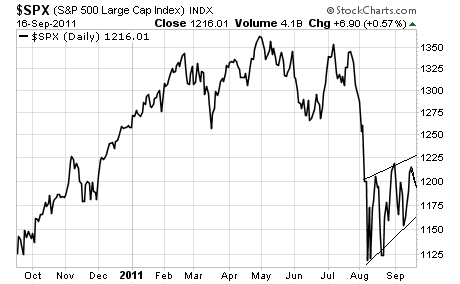
The market looks to be agreeing with me. The bearish flag formation I warned about last week remains in play. The ultimate downside target for this is 1,000 on the S&P 500.

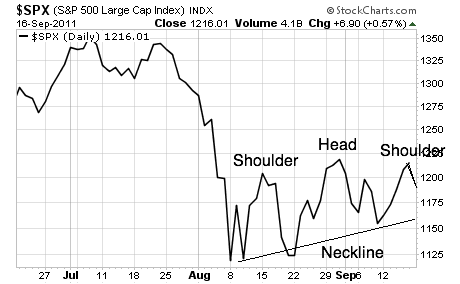
Within the bearish flag formation, we’ve also got the makings of a Head and Shoulders pattern: another very bearish formation. The drop Sunday night has made this pattern even more probable.

Neither of these formations predict a massive rally on QE 3 or some other new Fed program. Indeed, how can the Fed announce something new? A record number of Americans say they are paying more for their food. Oil is close to $90 per barrel. And Gold is north of $1,800, having touched $1,920 earlier this month.

Aside from this, the Fed has already instigated several new moves this month including the coordinated Central Bank intervention of last week and the opening of FX swap lines last month. I view these moves as preparation for a Greek default, which is most certainly in the near future.

Indeed, having staged two bailouts of Greece and talking down the possibility of a Greek default non-stop over the last 18 months, the ECB and political leaders in Europe seem to have done a complete 180, with the notion of a Greek default now a matter of “when” not “if.”

In early 2010, a Greek default was never even considered to be on the table. At that time, the entire discussion focused on whether or not Greece even needed a bailout. Today, the words “Greek Default” show up in almost every headline pertaining to Europe.

Greece Has 98% Chance of Default on Euro-Region Sovereign Woes

Potential Greek Default Worries European Politicians

Greece default ‘virtually 100 percent

Scenarios: Potential market impact of a Greek default

I fully believe that behind the scenes, the groundwork has already been laid for Greece to default. The market is already pricing this as a 100% certainty. France has its own problems and won’t be able to provide another Greece bailout. Germany is now in another round of elections in which voters are destroying Angela Merkel and her party for supporting the bailouts… at a time when it’s revealed that even German banks needs tens of billions more in capital.

In simple terms, the “bailout” madness is ending in Europe. What will follow will be a Greek default followed by debt collapses and restructurings in Italy and Spain. Europe is already aware of this, which is why liquidity has dried up to the point that the world’s Central Banks had to stage a coordinated intervention last week.

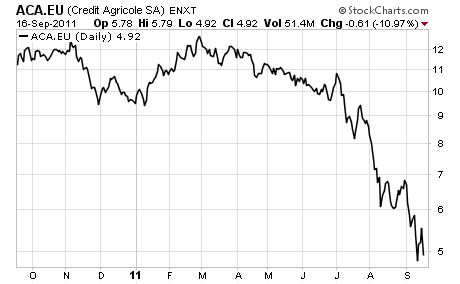
Indeed, I fully believe that we may in fact be on the verge of a Crash in the markets. All the Red Flags are there. Europe’s entire banking system is on the verge of systemic collapse. Take a look at European banks and you’ll see what I mean.


This is Agricole, the mega-French Bank. Does this look like a solvent financial institution to you? Do you really think that Europe has a chance when even French and German banks are collapsing?

Let’s be blunt, the global financial system is now on DEFCON Red Alert. If you have not already prepared your portfolio for a possible CRASH, you NEED to move now! Because by the time the selling pressure comes back into the markets in a BIG way (next week or so) it will be too late.

European Markets A Local’s Perspective

by Macro Story

I’m traveling this week and posts will be lighter than normal. Below is a guest post from a reader sharing some insights to the ways of the European markets.
 
To understand and appreciate the severity of the current European debit crisis, it is imperative to dig deeper into the history of the Euro, the history of the social benefits in Europe, what the common average European person feels about their entitlements and where their current economics are leading them to.

The deficit crisis that threatens the Euro has also undermined the sustainability of the European standard of social welfare, built by left-leaning governments since the end of World War II. European governments with big budgets, falling tax revenues and aging populations are experiencing rising deficits, with more bad news ahead.

With low growth, low birthrates and longer life expectancies, Europe can no longer afford its comfortable lifestyle, at least not without a period of austerity and significant changes. If we look at the Italian life style as an example, you will see that 85% of the younger Italian generations have decreased the birth rate of the general Italian population by electing to have 1 or 2 children at best fearing economic un-sustainability of their
future generations in comparison to their older generations in the early 19th century.

Europe’s population is aging quickly as birthrates decline. Unemployment has risen as traditional industries have shifted to Asia. The region lacks competitiveness in world markets. According to the European Commission; by 2050 the percentage of Europeans older than 65 will nearly double. In the 1950s there were seven workers for every retiree, by 2050, the ratio in the European Union will drop to 1.3 to 1.

The reaction so far to the southern European governments’ efforts to cut spending has been pessimism and anger, with an understanding that the current system is unsustainable. The younger generations of southern Europeans paying high taxes to finance bloated state sector and its employees resent that and they feel that state employees sit there for years drinking coffee and chatting on the telephone and then retire at age 50 ( In Greece ) with nice fat pensions.

Most young southern Europeans believe that their high ranking politicians within their governments have pocketed Billions of Euros for their special interest groups and shady business government deals and thus resent paying any higher taxes to bailout their corrupted officials who have created these financial entanglements on their own. The level of governments’ corruptions inEurope has been very high within the last 2 decades and many people as they resent it; they feel powerless in addressing it legally within their courts.

Middle age Italians as an example are very pessimistic about their future pensions and feel that their country has no future. Figures show the severity of the problem. Gross public social expenditures in the European Union increased from 16 percent of gross domestic product in 1980 to 21 percent in 2005, compared with 15.9 percent in the United States. In France, the figure now is over 31 percent, the highest in Europe, with state pensions making up more than 44 percent of the total and 30 percent for health care.

The challenge is particularly daunting in France, which has done less to reduce the state’s obligations than some of its neighbors. In Sweden and Switzerland, 7 of 10 people work past the age of 50. In France, only half do. While Germany has raised the retirement age to 67 for those born after 1963. The French state pension system today is running a deficit of over 11 billion Euros, or about $13.8 billion; by 2050, it will be 103 billion Euros, or $129.5 billion, about 2.6 percent of projected economic output.

Until the Euro was adopted in 1999, southern European countries would let their national currencies gradually fall in value against the German mark and other currencies of richer nations. That boosted exports and tax revenues, but the pensions paid by Portugal, Greece and others became worth less if spent in Germany and other northern jurisdictions. Conversely, these Mediterranean states became great places for Americans and northern Europeans to vacation and retire.

After 1999, national governments in Spain, Portugal and Greece, and to a lesser extent more prosperous Italy, faced the difficult prospect of telling their citizens they could not retire as young, enjoy the same health benefits or employment security as the wealthier French, Germans and Dutch. Instead, these governments borrowed heavily and now face severe retrenchment and perhaps eventual bankruptcy.

The austerity Germany and others will compel to bail out these floundering southern European governments will shatter the myth that the welfare state can be provided equally across Europe, or these southern states will simply quit the Euro and take with them the Franco-German dream of European Unity.

For the last several months these harsh realities of possible defaults have been felt more severely within the southern European countries. The younger generations are facing a battle against their governments that are enforcing austerity measures while their parents’ generation have enjoyed full social liberal benefits, these young people can not understand the sudden abruption of their benefits and thus are taking their claims out to the streets and protesting against what they call corrupted politicians who have stole their future benefits to pay as a high tax to satisfy the Germans hard working life style.

As to the older and senior generations of the European population, they are divided into 2 main schools of thoughts. The much older generation that are over the age of 80 are not very concerned of the current crisis, they are physically weak to fight any changes and their life expectancies will not be affected by any changes in the near term. The other group between the ages of 60 – 80 has just started to feel the crunch of such crisis. As most of them are still in their early retirements, many have been reluctant to protect their financial assets in case of another financial collapse in Europe. They feel that any possible events may not be worse than what was seen 3 years ago.

However, within the last 3 months many have started to act by withdrawing their savings out of the big banks and seeking safe deposit boxes and other means to protect their cash, fearing another banking system collapse. The recent call of solidarity between several global central banks to sure up dollar funding liquidity for European banks is a red alarm and an interpretation of lack of depositaries reserves for some of the largest European banks as many people will continue to withdraw their entire savings accounts; mostly done by the senior populations between the ages of 60 – 80 to protect what they have left in savings in case their governments can not provide for their social benefits moving forward.

The fact that the southern European populations are dominated by the older age groups, an increase in sudden wave of bank depositary withdrawals in case of more alarming economic news such as a default will create an overnight liquidity crunch and credit lock up in the entire European banking system. The cultural aspect of such population to act in this manner is not out of the roam of possibilities if the headlines started to become more fearsome and economically damaging. That is one of the main reasons why the European politicians will not fear any criminal prosecutions if they make false public statements, rumors or intentional public lies to sooth and calm their anxious aging populations who may not hesitate to make a run on their banks. Unfortunately, this cycle will negatively feed on itself once it starts.

There is a complete state of confusion between all ages and all sectors of the southern Europeans regarding what their politicians are voicing within the public arena regarding their debt crisis.

Most Europeans believe that their politicians will utter any statements in public even lies to help bolster their objectives. It is not uncommon to see many headlines cross the airwaves, print media and online that may not be true, perhaps rumors or even flat out lies just to either falsely deny the reality, create misconceptions, or even to calm the masses hoping for lesser protests in the coming weeks. The southern European governments are aware of the truth and perhaps the true causes of their fiscal deficits, yet they are trapped at this point between a non-credibility within an angry young populations and the anger of the German population who have felt that their hard working tax revenues are wastefully being spent on guaranteeing pensions for their floundering southern neighbors.

The fate of the Euro is true financial misfortune that is unavoidable at this time. This experiment was meant to fail from the start, and unfortunately it will drag the entire western world economies along for the ride. The course of this experimental journey is coming to an end regardless of what the European governments are trying to muster up in the interim at this time. Any moves or tactics will be temporary band aids and will not address the social complexity that caused these social entitlements mounting debts; the depth of the debt problem is deeper than any liquidity issues or just bailing out failing banks. The cost of such crisis is in the trillions of Euros and this has been accumulating over the last 11 years since the inception of the Euro currency.

Therefore, when the US Treasury Secretary tries to assure the media by saying that we will not have another Leman’s collapse, tragically and ironically he is correct, the collapse that is anticipated is much worse and much bigger than 10 Leman’s events put together, only if he or others are willing to admit to this reality.

Follow Us