Saturday, August 20, 2011

Macro Week in Review/Preview August 20, 2011

by

Last week’s review of the macro market indicators looked like a reversal of the previous week. Gold looked heading lower while Crude Oil had a short term bias higher in a downtrend. The US Dollar Index looks to continue sideways in the 73.50-76 range, while US Treasuries look to continue lower in an uptrend. The Shanghai Composite and Emerging Markets look to be headed higher. Volatility looks biased to the downside with a move under 34 key to continuing lower, and giving a bias to the upside for the Equity Indexes SPY, IWM and QQQ, also within a downtrend. The big question looks to be whether this is a dead cat bounce or for real.

As the week began the macro trends took control. Gold moved higher while Crude oil started higher but fell off through the week. The US Dollar Index did continue sideways but to the lower end of the range while US Treasuries moved higher. The Shanghai Composite and Emerging Markets started higher but reversed ending the week lower. The Volatility Index started the week heading lower as Equity Index ETF’s SPY, IWM and QQQ moved higher only for all to reverse with Equities closing near the lows of the week and Volatility spiking again. How does this impact the view for the week ahead? Let’s look at some charts.

As always you can see details of individual charts and more on my StockTwits feed and on chartly.)
Gold Daily, $GC_F

Gold Weekly, $GC_F

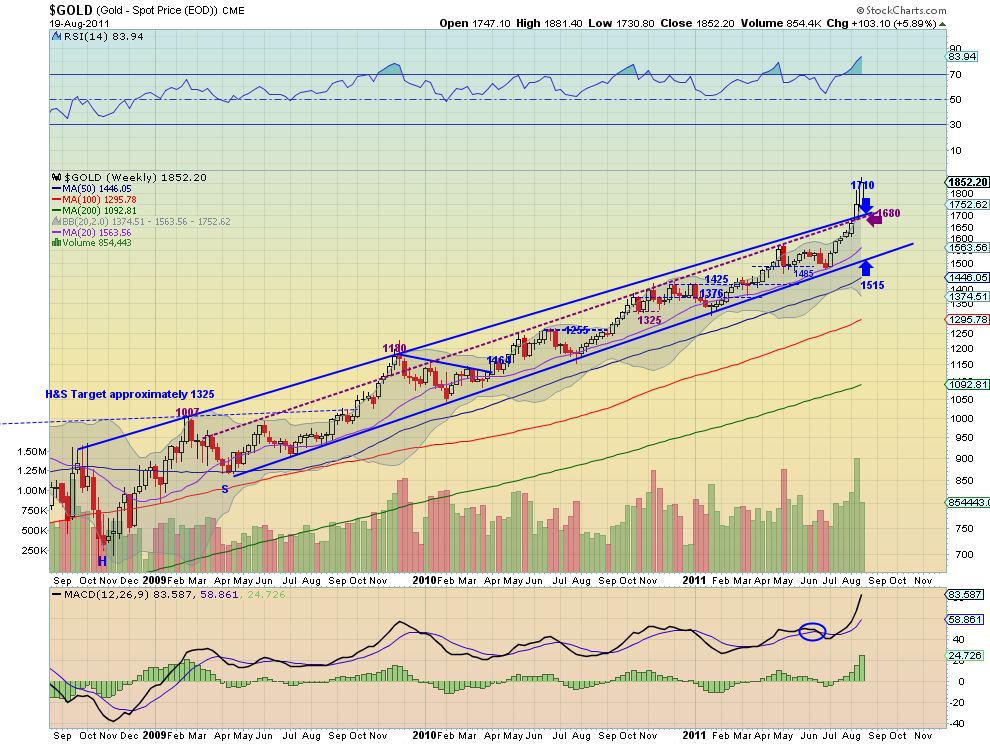
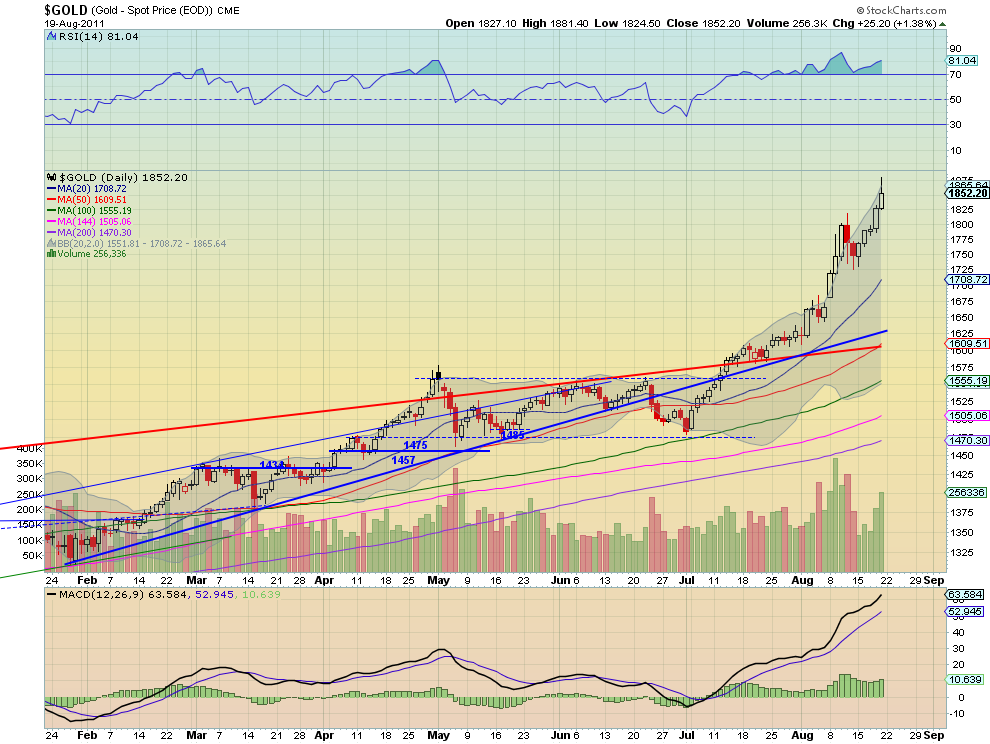
Gold took off right out of the gate and never looked back adding over $100 for the week. The Relative Strength index (RSI) on the daily chart remains elevated but the Moving Average Convergence Divergence (MACD) is increasing again. It did stay within the Bollinger bands this week and volume was increasing for this leg higher. The weekly chart printed a continued move higher above the channel, confirming the breakout with a target of 1905. The RSI is higher than it has been since May 2006 and the MACD is large. It finished well outside of the Bollinger bands on the weekly time frame. The trend remains higher ans expect that to continue next week, but be cautious about adding or creating a new position as it is getting extended from the trend and the Simple Moving Averages (SMA). Any pullback should find support at 1800 or 1748 below that.
West Texas Intermediate Crude Daily, $CL_F

West Texas Intermediate Crude Weekly, $CL_F
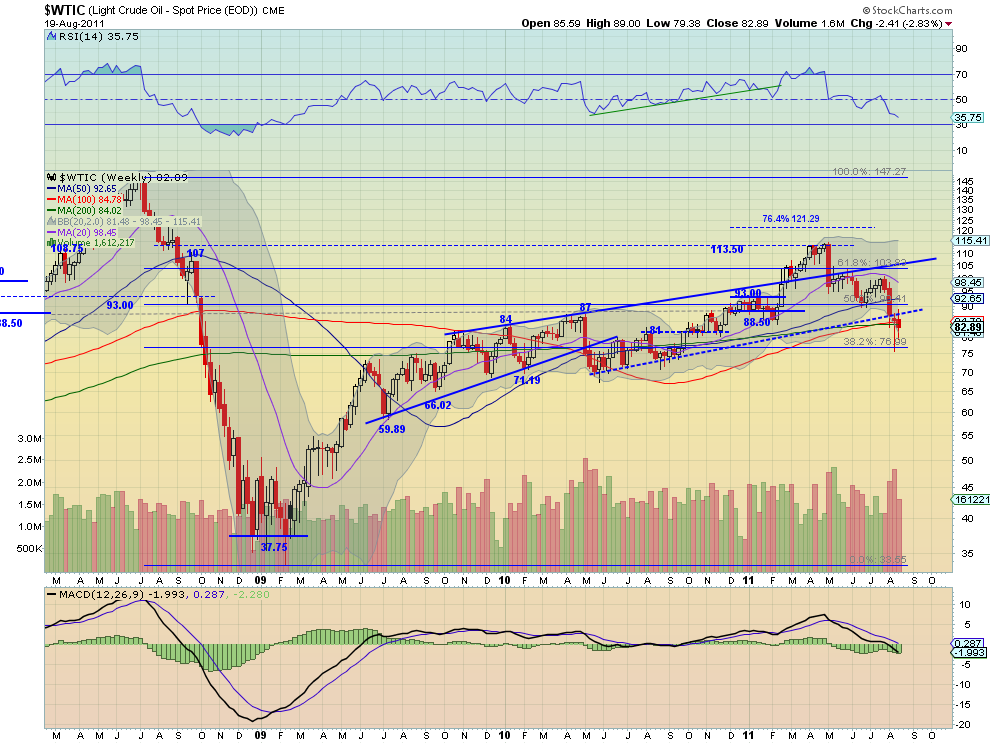
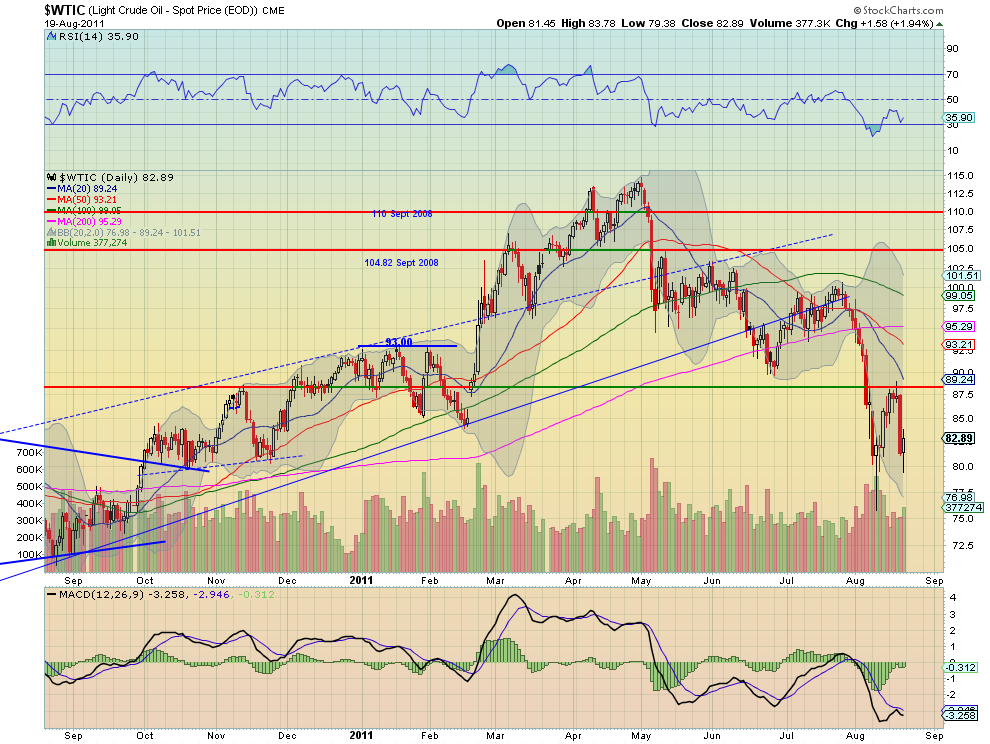
Crude Oil continued its move higher early in the week but found resistance at the 88 support/resistance level and moved lower. By Friday it held support at the previous low area at 81. The daily chart shows the RSI bouncing off of the 30 level but the MACD kissed and moving lower. The weekly chart shows the continued break lower, failing to confirm the hammer from last week. The RSI is heading lower as is the MACD, suggesting more downside on the time frame. Look for Crude Oil to continue lower next week with the 81 area proving important and then 77 below that. Keep in mind a Measured Move (MM) lower would target 68.
US Dollar Index Daily, $DX_F

US Dollar Index Weekly, $DX_F

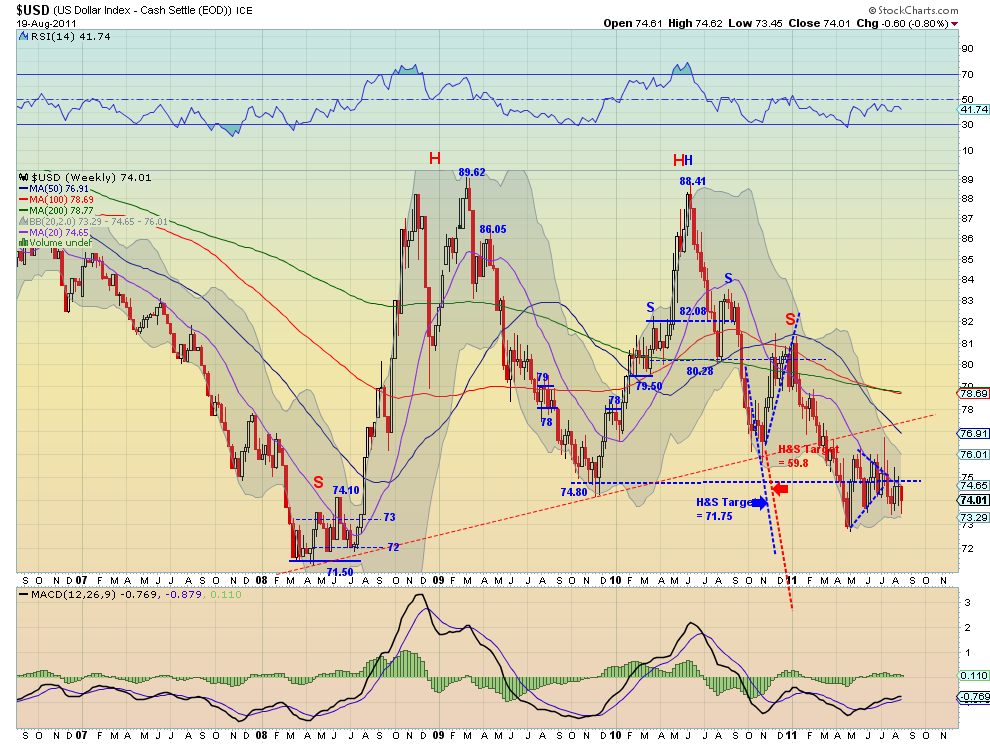
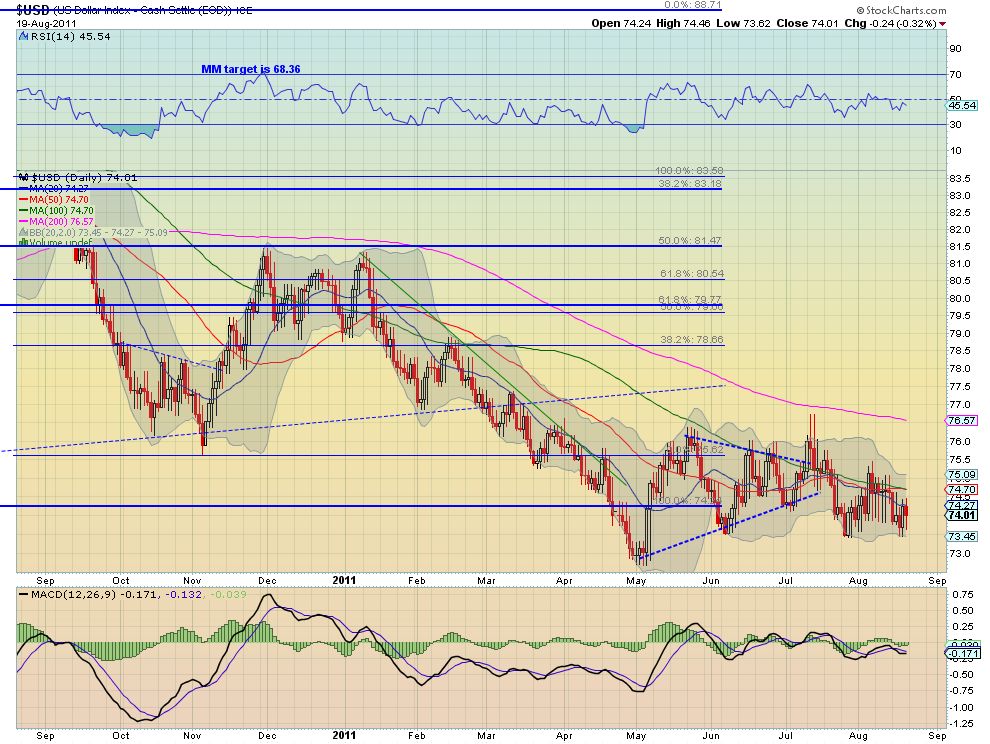
The US Dollar Index continued its move sideways in the range between 73.50 and 76. The RSI and MACD on both the daily and weekly basis continue to muddle around the mid line offering little guidance for any future move. But the trend remains lower with a long bear flag. The target on a MM lower is 56, below the Head and Shoulders target of 59.80. Look for more milling around next week within the 73.50-76 range, with a move lower finding support at 73 and then 71.50. Above 76 has resistance at 77.30.

iShares Barclays 20+ Yr Treasury Bond Fund Daily, $TLT

iShares Barclays 20+ Yr Treasury Bond Fund Weekly, $TLT
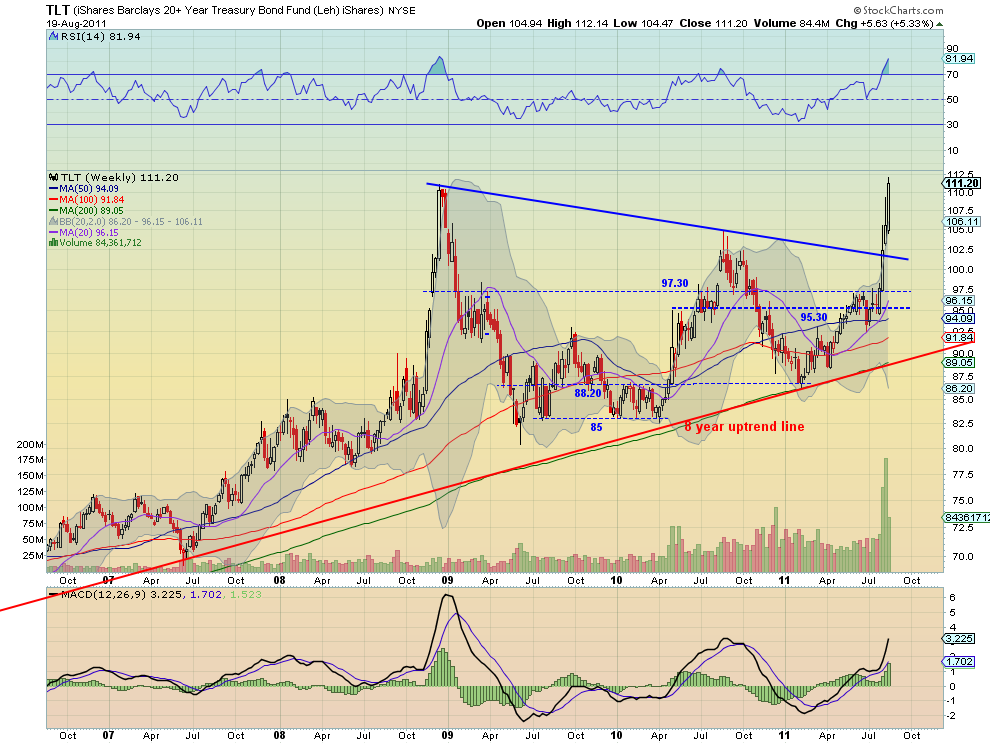
Treasuries, as measured by the ETF $TLT, continued their breakout higher this week making a new all time high. the RSI on the daily chart is strong pointing higher and the MACD is increasing again, both supporting more upside. The weekly chart continued the breakout of the symmetrical triangle, with the RSI becoming elevated near 82 but the MACD growing. Volume was a bit lower this week and it finished well outside of the Bollinger bands for the third week in a row, both adding to the caution of the elevated RSI. Look for more upside next week with 115 the next target and a note that the target for the triangle breakout is at 136. Any pullback has some support at 109.30 and 108 before 106.
Shanghai Stock Exchange Composite Daily, $SSEC

Shanghai Stock Exchange Composite Weekly, $SSEC

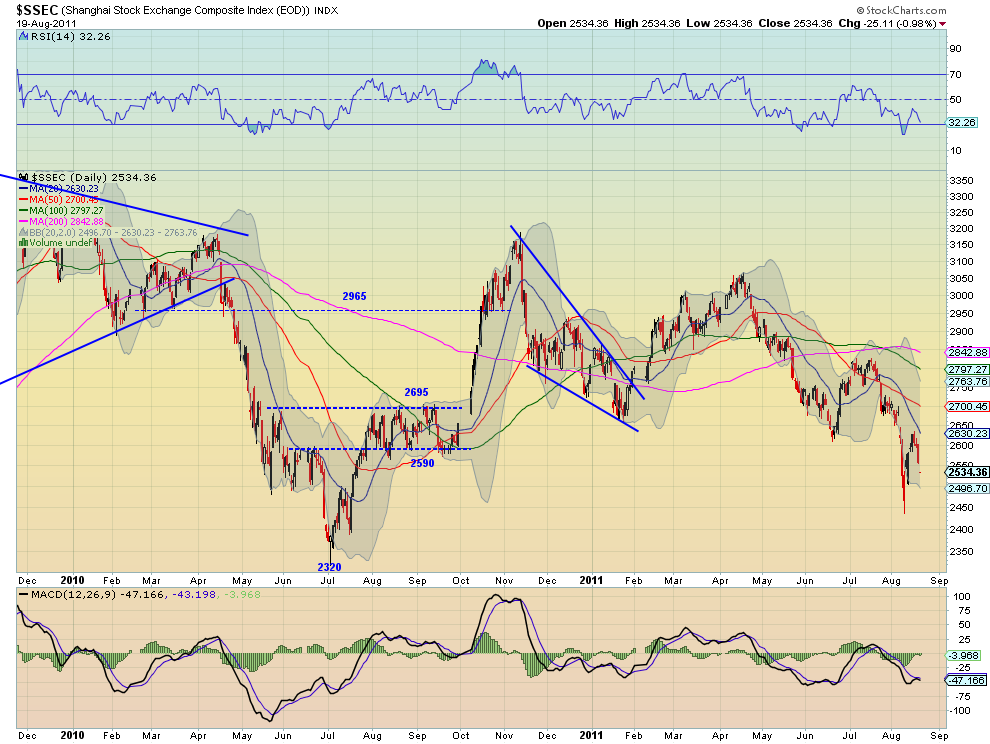
The Shanghai Composite continued its move lower after finding resistance at the June low near 2625. The RSI is moving lower and the MACD is also after missing a cross higher on the daily chart. The red candle on the weekly chart could not confirm the hammer from last week as it moves below support between 2571 and 2590. the weekly RSI and MACD continue to signal more downside. Look for next week to continue lower for the Shanghai Composite. there is support at 2500, 2450 and 2400 before a MM target at 2360, coinciding with the 61.8% Fibonacci retracement at 2357. Any move higher has resistance at 2695-2700.
iShares MSCI Emerging Markets Index Daily, $EEM

iShares MSCI Emerging Markets Index Weekly, $EEM
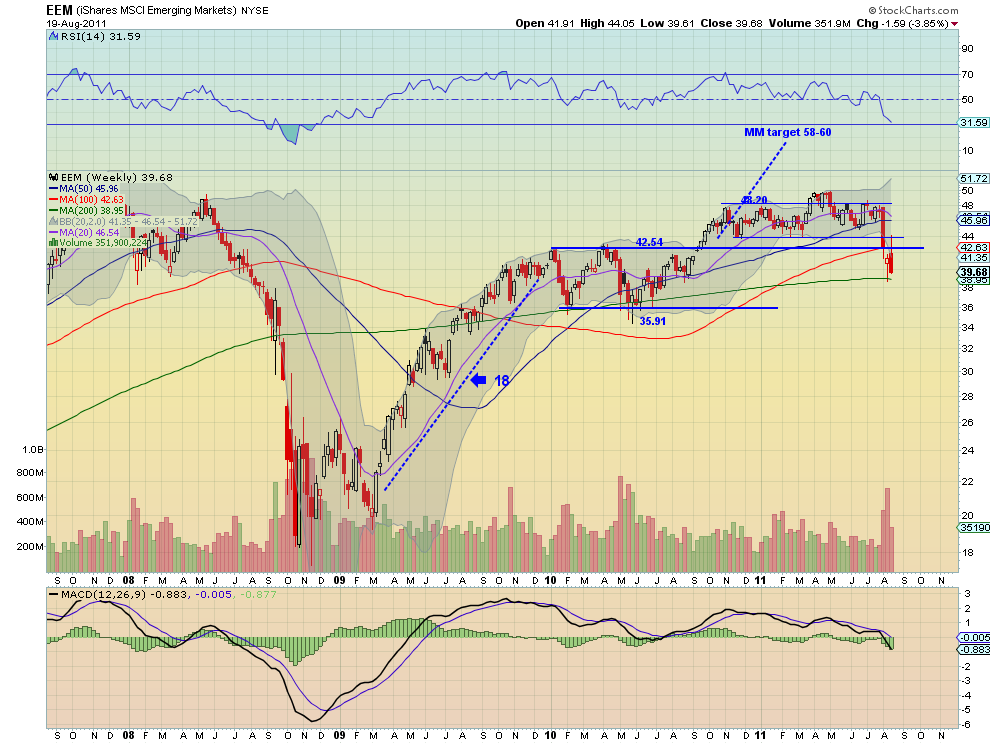
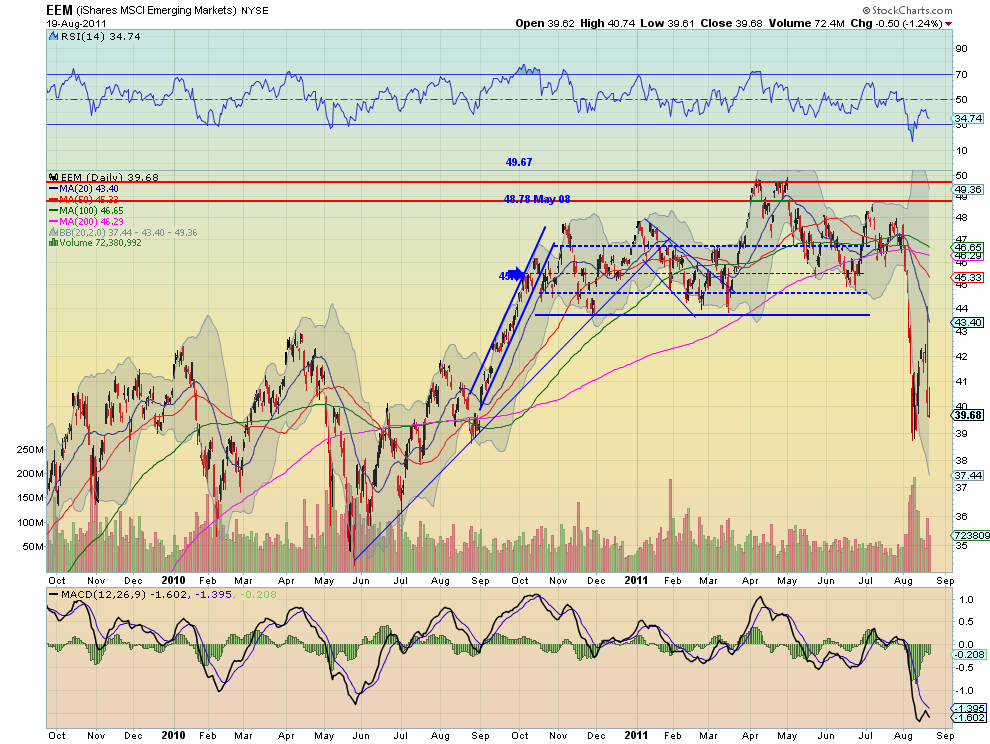
Emerging Markets, as measured by the ETF $EEM, moved higher before crashing on Thursday. The RSI on the daily chart has turned lower and the MACD blew an air kiss before heading back lower. The weekly chart looks worse with a big bearish engulfing candle complementing a RSI that is falling and a MACD that is growing more negative. Look for the downside to continue next week with support at 39 followed by 38 and 35.91. Any move higher should find some resistance at the 40.75-.89 area and then 42.54.
VIX Daily, $VIX

VIX Weekly, $VIX

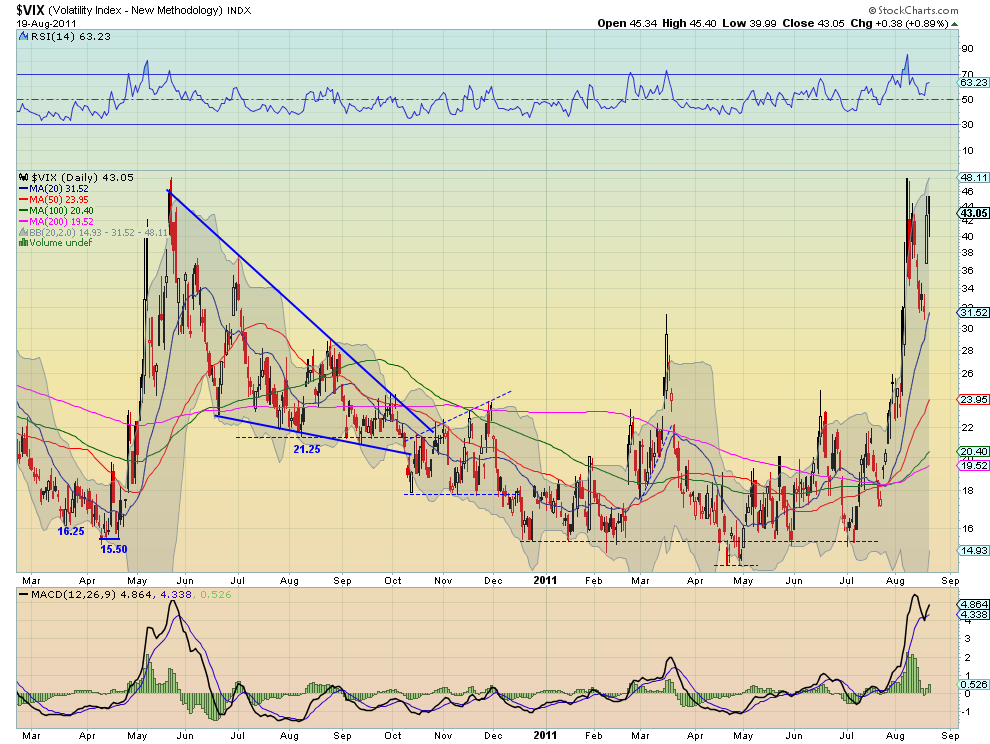
The Volatility Index jumped back higher to end the week, after a move lower early, breaking the bull flag higher to near last week’s high. The target for the flag break is 56. The RSI on the daily chart is rising and the MACD is increasing again both suggesting more upside. On the weekly chart the bullish engulfing candle negated last week’s inverted hammer/shooting star. The RSI on this time frame is rising and becoming elevated while the MACD is increasing as well. The RSI has fallen hard the last 2 times it has reached this level, suggesting a move lower may come soon. look for continued elevated Volatility next week with any pullback finding support at the 34-35 area and a move above 50 leading to a greater rise.
SPY Daily, $SPY

SPY Weekly, $SPY

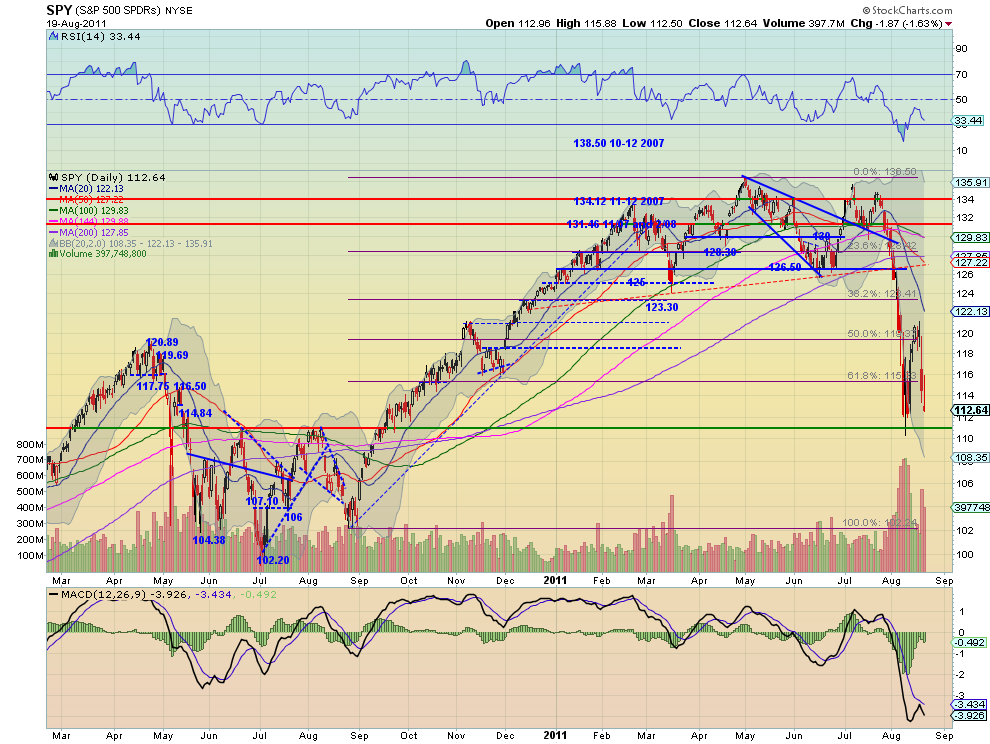
The SPY started the week higher before a violent move lower to end the week near 112 support and the recent lows. The RSI is pointing lower and the MACD is growing more negative after it blew a Real Housewive’s of New Jersey air kiss. The weekly chart printed a bearish engulfing candle just above the 200 week SMA at 111.16. The RSI and MACD on the weekly basis support more downside. Look for the carnage to continue next week with some support in the 111.15 area and then the range between 110 and 102.50. Any upside move looks to find resistance at 114.14 and then 115.83-116.
IWM Daily, $IWM

IWM Weekly, $IWM

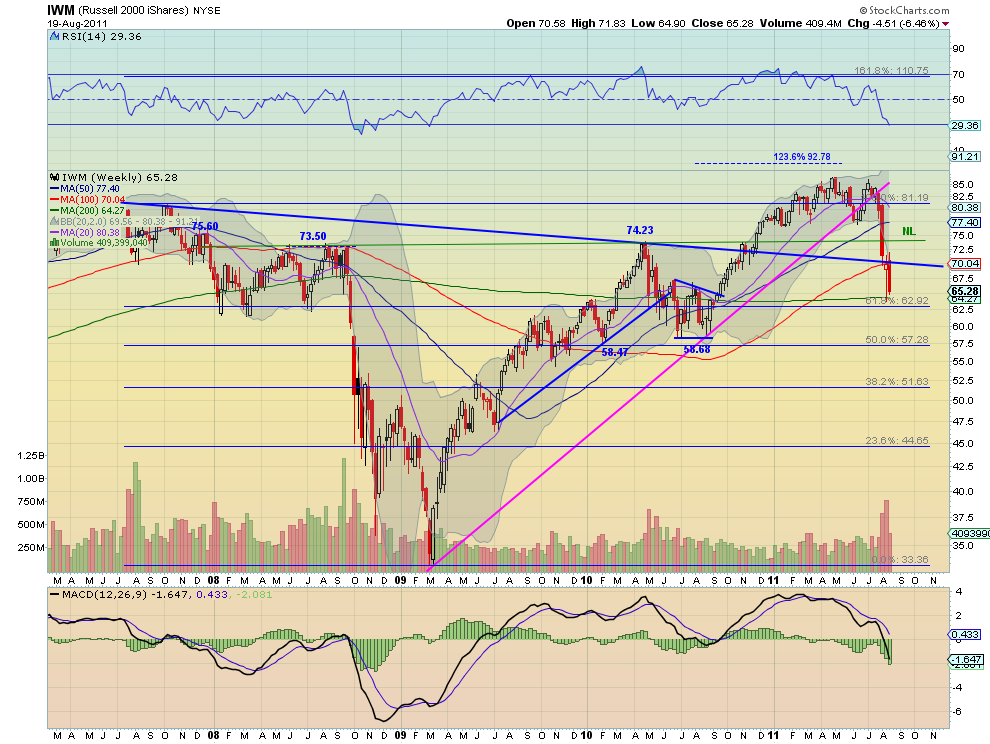
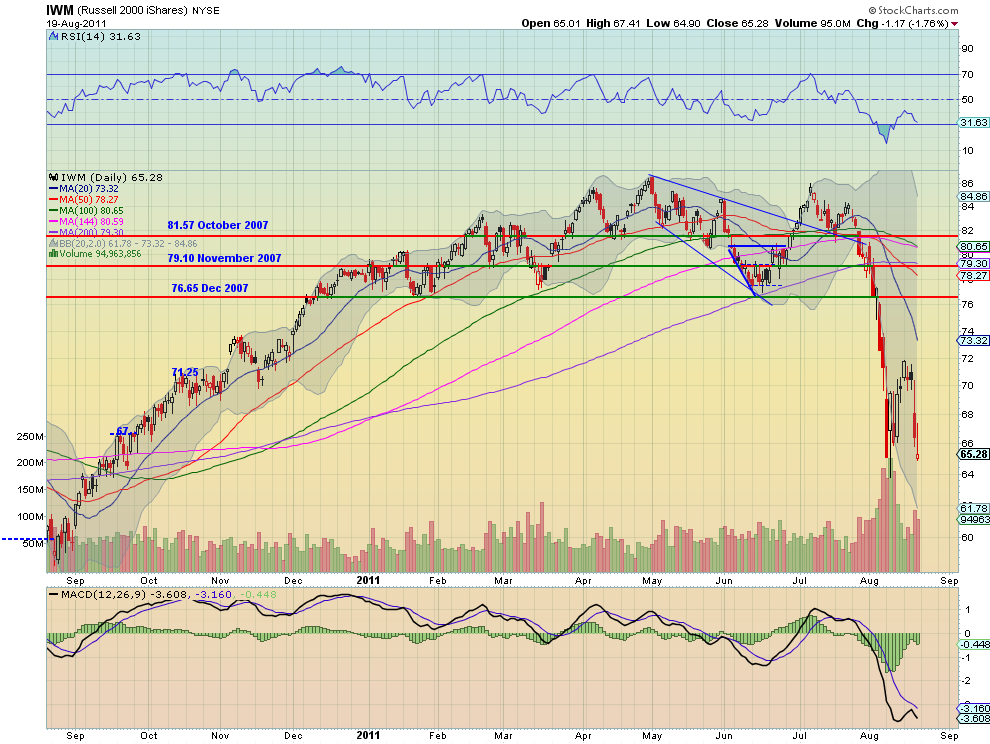
The IWM also started the week higher before a violent move lower to end the week near 65.25 support. The RSI is pointing lower and the MACD is growing more negative after it blew a air kiss on the way down. The weekly chart printed a bearish engulfing candle just above the 200 week SMA at 64.27, that rejected on a test of the Head and Shoulders neckline from below near 70. The RSI and MACD on the weekly basis support more downside also. Look for the downside to continue next week with support in the range between 64 and 58.60. Any upside move looks to find resistance at 70 and then 72.
QQQ Daily, $QQQ

QQQ Weekly, $QQQ

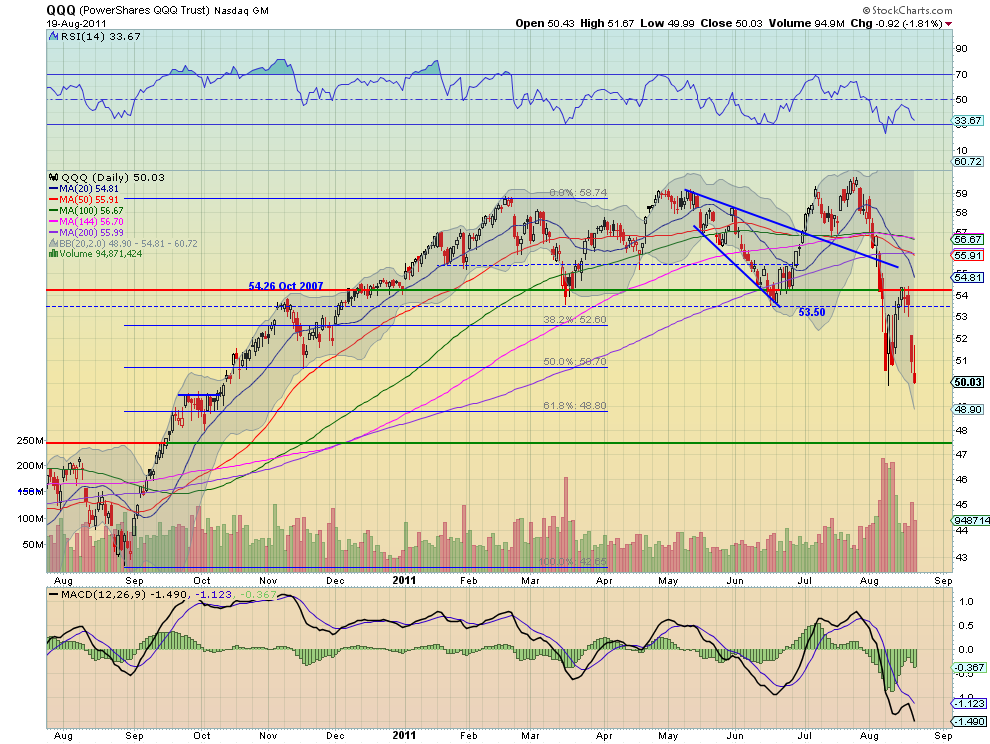
The QQQ also started the week higher before a violent gap move lower to end the week at 50.03 support. The RSI is pointing lower and the MACD is growing more negative after it also blew an air kiss on the way down. The weekly chart printed a bearish engulfing candle just above the 100 week SMA at 49.85, that is testing from above the Head and Shoulders neckline. The RSI and MACD on the weekly basis support more downside also. Look for the downside to continue next week with support in the range between 49.50 and 48. Any upside move looks to find resistance at 52.60 followed by 53.50 and then 54.26.

The entire rubber band of the market is getting a little stretched but expect it to continue next week. Gold looks to continue higher as Crude Oil continues to sell off. The US Dollar Index appears comfortable continuing sideways while US Treasuries move higher. The Shanghai Composite and Emerging Markets look ready for more downside. Volatility looks biased higher leading to the expectation that Equity Index ETF’s SPY, IWM and QQQ continue lower. Remember that a stretched rubber band can result in two outcomes: a snap back, or the rubber band breaks and the real carnage results. Stay nimble. Use this information as you prepare for the coming week and trade’m well.

Friday, August 19, 2011

Socio-Economics Put China and India at Higher Investment Risk Than The U.S.

By EconMatters

This week has turned out to be Wall Street's wildest week since 2008. The Dow Jones industrial average closed down 519 points on Tuesday, Aug. 10, but then went up 423.37 points. But overall, Down has now lost more than 2,000, or 16% since July 21, less than three weeks ago. The selloff intensified after the U.S. got stripped of the top notch AAA rating by S&P first time ever in history.

The double AA status has put the U.S. in the same category as China, based on S&P's rating. But one consolation for the United States is that the country's high socio-economic resilience has placed the U.S. at a more favorable investment risk position than major emerging economies like China and India. Socio-economic Resilience Index is a risk metric developed by risk analysis firm Maplecroft measuring the ability of countries to cope with the impacts of a major event.

It is interesting that although some of the developed countries and emerging economies, while all subject to economic exposure to natural disasters, it is the socio-economic resilience that sets these countries apart when it comes to the overall risk to investors.

Based on another risk metric - Natural Hazards Risk Atlas 2011 (NRHA)--from Maplecroft, out of 196 countries, USA (1), followed by Japan (2), China (3) and Taiwan (4) are the only four countries rated as "extreme risk" to economic exposure to natural hazards such as floods, hurricanes, earthquakes.

The large emerging economies of Mexico (5), India (6), Philippines (7), Turkey (8) and Indonesia (9), and two developed countries--Italy (10) and Canada (11) are the remaining to be rated as ‘high risk’.(See Map)


However, in the Socio-economic Resilience category, most developed countries such as the US and Japan are rated as ‘low risk’, whereas some hot growth emerging economies like China, India, the Philippines, Indonesia, Pakistan, Bangladesh, and Iran are all rated as 'high risk’.

According to Maplecroft, while the large developed economies of the US and Japan have the greatest economic exposure to major natural hazards, they also have the capacity and readiness to weather impacts from major disasters. That includes: economic strength, infrastructures, disaster contingency plans, as well as tight building standards, etc.

Many of the emerging economies rated with high socio-economic risk have attracted high FDI (Foreign Direct Investment) inflow in recent years with their rapid growth. The rising economic power of the major emerging economies like China and India, and their lack of resources to respond to major events means the occurrence of a major disaster in these countries may also have global economic impacts and severely affect the global supply chain.

For instance, the severe drought in China earlier this year threatened global wheat crop production and prompted the U.N. food agency to issue warning due to the impact of China’s drought on global food prices and supplies.

Companies deriving a large portion of revenues from emerging Asian countries, although may have enjoyed higher growth in recent year, are at the same time subject to a greater risk of business disruptions than their more domestic-centric competitors.

Nevertheless, just as each country differentiates itself in its capability to respond and withstand major events / disasters, how each company executes its disaster response and business continuity plans may also serve as a differentiator within the pack.

For example, some companies like Apple were able to move quickly to secure their supply chain after the Japan quake, whereas others had to cut or halt production, powerless to respond to lost business and market share.

This also means investors, who are currently diversifying portfolios into Asian countries, need to also factor in natural hazards risks in to their investment strategies.

Bloomberg quoted an EPFR Global report that emerging-market equity mutual funds had more than $7 billion of withdrawals in the week ended Aug. 10, the most since the third week of 2008.

Emerging economies have been all the rage and buzz in recent years partly on stagnant growth in the OECD countries. But in times of uncertainty like we have now, investors tend to put stability above other considerations. Right now, the U.S. still offers relatively stable outlook (albeit with a gloomy near-term GDP growth projection) than most of other regions in the world.


So the risk factors discussed here probably already are playing an implicit role, particularly in the wake of Japan's mega earthquake and the resulted tsunami's, in the recent stock performance of MSCI emerging markets index vs. the S&P 500 (see chart above).

Get Ready! Gold & Stocks Are About To Diverge


The past few weeks traders and investors have been completely spooked from the surge of negative news and collapsing stock prices. This fear can be seen by looking at the volume on the GLD gold ETF fund. With gold being in the spot light for several years now and the fact that anyone can own gold simply through buying some GLD shares. It only makes sense that reading the volume on this chart gives us a good feel for what the masses are feeling emotionally.

If we step back to trading basics we know that fear is the strongest force in the financial market for moving prices. And that there are a few ways to read fear in the market and the more which line up at the same time means there is a higher probability of trend reversal in the near future.

The first thing I look for is a rising volatility index (VIX). This index rises when investors become fearful of stock prices falling be hedging positions or flat out buying put options to profit from a falling market.

Second, I look for a high selling volume ratio meaning at least 3:1 shares traded are from individuals hitting the sell button in a panic thinking that the market is about to collapse.

And last but not least… I look at the GLD gold etf volume and price action. A surge in GLD volume after a strong move up means everyone is scared and dumping their money into a safe haven.

Let’s take a look at some charts to get a better feel.

GLD Weekly Gold Chart:

As you can see there are sizable price movements which ended with strong volume surges. Those volume surges mean that the majority of investors have reached the same emotional level and bought gold for safety (GLD ETF). Keep in mind that the big money players and market makers can see this taking place and that is when they start selling into that surge of buying volume locking in maximum gains before there are no more buyers left to hold the price up. Tops generally take a few weeks to form so don’t expect a one day collapse.

The recent rally in gold has taken place when stocks have fallen sharply. Money has been pulled out of stocks and pushing into gold but I think that is about to change…


SPY Weekly SPX Chart:


The past month has been a blood bath for stocks. But from looking at the charts, volume and the fear in the market I can’t help but think we are going to see higher stock prices as investors see stocks moving higher, they will pull money out of gold and dump it back into stocks and likely high dividend paying stocks…


Mid-Week Trading Conclusion:

In short, everyone piled into gold sending it rocketing higher and I feel it has moved to far – to fast and is ready for a pullback (pause lasting 2-12 weeks). In association with gold’s pullback I feel investors are now realizing they sold their stocks at the bottom of this correction because fear took hold of their investing decisions. Now they are starting to think about getting long stocks but it still may be a bumpy ride for a few weeks yet…

ChartMatters: Dollar, Gold and Silver


Here now is a fresh look and the world's reserve currency and the two metals, starting with a 20-year timeline for the Dollar and Gold. Since late April, the Dollar has been in a narrow range with yesterday's close down 0.2% from our last inspection. Gold, in contrast, has risen 18.59%.
Click to View

What about Silver? It has been more volatile than Gold, but over the same timeframe, it has a nearly identical gain of 18.11%.
Click to View

The next chart starts the timeline in 1980, the earliest date my source, Stockchart.com, supplies data. Gold and Silver data are available across the complete timeline, but the Dollar tracking begins in mid-1983.

Click to View

By starting in 1980, we see the downside of the historic bubble in Silver that peaked on Silver Thursday, March 27, 1980.
Click to View
Source: www.RealTerm.de via Wikipedia


The circumstances surrounding the 1980 Silver Bubble, nicely summarized in this Investopedia article, were unique in modern history. In nominal terms, Silver is back in the territory of the 1980 bubble, but in real terms, and in light of the global financial distress, precious metals will doubtless remain attractive to many investors.

What about the Dollar? As of yesterday's close, the Dollar is down 55% from its 1985 peak. I won't hazard a forecast as to where it's headed, but I wouldn't be surprised to see the range of the past two years set the boundaries for the next several months.

See the original article >>

Is China Going To Stop Buying US Government Debt?


Is the PBoC going to stop buying USG bonds? Once again we are hearing very worried noises from various sectors about the possibility of a reduction in Chinese purchases of USG bonds. Here is what an article the South China Morning Post said:

"China will press ahead with diversification of its US$3.2 trillion in foreign exchange reserves, the State Administration of Foreign Exchange (SAFE) said on Thursday, adding it does not intentionally pursue large-scale foreign currency holdings. Officials have long pledged to broaden the mix of the country’s huge reserves – as much as 70 per cent of which are now in US dollar assets, according to analysts’ estimates – but the process has been gradual.
“We will continue to diversify the asset allocation of our reserve assets and continue to optimise the holdings based on market conditions,” the foreign exchange regulator said in a statement, responding to questions about its reserve management from the public. It did not mention the US debt debacle. Top Republicans and Democrats worked behind the scenes on Wednesday on a compromise to avert a crippling US default and potential credit rating downgrade.
Xia Bin, an adviser to the central bank, told reporters earlier this month that China should speed up reserve diversification away from dollars to hedge against risks of the US currency’s possible long-term decline."
It sounds like this time the PBoC might be pretty serious about diversifying their risk away from USG bonds, right? Let’s leave aside the fact that every six months we have heard the same thing for the past several years, and nothing has happened, shouldn’t we nonetheless be worried? Won’t reduced PBoC purchases be hugely disruptive to the US economy and to the US Treasury markets?

No, they won’t. There is so much nonsense still being said about this, even by economist who should know better, that I thought I would try to address what it would mean if the PBoC were actually serious and not simply making noises aimed at domestic political constituents.

First of all, remember that the PBoC does not purchase huge amounts of USG bonds because it has a lot of money lying around and doesn’t know what to do with it. Its purchase of USG bonds is simply a function of its trade policy.

You cannot run a current account surplus unless you are also a net exporter of capital, and since the rest of China is actually a net importer of capital, the PBoC must export huge amounts of capital in order to maintain China’s trade surplus. In order the keep the RMB from appreciating, the PBoC must be willing to purchase as many dollars as the market offers at the price it sets. It pays for those dollars in RMB.

It is able to do so by borrowing RMB in the domestic markets, or by forcing banks to put up minimum reserves on deposit. What does the PBoC do with the dollars it purchases? Because it is such a large buyer of dollars, it must put them in a market that is large enough to absorb the money and – and this is the crucial point – whose economy is willing and able to run a large enough trade deficit.

Remember that when Country A exports huge amounts of money to Country B, Country A must run a current account surplus and Country B must run the corresponding current account deficit. In practice, only the US fulfills those two requirements – large financial markets, and the ability and willingness to run large trade deficits – which is why the PBoC owns huge amounts of USG bonds.

If the PBoC decides that it no longer wants to hold USG bonds, it must do something pretty drastic. There are only four possible paths that the PBoC can follow if it decides to purchase fewer USG bonds.

  1. The PBoC can buy fewer USG bonds and purchase more USD assets
  2. The PBoC can buy fewer USG bonds and purchase more non-US dollar assets, most likely foreign government bonds.
  3. The PBoC can buy fewer USG bonds and purchase more hard commodities
  4. The PBoC can buy fewer USG bonds by intervening less in the currency, in which case it does not need to buy anything else.

We can go through each of these scenarios to see what would happen and what the impact might be on China, the US, and the world. To make the explanation easier, let’s simply assume that the PBoC sells $100 of USG bonds.

The PBoC can sell $100 of USG bonds and purchase $100 of other USD assets. In this case basically nothing would happen. The pool of US dollar savings available to buy USG bonds would remain unchanged (the seller of USD assets to China would now have $100 which he would have to invest, directly or indirectly, in USG bonds), China’s trade surplus would remain unchanged, and the US trade deficit would remain unchanged. The only difference might be that the yields on USG bonds will be higher by a tiny amount while credit spreads on risky assets would be lower by the same amount.

The PBoC can sell $100 of USG bonds and purchase $100 of non-US dollar assets, most likely foreign government bonds. Since in principle the only market big enough is Europe, let’s just assume that the only alternative is to buy $100 equivalent of euro bonds issued by European governments.

There are two ways the Europeans can respond to the Chinese switch from USG bonds to European bonds. On the one hand they can turn around and purchase $100 of USD assets. In this case there is no difference to the USG bond market, except that now Europeans instead of Chinese own the bonds. What’s more, the US trade deficit will remain unchanged and the Chinese trade surplus also unchanged.

But Europe might be unhappy with this strategy. Since there is no reason for Europeans to buy an additional $100 of US assets simply because China bought euro bonds, the purchase will probably occur through the ECB, in which case Europe will be forced to accept an unwanted $100 increase in its money supply (the ECB must create euros to buy the dollars).

On the other hand, and for this reason, the Europeans might decide not to purchase $100 of US assets. In that case there must be an additional impact. The amount of capital the US is importing must go down by $100 and the amount that Europe is importing must go up.

Will this reduction in US capital imports make it more difficult to fund the US deficit? Not at all. On the contrary – it might make it easier. Why? Because if US capital imports drop by $100, by definition the US current account deficit will also drop by $100, almost certainly because of a $100 contraction in the trade deficit.

A contraction in the US trade deficit is of course expansionary for the economy. Since the purpose of the US fiscal deficit is to create jobs, and a $100 contraction in the trade deficit will create jobs, the US fiscal deficit will contract by $100 for the same level of job creation – perhaps even more if you believe, as most of us do, that increased trade is a more efficient creator of productive jobs than increased government spending.

In other words although there is $100 less demand for USG bonds, there is also $100 less supply (or more) of USG bonds. It is of course possible that the USG ignores the employment impact of the contraction in the trade deficit, and goes ahead and spends the $100 anyway, but in that case unemployment would drop even more than expected.

This is the key point. If foreigners buy fewer USD assets, the US trade deficit must decline. This is almost certainly good for the US economy and for US employment. When analysts worry that China might buy fewer USG bonds, in other words, they are worrying that the US trade deficit might contract. This is something we should welcome, not deplore.

But the story doesn’t end there. What about Europe? Since China is still exporting the $100 by buying European government bonds instead of USG bonds, its trade surplus doesn’t change, but of course as the US trade deficit declines, the European trade surplus must decline, and even possibly go into deficit. This is because by selling dollars and buying euro, China is forcing the euro to appreciate against the dollar.

This deterioration in the trade account will force Europeans either into raising their fiscal deficits or letting domestic unemployment rise. Under these conditions it is hard to imagine they would tolerate much Chinese purchase of European assets without responding eventually with trade protection.

The PBoC can sell $100 of USG bonds and purchase $100 of hard commodities. This is no different than the above scenario except now that the exporters of those hard commodities must face the choice Europe faced above. Either they can neutralize the trade impact of Chinese purchases by buying US assets or they have to absorb the employment impact of deterioration in their trade account.

This, by the way, is a bad strategy for China but one that it seems nonetheless to be following. Commodity prices are very volatile, and unfortunately this volatility is badly correlated with Chinese needs. Since China is the largest or second largest purchaser of most commodities, stockpiling commodities is a good investment only if it continues growing rapidly, and a bad investment if its growth slows. This is the wrong kind of balance sheet position any county, especially a very poor country like China, should be engineer. It simply exacerbates underlying conditions and increases economic volatility – never a good thing, especially for a poor and undeveloped economy.

The PBoC can sell $100 of USG bonds by intervening less in the currency, in which case it does not need to buy anything else. In this case, which is the simplest of all to explain, China’s trade surplus declines by $100 and the US trade deficit declines by $100 as the RMB rises. The net impact on US financing costs is unchanged for the reasons discussed above. Chinese unemployment will rise because of the reduction in its trade surplus unless it increases the fiscal deficit.

It’s about trade, not capital

This may sound counterintuitive to all except those who understand the way the global balance of payments work, but countries that export capital are not doing anyone favors unless incomes in the recipient country are so low that savings are impossible or the capital export comes with technology, and countries that import capital might be doing so mainly at the expense of domestic jobs. For this reason it is absurd to worry that China might stop buying USG bonds.

On the contrary, the whole US-China trade dispute is indirectly about China’s insistence on purchasing USG bonds and the US insistence that they stop. Because make no mistake, if the Chinese trade surplus declines, and the US trade deficit declines too, by definition China is directly or indirectly buying fewer USG bonds, and this reduction in bond purchases will not cause US interest rate to rise at all. If it did, it would be like saying that the higher a country’s trade deficit, the lower its domestic interest rates. This statement is patently untrue.

Inevitably whenever I write about trade and capital exports someone will indignantly point out a devastating flaw in my argument. Since the US makes nothing that it imports from China, they will claim, a reduction in China’s capital exports to the US (or a reduction in China’s trade surplus) will have no impact on the US trade deficit. It will simply cause someone else’s exports to the US to rise with no corresponding change in the US trade balance.

No it won’t, unless this other country steps up its capital exports to the US and replaces China – which is pretty unlikely. Aside from the sheer idiocy of the claim that the US does not produce, or is incapable of producing, anything it imports from China, the claim is irrelevant even if it were true. Trade does not settle on a bilateral basis but must settle on a multilateral basis. If the US imports less capital its current account deficit must decline, whether because of bilateral changes in trade or not.

The basic point is that if reduced intervention in Chinese capital exports causes a reduction in Chinese exports to the US to be matched dollar for dollar with an increase in, say, Mexican exports to the US, the story doesn’t end there. Since Mexico’s trade balance is itself decided by the relationship between domestic investment and savings, a rise in Mexican exports will mean a rise in Mexican imports. It may very well be that lower Chinese exports to the US are matched by higher US imports from Mexico, but this will come with higher US exports to Mexico. And if it isn’t Mexico, it will be someone else.

The New Abnormal: Permanently Engineered Market Volatility

By Shah Gilani

If the gut-wrenching market volatility of the past few weeks has made you sick to your stomach , I have some bad news for you: violent volatility is the new normal - or more precisely, the new ab-normal.

After massive market moves last week, the Dow Jones Industrial Average tumbled 419.63 points yesterday (Thursday). And, while t hat may be bad news for average investors, it's something Wall Street wants.

If you're not a day-trader, high-frequency trader, hedge-fund manager, or institutional desk trader, reading this is going to make you mad as hell. But it's something you have to know, understand, and accept if you're going to be a successful investor going forward.

The reality is that in their crusade to manufacture extraordinary personal wealth, Wall Street insiders have engineered volatility into the capital markets.

This change is permanent.

Indeed, the same dangerous volatility that destabilizes markets creates innumerable trading opportunities for Wall Street's proprietary traders. These traders feed off each other and off their banking-industry clients.

The game is simple: Wall Street creates market volatility, some of which leads to panic. Panicked investors, in desperate searches for safety, turn to "experts" for protection. And Wall Street rakes in the profits - not just from their market-crushing trades, but from the investment fees they charge individual investors, companies and nations.

It's similar to how the mafia might trash your business and then offer to "sell" you their protection services.

By increasing volatility in stock, bond, commodity and real estate markets, The Street has created a self-perpetuating moneymaking machine.

Obviously, without the manufactured volatility, markets would be more stable, predictable and better serve economic development and growth. But there are no extraordinary gains to be made in calm and stable markets.

So Wall Street for decades has worked to make market volatility the norm. 

Exodus: The Beginning of Volatility for Profit

The roots of manufactured market volatility can be traced back to an obsession Wall Street has with disadvantaging the public while giving itself every advantage it can.

In 1969, Institutional Networks Corp. launched Instinet, the original off-exchange "communications network" designed for private use by institutional traders and dealers.

Instead of placing their orders and transacting on the principal exchanges where stocks traded almost exclusively, Instinet provided its members a competing venue where they could show each other bids and offers that the public wasn't privy to.

The club became so successful (I was member myself) - partly as a result of its exclusivity - that it eventually spawned competition.

In fact, it spawned a lot of competition.

What eventually became known as electronic communications networks (ECNs) proliferated in the 1990s. Eventually the multiple electronic exchanges, fashioned after Instinet and the over-the-counter (OTC) exchange that became Nasdaq, ended up competing for orders from brokers, dealers, institutions and a new breed of gunslingers known as "day traders" .

All of this competition dispersed trading to such a degree that it was difficult to know where to go to get the best price when trying to buy or sell stocks. But Wall Street eventually saw the benefit of the wide price discrepancies across multiple trading venues: It increased volatility, creating new trading opportunities.

Working (Over) the System

Of course, nobody on Wall Street believes you can ever have too much of a good thing. The first result was that big-name trading shops and old-world exchanges bought up the more profitable ECNs. Then they went on to start other private exchanges and trading conclaves known as "dark pools ."

In order to drive business to their trading venues, these synthetic exchanges pay for "order flow" and offer incentives to attract bids and offers for blocks of stocks.

The game, invisible from the surface, is designed to accomplish several things. If you control a venue that generates a lot of buying and selling, you can "internalize" the order flow. That means you don't have to trade outside your house - you match orders internally because you have so many buy and sell orders coming in. And then there are transaction fees.

If you are the "house," you can also take the other side of any trade you want, which has its advantages.

But the biggest advantage these venues have is that they "see" what orders are coming into them. And, regardless of whether or not it's legal, they trade against them and take advantage of knowing the specifics of other pending orders that can be used to backstop losses. I'll get to that is a moment.

Another piece of the market-volatility puzzle was neatly fitted with the advent of "decimalization."

Beginning in 2000, and finally encompassing all stocks on July 9, 2001, trades could take place only in increments of one cent. Prior to the implementation of decimalization, stocks traded in increments of eighths. Stocks used to trade in increments of $0.125, $0.25, $0.375, $0.50 and so on. You couldn't buy or sell a stock for $50.01 or $50.05, for example. You would have to transact at $49.875, $50.00, $50.125, or $50.25.

Even though changing to one-penny increments was sold as a way to reduce spreads and transaction costs, the hidden agenda was to increase volatility.

Decimalization didn't make for more liquid markets. It simply encouraged more risk-taking. Trading and holding horizons became shorter. And institutions stopped putting down big limit orders, because traders used those orders as backstops to sell into if their speculative buying didn't work out.

Markets got "thinner" and less liquid as a result of smaller orders being put up. Instead of lowering transaction costs, decimalization increased transaction costs: It now takes a lot more trades to buy or sell large blocks. It also can take a lot more time and expose buyers and sellers to steeper price moves.

The increased number of venues combined with more risk-taking to increase volatility exponentially. It was all working.

But there was still one little problem that Wall Street wanted out of the way.

The New Abnormal

Wall Street finally got what it wanted on July 6, 2007, when the Securities and Exchange Commission (SEC) did away with the "uptick rule." As of that day, it was no longer necessary to wait for a stock to go up in price before short-selling it. Without the uptick rule, short-sellers can short any stock, at any price, at any time.

There's plenty more that Wall Street has done to ratchet up volatility. It has flooded the world with derivatives that aren't regulated, and blessed high-frequency trading. It also introduced innumerable securities and financial instruments that it can arbitrage for healthy profits against unsuspecting institutions and the public.

Not surprisingly, market volatility is now a tradable product. And now that Wall Street has taken us down this path of entrenched, institutionalized volatility, there's no going back.

Don't expect any respite from what's going on in the markets now. On the surface, it's all about Europe, debt, downgrades, earnings, fundamentals and technicals. But underneath all those prime movers are the real shakers, the greasy palms of the markets hidden hands.

Abnormal is the new "normal."

Follow Us