Friday, February 25, 2011

Silver's Price Moves: Anticipating a Fall?

By: Greg Holden

After this past week’s surging price of precious metals, traders appear to be expecting some level of retracement in value for silver.

In an earlier article, it was argued that silver prices may outpace the spiking price of gold, which has so far panned out. Gold reached just shy of its all-time nominal high, whereas silver jumped to a 30-year peak and held steady, for the most part.

As of yesterday, however, silver prices appear to be coming back down. So far, it seems, there appear to be two fundamental factors and one technical aspect fueling this retracement.

First, profit-taking among the precious and noble metals yesterday constituted the bulk of the sudden plummet in silver prices. As several industries which apply silver in their production posted above-expected profits in Q4, many analysts seem to be anticipating a pull-back as part of an impending cyclical downturn.

Second, the flaring tensions in Libya, which have driven oil traders bonkers this week, have also created a capital shift towards safe-haven stores of value, like gold. Gold’s upward mobility pulled other associated metals higher along with it, but silver’s spike was given impetus by a multitude of other factors associated with growth among industry and hi-tech.

As long as Libya’s president, Muammar Qaddafi, fights to hold onto power, commodity prices will likely continue to find support. But traders should be cautious since revolutions like those spreading throughout the Middle East may end as abruptly as they began, creating a whiplash turnaround in market activity.

Australia’s central bank governor, Glenn Stevens, warned of such sentiment recently by calling on markets to begin pricing in the impending correction to the latest surge in asset prices. Gov. Stevens’ concern is connected to the fact that Australia’s economy is closely aligned with the value of precious metals and an overextension of investment could create a nasty backlash on the economy Down Under.

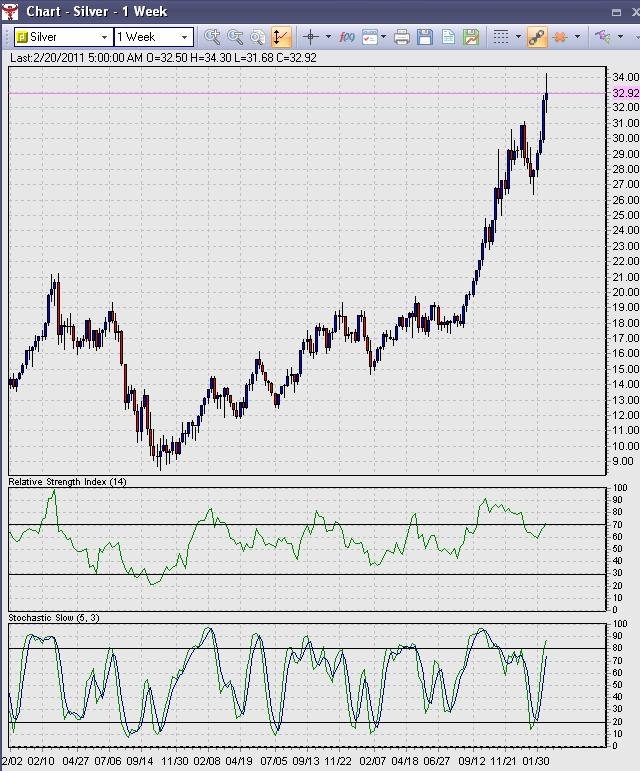
The technical factor is, as usual, a theoretical prediction. The daily and weekly charts on silver show what may end up being the first shoulder and the head of a head-and-shoulders formation. If true, we may expect a retracement back towards $27 before a secondary surge, likely reaching as high as $31. If it does end up being such a formation, we may see silver prices breaking out of its uptrend over the next few months, possibly falling back into the low $20s.

Silver - Weekly Chart
click to enlarge


Continue reading this article >>

Livestock, milk outlook firm - but farms to suffer

by Agrimoney.com

Prices of cattle and milk are poised for double-digit increases, but dairy and livestock farmers face a tough year nonetheless, a top US official has forecast, noting grain prices were already taking their toll on chicken producers.
Joe Glauber, chief economist at the US Department of Agriculture, forecast that milk prices would average $17.70-18.40 a hundredweight this year, a rise of up to 13%.
The figure was also above a preliminary, so-called "baseline", forecast of $16.40 a hundredweight revealed by the USDA last week.
Cash prices for steers would set a record, reaching up to $109 a hundredweight, an increase of 15%, and above a baseline estimate of just under $100 a hundredweight.
"Livestock prices are expected to remain strong and further improvement in milk prices is likely," Mr Glauber told the USDA's Outlook Forum, noting firmer demand on both domestic and export markets.
'Financial pressure' 
However, higher feed costs, as growers struggle to replenish grain stocks, meant would depress margins for livestock and dairy farmers at "low levels".
"While milk prices are forecast to be higher in 2011, increasing feed costs could continue to put financial pressure on dairy producers, especially those producers that purchase feed at current price levels," Mr Glauber said.
Poultry farmers were already suffering, to judge by a fall from 5.5% to 0.8% in less than two months in the growth rate in the numbers of chicks placed for feeding up.
"This abrupt slowdown is likely the result of sharp increases in feed prices, especially coming at a time when wholesale prices for many broiler products have been declining," he said.
Price drop?
Indeed, the USDA forecast a potential easing off in broiler prices from last year's average of 83 cents a pound, rather than the baseline forecast of an increase to 86 cents a pound.
The comments came as poultry giant Sanderson Farms revealed a return to first-quarter loss, and delayed plans for a processing factory in North Carolina.
On Chicago livestock markets, live cattle for April stood 0.2% higher at 113.85 cents a pound in late deals, with March feeder cattle up 0.2% at 129.425 cents a pound, and lean hogs for April up 0.3% at 89.775 cents a pound.

Sell-off in grains and oilseeds 'an over-reaction'

by Agrimoney.com

The sell-off of in grain and oilseed markets in response to the Libyan crisis is an over-reaction, with tight supplies, particularly of corn, warranting continued high prices.
The Canadian Wheat Board said that the Libyan unrest "in reality, does not materially change the grain fundamentals facing the market", even through the global economic fears it has provoked through lifting oil prices.
"There are macro-economic impacts that may arise from the political uncertainty, but these factors are not anticipated to have a measurable impact on wheat demand or trade," the board, the world's biggest marketer of wheat and barley, said.
For durum wheat, the variety used in making pasta, "the turmoil across North Africa and the Middle East has had neither a positive or negative effect on demand".
'Unsustainable levels'
Rabobank analysts said the sell-off of up to 14% in grain prices in seven sessions had driven them to "unsustainable levels", provoking demand at a time when, with supplies thin, high prices were needed to limit consumption.
"The underlying fundamentals in grains and oilseeds remain bullish," the bank said, retaining an upbeat view on prices over the medium term.
"Grains and oilseed prices are likely to find support from consumers who have shown an increase in buying activity amidst this pullback in prices. Higher prices are needed to further ration demand."
The bank attributed the correction largely to a sell-off by speculators trimming risk exposures, or switching to oil, whose prices have been sent by fears of further Middle East unrest to two-year highs above $100 a barrel.
'Single most bullish aspect'
Both the CWB and Rabobank were particularly bullish over corn prices, which the board saw as taking over "market leadership" from wheat.
"Corn futures should stay strong to ensure acres and will thrive with any adverse weather during the planting window," the board said, terming the dynamics of the broader coarse grain complex, including barley, oats and sorghum too, as the "the single most bullish aspect" in farm commodity markets.
"The massive world protein push coupled with key production disruptions and of course the continued use of grain as fuel has placed enormous pressure on the global coarse grain supply-and-demand balance."
Without a "massive" US corn harvest, and decent production in the Black Sea producers, coarse grain stocks could challenge the 20-year low set in 2007-08 – a major driver behind the last spike in farm commodity prices.
Wheat price prospects 
The CWB added that wheat prices were, nonetheless, set for a gentle decline as global production recovers this year.
Even the "perilous condition" of America's hard red winter wheat crop looked surmountable, given the relatively strong levels of stocks, of 309m bushels, which the US was set to hold at the close of 2010-11.
"The stocks situation may potentially play a role in cooling wheat markets as the US marketing year winds down between now and the end of May," the CWB said.
But spillover strength from corn meant that richer inventories did "not necessarily mean that wheat futures will decline precipitously from the recent heights"
Continue reading this article >>

India economic survey calls for 2nd green revolution

by Commodity Online

Recalling the pioneer work by agriculture scientists and farmers to achieve a breakthrough in the agriculture sector in the 1960s, the Economic Survey conducted by the finance ministry of India, in the wake of 2011-12 Union Budget, observes that the country has not witnessed any big technological breakthrough in agriculture since then.
The food safety net for each and every of the over a billion citizens requires enhanced agriculture production and productivity in the form of a second Green Revolution.

The Survey points out that the country is likely to achieve a more production of wheat (81.47 million tonnes), pulses (16.51 million tonnes) and cotton (33.93 million bales of 170 kg each) this year in spite of drought in some States, cyclones, unseasonal and heavy rains and cold wave and frost condition in several parts.

Still, special attention is required for achieving higher production and productivity levels in pulses, oilseeds, fruits and vegetables, which had remained untouched in the First Green Revolution but are essential for nutritional security. It suggests efforts to achieve high production of poultry, meat and fisheries.

Stressing on the development of infrastructure support in agriculture and allied sector, the Survey says that the relative weak supply responses to price hike in agriculture commodities, specially food articles in recent brings into the focus the Central question of efficient supply management and more investment in agriculture and allied sectors with the right strategies, policies and intervention.

“Things are looking bright in the current year with a relative good monsoon and the agriculture sector is expected to grow at 5.4% as per the 2010-11 advance estimates (AE) . There is a marked improvement in the gross capital formation (GCF) also in agriculture sector.” the survey observed.

Underlining the importance of the agricultural sector in the Indian Economy, the Survey says that the agriculture sector needs to grow at 8.5% during 2011-12 to achieve the Plan target of average 4 per cent growth per year.

The Survey points out that the Increased Minimum Support Price (MSP) along with various other steps taken by the Government have resulted in higher levels of food-grains. While the economic cost of wheat and rice has continuously gone up, the issue price has been kept unchanged since 1st July, 2002.

The country has made great strides towards increasing food grains production. In spite of that the agriculture sector is at a cross roads with rising demand for food items and relatively slower supply response in many commodities resulting frequent spikes in food inflation.

The Survey says that increasing agriculture production and productivity is a necessary condition not only for ensuring national food security but also for sustaining the high levels of growth. Concerted and focused efforts are required for addressing the challenge of stagnating productivity levels in agriculture.

It suggests a holistic approach, including renewed agricultural research, dissemination of technology, better inputs such as quality seeds, fertilizers and modern irrigation facilities. Specially rice and wheat, the Survey says that given the constraints in area expansion there is a need for further research to boost production and productivity.

Similarly, a technological breakthrough in pulse production is necessary to keep pace with rising demand. Significant increase in the area under sugarcane and cotton suggests some shift in the cropping pattern in Kharif 2010, the Survey observes.

Expressing concern over stagnation of capital investment in the sector, it says both private and public sector should enhance the investment in agriculture sector in a sustained way. A targeted development of rainfed area should be prioritized and effective marketing links should be ensured for better returns to the farmers.

The Government should also encourage in food processing, cold chain and handling and packaging of processed food, the Survey says.

Taking a note of declining per capita availability of foodgrains, the Survey suggests thrust on horticulture products. In view of increasing pressure on livestock products due to rising level of income, a long term strategy should be evolved to increase the production of these items.

It also says that the issue of efficient food stocks management of and uploading of stocks in time needs urgent attention.

Continue reading this article >>

WHY THE MIDDLE EAST IS A DRAG ON GROWTH

by Comstock

The Mid-East turmoil is not over, and, most likely, has only begun. The revolt in Tunisia spread to Egypt, and now Libya, a nation that produces 2% of the world’s oil. There have also been demonstrations in other Arab nations such as Bahrain, Yemen, Algeria and Iran. Others may be next. History tells us that revolutions of this type are contagious once the first nation shows what could be done. This was true hundreds of years before the age of the internet and cell phones, and is therefore even truer today.

We also know that revolutions seldom end in benign fashion and that violence and chaos are more the norm. This is particularly valid in the Mid-East where revolts have never ended with the formation of stable democracies. It is therefore likely that turmoil in this section of the world will continue for some time with unpredictable results.

As a result of this unpredictability and the extremely small chance of a quick and benign outcome, oil prices have already soared and will remain high and volatile for an extended period of time. Libya produces 2% of the word’s oil, an amount that could probably be replaced by Saudi Arabia within a reasonable period. What is particularly worrisome is that demonstrations in largely Shia Bahrain could spill over into neighboring Saudi Arabia, whose provinces bordering Bahrain produce most of its oil. This area also contains most of the minority Shia in a mostly Sunni country. In addition Bahrain’s rulers are Sunnis as well. Therefore it is easy to see that the potential for trouble is not insignificant.

The upshot of all this is that oil prices will probably remain high and could very well rise significantly even from current levels. For the U.S., studies indicate that every $1 rise in the price of a barrel of oil is about equivalent to a 2.5 cent increase in a gallon of gas. Oil prices have already jumped about $10 a barrel since the start of the crisis and $22 since November, translating into an eventual 55 cent a gallon rise in the price of gas. Since every 1 cent rise in a gallon of gas costs consumers about $1.2 billion the increase to date will cause a $66 billion rise in spending for gas alone alone without even including the gas components in the price of such items as airline tickets, express mail and anything that is transported by truck. This is virtually the same as an increase in taxes since it means less money available for spending on discretionary goods. When we consider the possibility of even further increases in oil prices and then add in the prospective rise in food prices, it is easy to see the highly negative effect on economic growth in the period ahead.

This all in addition to high unemployment, modest income growth, lower housing wealth, high rates of mortgage foreclosures, elevated inventories of unsold homes and tight credit conditions. Furthermore, don’t overlook the impact that higher oil and other commodity costs will have on overly optimistic earnings forecasts that will have to be revised down.

Ordinarily, in order to combat such a headwind to growth the Fed would ease monetary policy and the Administration and Congress would provide fiscal stimulation. At this time, however, this policy is not feasible as the interest rates under Fed control are already near zero and Congress is pressing to reduce the deficit. When we also consider that QE2 ends in June, we think that current economic growth forecasts are subject to important downward revisions in the months ahead.

At the same time, the market is up 100% in two years for the first time since the depression era in the 1930s, and is overbought, overextended and overvalued. It is therefore likely that the Mid-East turmoil is the catalyst that finally ends this secular bear rally and starts the market on a downward course.

Continue reading this article >>

BUYERS LEVER UP ON MARGIN AS SHORT SELLERS DISAPPEAR

by Cullen Roche

According to the latest data from the exchanges the bears are becoming an endangered species.  As short interest craters investors are taking on record levels of debt to borrow at low rates and purchase equities.  In essence, the Bernanke Put is spurring on another risk taking binge for Wall Street.

Yesterday, CNN reported on the decline in short interest.  As you can see, total short interest in the S&P has declined as the seemingly unstoppable bull market forces shorts out of the bearish game:
This is perfectly normal during a bull market, however, there are more disturbing trends in margin data. While Ben Bernanke fails to keep rates low and induce business borrowing, he is in fact stoking a speculative boom at the Wall Street casino.  According to Bloomberg Wall Street has been leveraging up in preparation for the Fed’s “wealth effect”:
Debt at margin accounts at the New York Stock Exchange minus cash and unused credit from margin accounts climbed to $46 billion, according to data released by NYSE yesterday. Hedge funds had $290 billion of debt from margin accounts in December, the largest sum since Lehman Brothers Holdings Inc. collapsed in September 2008.
“It makes a lot of sense given the low cost of borrowing and some equities’ valuations,” said Patrick Armstrong, who helps manage $356 million in multiasset strategies at Armstrong Investment Managers LLP in London. “There is a capital- structure arbitrage to be made by buying stocks with leverage.”
We’re not yet back to 2007 levels, but as the rally progresses it becomes more and more clear that nothing has really changed in the USA.  We are simply back to all the same gimmicks, policies and speculative games that got us into this mess.  The Bernanke Put is only helping to reinforce this.

Continue reading this article >>

Follow Us